
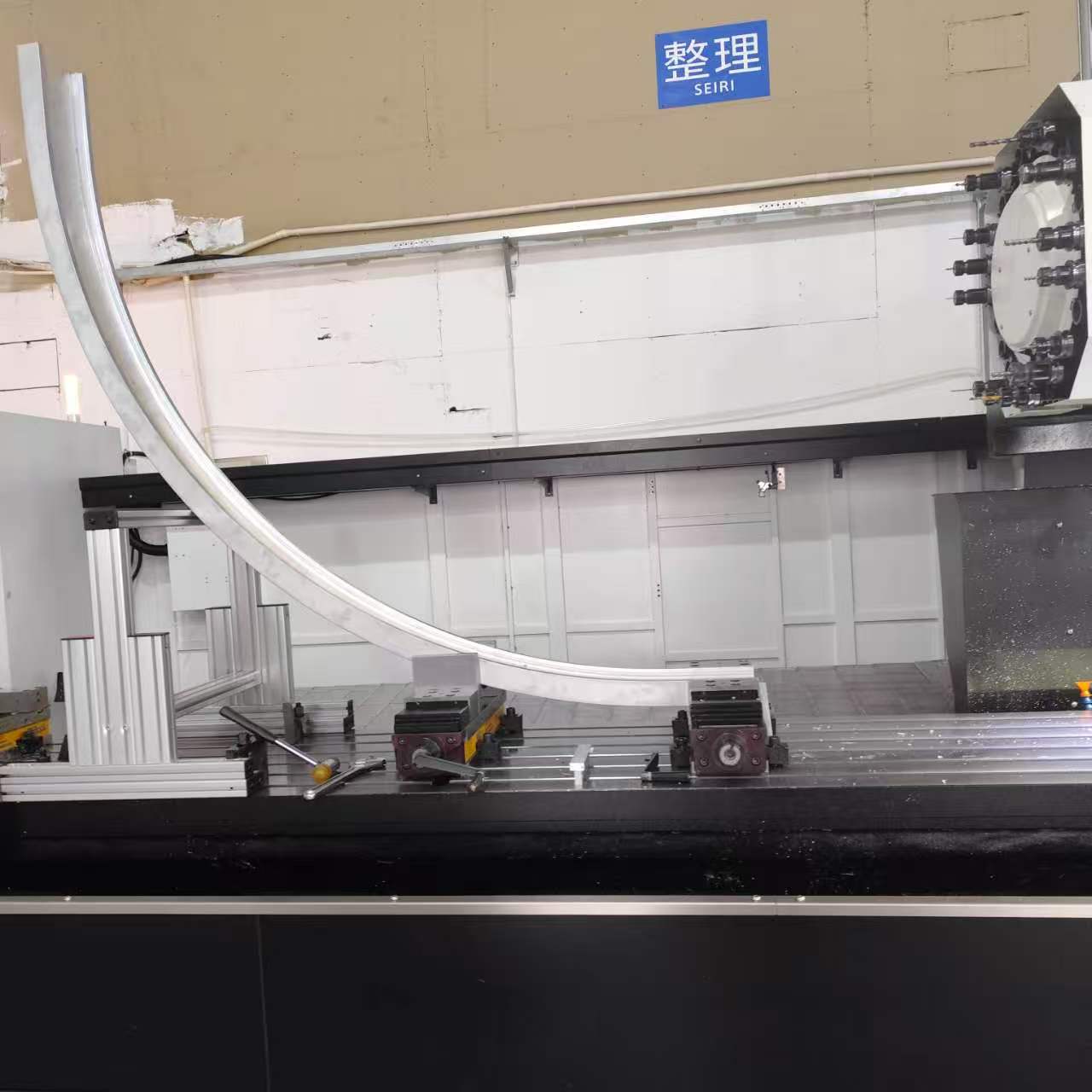
Aluminum Profile Bending
EMS Overhead Rail Arc Bending - Torsion and Hangers
A curved EMS rail is twisted, not just bent. Why an open section follows its load, where the hanger must sit, and why anodising comes after bending.
Product Details
An EMS overhead rail in a curve is not a beam in bending. It is a thin-walled open section being twisted, and the twist comes from the fact that the trolley hangs below the rail while the hanger pulls from above. If those two loads do not pass through the section's shear centre, the rail rotates about its own axis by an amount that has nothing to do with how accurately the arc was rolled.
This is why two curved EMS rails can measure the same radius and one of them runs smoothly while the other makes the trolley bind at the curve entry. The difference is not the arc accuracy. It is the hanger position and the torsional stiffness of the section.
We roll-bend EMS and overhead conveyor rails from whole profiles, with no joint in the arc, to an arc error of ±0.4 mm and flatness of 0.1–0.5 mm, in 6061-T6 and 6005-T6, with hard anodising applied after bending rather than before.
A suspended rail in a curve is loaded in torsion
Three loads act on an overhead rail at a curve:
- The trolley load, hanging below the running surface, acting downward through the wheel contact.
- The centrifugal force of the trolley and its load, acting horizontally at the centre of gravity of the moving mass — which is below the rail.
- The hanger reaction, acting upward at the points where the rail is suspended from the structure.
Unless the hanger line, the wheel contact and the centre of gravity all lie on one vertical plane through the shear centre, the rail sees a torque. A trolley 300 mm below the rail at 2 m/s on a 1.5 m radius develops a lateral force that, multiplied by that 300 mm lever, is a continuous twisting moment applied to a section that is not designed to resist it.
What the operator sees is not a twisted rail. It is a trolley that runs heavily through the curve, a wheel flange that wears on one side, a rail that needs realignment after a year, and a curve that has to be replaced while the straight sections are still fine.
Why the open section is so sensitive to it
An EMS rail is an open profile: a C-shape, an I-shape, or a box with a slot down one side for the trolley. Those shapes are efficient in bending and very weak in torsion, because torsional stiffness of an open thin-walled section depends on the cube of the wall thickness, summed over the developed length, rather than on the enclosed area.
Put numbers on it. A C-section with 40 mm flanges and a 60 mm web, all 3 mm thick, has a torsional constant of roughly 2,000 mm⁴. With aluminium's shear modulus of about 26 GPa, one metre of that section twisted by 20 N·m rotates by more than 20 degrees. A closed section of the same weight has a torsional constant two orders of magnitude larger.
| Section type | Torsional behaviour | What it means for a curved rail |
|---|---|---|
| Open C or I section | Very low torsional stiffness; twist follows the load | Hanger position is a design parameter, not a detail |
| Open box with a trolley slot | Low, because the slot breaks the closed loop | Same problem; the slot is where the section is weakest |
| Closed box or tube | High torsional stiffness | Forgiving of hanger position, but no slot for the trolley |
| Closed section with an external guide | Compromise: stiffness from the tube, guidance from an added feature | Heavier and more expensive, used where twist cannot be tolerated |
Because the trolley has to run in a slot, the rail is almost always open, so the torsion cannot be designed out of the section. It has to be controlled by where the rail is supported.
Hangers must sit on the shear centre, and in a curve they must be radial
For an open section, the shear centre is not the centroid. On a C-section it sits outside the web, on the opposite side from the flanges, at a distance that depends on the flange width and the web depth — typically 20 to 40 mm out from the web for the proportions used in conveyor rails. A hanger bolted to the top flange, directly above the web, therefore applies its load offset from the shear centre by that distance, and every kilogram of rail and trolley becomes a twisting moment.
Two rules follow, and both are installation decisions that the drawing has to make possible:
- The hanger should be on the shear centre line, which for a C-section usually means a bracket that reaches out past the web, or a hanger attached to a feature the die places at that position.
- In a curve, the hangers should be radial — on the line from the curve centre through the rail — and closer together than in the straight. A tangential or skewed hanger in a curve applies its load along a line that does not pass through the rail axis, which is a torsion input on top of the offset.
A useful number: in a curve of 1.5 m radius, hanger spacing usually needs to be about half the straight-run spacing. The extra hangers are not there to carry more weight; they are there to reduce the length of rail between two torsional restraints.
Arc accuracy is checked as chord height, not as a radius
A rolled arc is specified by radius, and inspected by chord height, because a radius cannot be measured directly on a shop floor while a chord can. The relationship is fixed: for a chord of length L on a radius R, the offset at mid-chord is L² divided by 8R.
| Radius | Chord 300 mm | Chord 400 mm | Chord 500 mm |
|---|---|---|---|
| 800 mm | 14.1 mm | 25.0 mm | 39.1 mm |
| 1,500 mm | 7.5 mm | 13.3 mm | 20.8 mm |
| 3,000 mm | 3.8 mm | 6.7 mm | 10.4 mm |
There is a second use for the same formula, and it is the one that decides whether a trolley can pass. The chord height also tells you how far a trolley with a given wheelbase deviates from the rail line. A trolley with a 400 mm wheelbase on a 1,500 mm radius sits 13.3 mm off the arc at mid-span, and that offset has to be absorbed by the wheel clearance and the slot width. On tight radii, the wheelbase — not the rail — is the limiting feature, and a shorter trolley is often the cheapest fix.
Where whole-profile roll bending has to stop
Rolling a whole profile so that the arc has no joint is the right answer wherever it is possible, because every joint in a curve is a discontinuity that the trolley feels at every pass. The limits are physical:
- Transport length. A rolled piece cannot be longer than what can be shipped and lifted into the building. Above that, the arc is made in segments and the segments are joined.
- Curve angle and radius together. A 180° bend on a large radius can be longer in developed length than a 90° bend on a small one; it is developed length that decides, not the angle.
- Section stiffness. A very stiff or very asymmetric section resists being rolled true and may need stress relief or a different bending method.
Where a joint is unavoidable, the requirement to put on the drawing is not the gap but the tangent continuity — the two pieces must leave the joint on the same tangent, within about 0.1°. A joint that is closed but kinked by 0.5° is worse than a joint with a small gap, because the kink is a step in the running surface at every wheel pass. Joints should also be placed in a straight run rather than in the middle of the curve whenever the layout allows it.
Anodise after bending, never before
A hard anodic coating is brittle. Bending a coated profile cracks the coating on the outside of the arc, and the cracks are exactly where the trolley wheel runs. The order has to be: extrude, bend, machine, then anodise.
Two consequences worth planning for:
- The coating moves the running surface. A 50 µm hard coating grows about 25 µm outward, so a slot dimensioned to the bare profile closes by roughly 50 µm on width. The slot has to be cut to allow for it, which means the drawing has to state the coating thickness.
- Masking is required on any face that has to be electrically conductive or has to fit precisely — a conductor rail, an earth bonding point, a locating face. Masking adds a step and has to be specified, not assumed.
The running surface is where hard anodising earns its place: on a high-cycle EMS line the wheel contact is the wear surface, and an uncoated aluminium slot wears visibly within a year of continuous operation.
Specifications
| Item | Reference value |
|---|---|
| Alloys | 6061-T6, 6005-T6 |
| Bending method | CNC roll bending of the whole profile, no joint in the arc |
| Arc error | ±0.4 mm (against ±0.8 mm typical for segmented curved rails) |
| Flatness | 0.1–0.5 mm, depending on radius and section |
| Tangent continuity at a joint | ≈0.1° where a joint cannot be avoided |
| Maximum piece length | Limited by transport; quoted per part |
| Straightness of straight runs | ≤ 0.2 mm/m |
| Machining tolerance | ±0.01 mm on end faces and drilled features |
| Surface treatment | Hard anodising after bending; masking on request |
| Integrated features | Trolley slot, conductor cavity, cable cavity, sensor mounting groove |
| Standard | GB/T 6892-2023 high precision grade |
Where it does not fit
- Radii below about three times the section depth. The section distorts: the slot narrows on the inside of the arc and opens on the outside, and the trolley either binds or runs loose. Below that ratio the rail is usually machined from a billet or built from segments.
- Very tight radii with a long-wheelbase trolley. The chord height exceeds what the wheel clearance can absorb, and no rail accuracy fixes it. The trolley has to change.
- Curves that need a closed section. A closed tube has the torsional stiffness but no slot for the trolley, so the guidance has to come from an added feature and the cost rises sharply.
- Arcs longer than transport allows, where a joint falls in the curve. Possible, but the tangent continuity becomes the critical requirement and the joint is a wear point for the life of the line.
- Coated profiles that then have to be bent. The coating cracks. If a client has stock that is already anodised, the answer is to bend it and accept a re-coated or bare arc, not to bend it and hope.
FAQ
What arc accuracy can you hold?
Reference ±0.4 mm on the arc and 0.1–0.5 mm flatness, rolled from a whole profile with no joint in the curve, on 6061-T6 and 6005-T6 sections. Those are capability references: the value on your order is set by your drawing, and the achievable figure depends on the radius to section-depth ratio and on the section's asymmetry. We confirm what is achievable on your section in writing before the bend.
Why does my trolley bind in the curve when the radius is correct?
Usually because the rail is twisting, not because the arc is wrong. The trolley hangs below the rail and the hanger pulls from above; if those loads are offset from the section's shear centre, the open profile rotates about its own axis by an amount that no radius tolerance controls. Radial hangers, closer spacing in the curve, and a hanger line on the shear centre are the fixes.
Should the rail be anodised before or after bending?
After. A hard anodic coating is brittle and will crack on the outside of the arc, which is the running surface. The sequence is extrude, bend, machine, anodise — and the slot has to be cut oversize to allow for the coating growth of about 25 µm per surface.
Can a long curve be supplied in one piece?
Up to the transport limit. Beyond that the arc is made in segments, and the requirement becomes tangent continuity at the joint — about 0.1° — rather than gap. A kinked joint is worse than a gapped one because the kink is a step that every wheel feels.
What is the tightest radius you can roll?
It depends on the section rather than on a fixed number: as a rule, below about three times the section depth the slot distorts enough to affect the trolley. Send the section and the radius and we will say whether it can be rolled or has to be machined.
Does the section have to be a custom die?
Not always. Many EMS lines use a standard conveyor section, and bending an existing profile is much faster than developing a die. Where the line needs an integrated conductor cavity or a specific slot geometry, a custom section is worth it — but it should be justified by the features, not assumed.
Send your drawing
Email the section drawing with the radius, the arc angle, the trolley wheelbase and the hanger positions to linjunbing@truetrustlv.com, or send it on WhatsApp at +86 136 6644 0600. You will get a bend feasibility review, a note on the hanger line and the achievable arc tolerance, and a written statement of what the section can hold.
GET A QUOTE
Once you have submitted your requirements, we will contact you as soon as possible regarding your product inquiry.:EMS Overhead Rail Arc Bending - Torsion and Hangers