
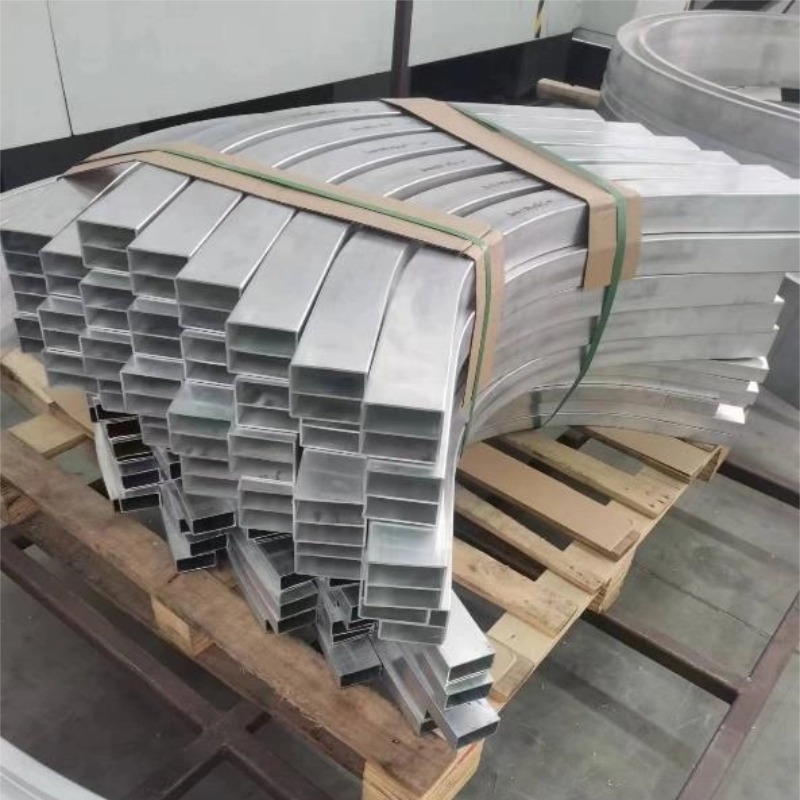
Aluminum Profile Bending
Track Ring Bending - Closed Loops for RGV and Overhead Rails
Closed track rings to ±0.4 mm ring error: fit-up segment for closure, planarity over radius, mitred tangent-matched joints, ≤0.5 mm splice gap.
Product Details
A closed track ring has a property that an open arc does not: it has to close. Every segment has a radius error, and when the ring comes together those errors have to go somewhere. They become a gap, an overlap, or a radius that is not what the drawing says — and which one you get depends on how the ring was planned, not on how carefully it was bent.
We bend and stretch-bend track profiles into arcs, half-circles, full rings and S-forms in 6063-T5, 6061-T6 and 6005A-T6, to a curvature accuracy of ≤0.5°, a ring error of ±0.4 mm, flatness of 0.1–0.5 mm and a splice gap of ≤0.5 mm. Here is what closing a ring actually requires.
The last segment is not made to the drawing
On a ring assembled from several segments, the first segments are made to their nominal arc lengths. By the time the ring is nearly closed, the accumulated error is sitting in the remaining gap — and that gap is not the nominal one.
So the last segment has to be made to fit the gap, not to the drawing. This is the "fit-up segment" principle, and it is the single most important thing to arrange in advance. It means:
- One segment is left unmade until the others are positioned. Its length is measured on the assembly, not calculated.
- The gap is measured in more than one direction. Not just the chord gap, but the step on the running face and the angular offset. A ring can close in length and still be misaligned.
- The fit-up segment is cut and formed with a small allowance, then trimmed to final size. Going straight to the calculated length leaves no room to correct.
If all segments are made to nominal and then assembled, the result depends on luck. When the accumulated error is small the ring closes; when it is not, the ring is forced closed and the profile is stressed, or a gap is left that the wheel will find.
Why planarity matters more than radius on a ring track
On a closed loop track, a carriage runs around the ring continuously. If the ring is not planar — if the track surface rises and falls around the circuit — the carriage climbs and drops on every lap. That produces vibration, uneven wheel wear and, at speed, a visible bounce.
The reference flatness of 0.1–0.5 mm is the figure that controls this, and it is easy to under-specify because the radius figure looks like the important one. On a ring, radius error moves the carriage sideways by a fraction of a millimetre, which the guide absorbs. Planarity error makes it climb, which nothing absorbs.
Two causes of lost planarity, in order of frequency:
Handling. A ring is a spring. Lifting a large thin ring by one point distorts it, and if it is stored or shipped flat without support it takes a set. The part leaves planar and arrives non-planar.
Assembly. If the ring is bolted to supports that are not coplanar, the ring is forced into the supports' plane. The track then follows the supports, not the drawing. Checking a ring on a flat plate before installation and again after is the only way to know which of the two you have.
Joint positions on a ring
On a closed track, every joint is crossed on every lap, so joint quality is multiplied by the number of laps the system will see in its life. Three rules:
Match the tangent. The two ends at a joint must have the same tangent direction, or the carriage is steered sideways at every pass. This is more important than the radius on either side being exact.
Mitre the gap where it is a running surface. A diagonal gap is crossed smoothly; a square gap of the same width is an impact. On a ring the impact happens once per lap, forever.
Put joints away from the fastest section. If the carriage speeds up on a straight and slows on the curve, put the joint in the slow region. It costs nothing and it halves the wear at the joint.
Specifications
| Item | Reference value |
|---|---|
| Forms | Arc, half ring, full ring, S-form |
| Curvature accuracy | ≤0.5° |
| Ring error | ±0.4 mm |
| Flatness | 0.1–0.5 mm |
| Splice gap | ≤0.5 mm |
| Alloys | 6063-T5, 6061-T6, 6005A-T6 |
| Length | up to 20 m developed |
| Equipment | Roll benders, stretch bending machines, CNC bending machines |
| In-house support | Profile die design, extrusion, CNC machining |
| Surface treatment | Anodising, hard anodising |
| Standard | GB/T 6892-2023, ISO 9001 |
Ring track against ordinary stretch bending
| Ordinary stretch bending | Track ring bending | |
|---|---|---|
| Purpose | Equipment frames, arc brackets | RGV arc tracks, robot overhead rails, ring conveyors |
| Curvature accuracy | General | ≤0.5° |
| Ring error | ±1 mm | ±0.4 mm |
| Splice gap | Not usually critical | ≤0.5 mm, mitred, tangent matched |
| Surface | General | No wrinkles, no scratches on the running face |
| What fails first | Radius error | Planarity, joint alignment, closure |
Alloy choice for a track ring
6063-T5 for most track rings: it forms to a tight radius easily, holds a good surface, and has the lowest springback of the three, which matters most where the ring has to close accurately.
6061-T6 where the track carries load or the carriage is heavy. Higher strength, but more springback and more distortion at the bend, so closure is harder to hold. If the ring has to close to a ±0.4 mm error in 6061-T6, plan for the fit-up segment and for more trial.
6005A-T6 for heavy duty and vibration: better fatigue behaviour than 6061 with reasonable formability, and a common choice for overhead rail systems where the carriage runs constantly.
Where it does not fit
- The ring must be perfectly round and the diameter is large. Roll bending tends toward a polygon at large radius and thin section. Stretch bending or a machined ring is the reliable route.
- The running surface must be continuous with no joint. Then the ring has to be one piece, which is limited by the 20 m developed length and by transport.
- Every segment is made before the assembly is measured. Then the accumulated error has nowhere to go. Insist on a fit-up segment.
- The ring is large and thin and will ship flat. It will arrive non-planar. Specify a cradle or a full-support packing, and check planarity on arrival.
- You need a tight planarity figure on a ring supported by a structure that is not planar. The track will follow the supports. Fix the structure, or design a shimmed interface with a stated adjustment range.
- The ring will be anodised and the joint is visible. Anodising makes the joint line more visible, not less. Either accept it as a design feature or paint.
What to send for a quote
Send the track profile drawing with the running faces marked, the ring diameter and the segment layout, the alloy, the number of joints and their intended positions, the carriage wheel diameter and load, and the surface treatment. Tell us whether the ring will be assembled on site or delivered assembled — that decides where the fit-up segment is made.
We will reply with the forming method, the segment plan including the fit-up segment, the joint design, the planarity we can confirm and how it should be measured, and the packing recommendation. Where the radius or the planarity is beyond what the section can deliver, that goes in the reply.
FAQ
What accuracy can you hold on a track ring?
Reference curvature ≤0.5°, ring error ±0.4 mm, flatness 0.1–0.5 mm and splice gap ≤0.5 mm. Those are capability references: the value on your order is set by your drawing, and on a closed ring we also agree the closure requirement — the gap and the step at the joint — because a ring can meet its radius and still not close cleanly. We confirm all of it in writing before you order.
Why does a ring track need a fit-up segment?
Because the accumulated radius error of the other segments ends up in the last gap. If the final segment is made to nominal length, the ring either does not close or is forced closed and stressed. Making the last segment after measuring the gap puts the error where it can be absorbed.
Is planarity more important than radius on a ring?
Yes, for a carriage that travels continuously. Radius error moves the carriage sideways by a fraction of a millimetre, which the guide absorbs. Planarity error makes it climb and drop once per lap, which produces vibration and uneven wear. Specify both, and check planarity after assembly, not only after forming.
How should the joints be treated?
Tangent matched, mitred where the joint is on a running surface, and positioned away from the fastest part of the circuit. On a closed ring, every joint is crossed on every lap, so a poor joint is not a one-off defect — it is a wear point that repeats for the life of the system.
Which alloy should I choose?
6063-T5 for most rings: easiest to form, lowest springback, best closure. 6061-T6 for loaded tracks, accepting more springback and harder closure. 6005A-T6 for heavy duty with vibration, which covers most overhead rail systems.
Can the ring be delivered assembled?
Yes, up to a size that can be transported. Delivering assembled lets the fit-up segment be made at the works, where the measurement is controlled. Delivering in segments puts that operation on site, where the measuring conditions are usually worse — a reason to prefer assembled delivery where transport allows.
How is it priced?
On the profile, the ring diameter, the number of segments and joints, and the forming method. A stretch-bent ring costs more than a roll-bent one because it is a different machine and setup, and a fit-up segment adds an assembly step. All of it is real work, and it is quoted as such.
Send your drawing
Email the track profile, the ring diameter, the segment layout and the carriage data to linjunbing@truetrustlv.com, or send it on WhatsApp at +86 136 6644 0600. You will get a segment plan, a joint design and a written tolerance statement including the closure requirement.
GET A QUOTE
Once you have submitted your requirements, we will contact you as soon as possible regarding your product inquiry.:Track Ring Bending - Closed Loops for RGV and Overhead Rails