
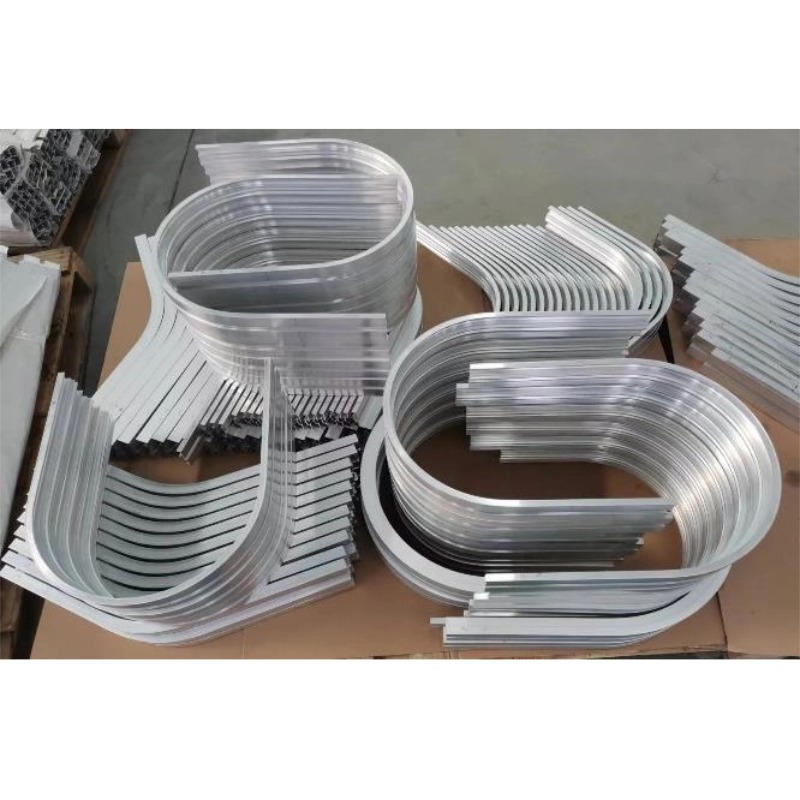
Aluminum Profile Bending
Small Radius Aluminum Bending - R100 to R300
Bending to R100-R300 in 6063-T5: the limit is R/H, not R. Inner flange support, wall thickening, ±0.3 mm radius, walls 0.8-3 mm.
Product Details
A radius of R100 is not small in absolute terms. It is small relative to the section being bent, and that ratio is what decides whether the part can be made. A 20 mm square tube at R100 is a comfortable bend; a 60 mm deep channel at R100 is a forming problem, because the inside of the curve has to compress by a large fraction of its own depth.
We bend profiles to R100–R300 in 6063-T5 and 6061-T6, with walls from 0.8 to 3 mm, to a reference radius error of ±0.3 mm and flatness of 0.1–0.3 mm. This page is about the ratio rather than the radius, because that is the number that predicts success.
Relative bend radius: the number that matters
Two ratios govern small-radius work. The first is R/t, the inside radius divided by the wall thickness. The second is R/H, the inside radius divided by the depth of the section in the plane of the bend.
R/t controls strain on the outer fibre, and it is the same calculation used for heavy-wall bending: the outer fibre strain is t/(2R+t). At R = 100 mm and t = 2 mm, that is 1 percent — trivial. So on a thin section, R100 is not a strain problem at all.
R/H controls something different: the geometry of the inner curve. When you bend a deep section to a radius comparable with its depth, the inner flange has to travel a much shorter path than the outer flange, and the difference is a large fraction of the flange length. The material has to absorb that difference by compressing, and a thin inner flange will buckle instead.
| Section depth | Inside radius | R/H | Practical verdict |
|---|---|---|---|
| 20 mm | 100 mm | 5.0 | Comfortable; standard tooling |
| 40 mm | 100 mm | 2.5 | Workable with support on the inner flange |
| 60 mm | 100 mm | 1.67 | Difficult; inner flange needs full support |
| 100 mm | 100 mm | 1.0 | At the limit; expect distortion or a design change |
So when a drawing says "small radius", the first thing to establish is the section depth. A part described as R100 can be routine or near-impossible depending on it, and the radius alone does not tell you which.
Two failures, and they need opposite treatments
Outer fibre cracking. The outside of the bend stretches. The strain is t/(2R+t), which on a thin wall at R100 is small — so cracking on a small-radius thin-wall part is usually not a strain problem but a material problem: a tight local radius at a corner, a burr on the cut edge, or a T6 temper with exhausted ductility. The fix is edge preparation and temper, not a bigger radius.
Inner flange wrinkling. This is the real constraint at small radius. The inner flange compresses, and a thin flange buckles. The wrinkling starts as a wave and becomes a fold, and once folded it cannot be recovered.
The treatment is support: a pressure pad that holds the inner flange against the die through the whole stroke, a wipe die that controls the material flow, or an internal filler for a hollow section. The support has to be continuous through the bend, not applied at the start and released.
Wall thickening and thinning
A bend moves material. The outer wall thins because it stretches; the inner wall thickens because it compresses. On a small radius relative to the section, both effects are larger.
Thinning on the outer wall is the one that matters structurally, because it reduces the section where the bending stress is highest. A 10 percent wall reduction on a load-bearing member is a 10 percent reduction in local strength, and it is not visible.
Thickening on the inner wall is a fit problem: a thickened inner flange can interfere with a mating part or with a slot it has to enter. On a small radius it can be significant enough to require machining after forming.
Both are predictable from the geometry and both should be checked on the first article rather than assumed. On a part where the wall thickness is functional — a pressure section, a sliding fit, a threaded area — measure it after forming, not before.
Specifications
| Item | Reference value |
|---|---|
| Minimum inside radius | R100 mm |
| Working radius range | R100–R300 mm |
| Wall thickness range | 0.8–3 mm |
| Radius error | ±0.3 mm |
| Flatness | 0.1–0.3 mm |
| Alloys | 6063-T5 (recommended); 6061-T6 subject to evaluation |
| Sections | Round tube, square tube, channel, special profile |
| Equipment | High-precision CNC bending machines, roll benders |
| In-house support | Extrusion, die design, CNC machining |
| Surface treatment | Anodising, hard anodising |
| Standard | GB/T 6892-2023, ISO 9001 |
Small radius against conventional bending
| Conventional bending | Small-radius bending | |
|---|---|---|
| Radius | ≥500 mm | R100–R300 mm |
| Cracking risk | Low | High at corners and cut edges |
| Wrinkling risk | Low | High on the inner flange; needs support |
| Machine | Ordinary bender | High-precision CNC bender |
| Tooling | General purpose | Dedicated die plus pressure pad or filler |
| Process | Conventional roll bending | Speed control plus continuous support |
Alloy choice at small radius
6063-T5 is the recommended alloy and it is not a marketing preference. It has the most ductility of the common extrusion alloys, it work-hardens less, and it recovers less on release, which makes a small radius easier to hold. Most small-radius work is done in it.
6061-T6 can be bent to a small radius, and it needs evaluating first. The ductility is largely used by the temper, so the forming window is narrow, and a corner or a burr that would be harmless in T5 will start a crack. Where 6061-T6 is needed for strength and the radius is small, the usual route is to bend in a softer temper and age after forming — accepting the distortion that the aging step brings.
The exception worth knowing: a small radius on a thick-ish wall in T6 is often easier than the same radius on a thin wall, because the outer fibre strain is lower relative to the material's capacity in a thicker section. It is the R/H ratio and the support, not the wall thickness alone, that decides.
Where it does not fit
- The section depth approaches the bend radius. At R/H near 1 the inner flange has to compress beyond what the material will take, and it folds. Redesign the section or the radius.
- The alloy is 6061-T6 and the radius is at the limit. The forming window is too narrow to be reliable in production. Bend in T5, or change the design.
- The profile is a hollow section that cannot be filled. Without internal support the section collapses at a small radius. A filler solves it, at a cost per part.
- The part will be anodised and the outer bend is visible. Small-radius forming produces flow lines and possible orange-peel texture that anodising makes more visible.
- You need a tolerance tighter than ±0.3 mm on the radius. Springback on a small radius is harder to predict, and the batch variation is larger. That figure is already a tight reference.
- The volume is small and the section is custom. A dedicated die plus a pressure pad is not trivial tooling. For a handful of parts, consider a welded corner instead.
What to send for a quote
Send the section drawing with the depth in the plane of the bend and the wall thicknesses, the bend geometry, the alloy and temper, the quantity, and whether the profile is hollow. The section depth is the single most useful number, because it fixes R/H and therefore the difficulty.
We will reply with the feasible radius for your section, the support method, whether the alloy needs changing, the wall thickening and thinning you should expect, and the tolerance we can confirm. If R/H is beyond what the material will take, that goes in the reply rather than in a failed first article.
FAQ
What is the minimum radius you can bend?
Reference R100 mm, with working radii from R100 to R300. That figure is a process limit, not a universal one: what matters is the section depth relative to the radius, so a deep section may need a larger radius even though the machine can do R100. The value on your order is set by your drawing, and we confirm in writing what radius your specific section can take before you order.
How is small-radius bending different from conventional bending?
The dominant failure changes. At a large radius the risk is springback and angle deviation; at a small radius the inner flange tends to wrinkle and the outer fibre is at its strain limit. That needs a dedicated die, continuous support on the inner flange, and controlled forming speed rather than a standard roll pass.
6063-T5 or 6061-T6?
6063-T5 is recommended: more ductility, less work hardening, less springback, and a wider forming window at a small radius. 6061-T6 is possible and should be evaluated on the actual section first — its ductility is largely consumed by the temper, so a corner or a burr that is harmless in T5 will initiate a crack.
How is outer cracking prevented?
By keeping the outer fibre strain below the material's forming limit, which means controlling the radius relative to the wall; by preparing the cut edges so there is no burr to act as a crack starter; and by choosing a temper with ductility left. On a thin wall at R100 the strain is small, so a crack is usually an edge or a temper problem rather than a radius problem.
How is inner wrinkling prevented?
By supporting the inner flange continuously through the stroke: a pressure pad against the die, a wipe die controlling material flow, or an internal filler for a hollow section. Support applied only at the start of the bend does not prevent wrinkling, because the buckle forms in the middle of the stroke.
How is it priced?
On the section complexity, the radius, the wall thickness and the quantity. A dedicated die and a pressure pad are the setup cost, and small radii run slower, which adds machine time. It is quoted as real work rather than a surcharge.
What is the minimum batch and lead time?
Reference minimum 50 kg, and small batches for evaluation are supported. Lead time depends on whether tooling has to be made: a new die for a small radius adds days before the first part. We quote the tooling and the parts separately so the timing is visible.
Send your drawing
Email the section drawing with the depth and wall thicknesses, the bend geometry, the alloy and whether the section is hollow to linjunbing@truetrustlv.com, or send it on WhatsApp at +86 136 6644 0600. You will get the feasible radius for your section, the support method and a written tolerance statement.
GET A QUOTE
Once you have submitted your requirements, we will contact you as soon as possible regarding your product inquiry.:Small Radius Aluminum Bending - R100 to R300