
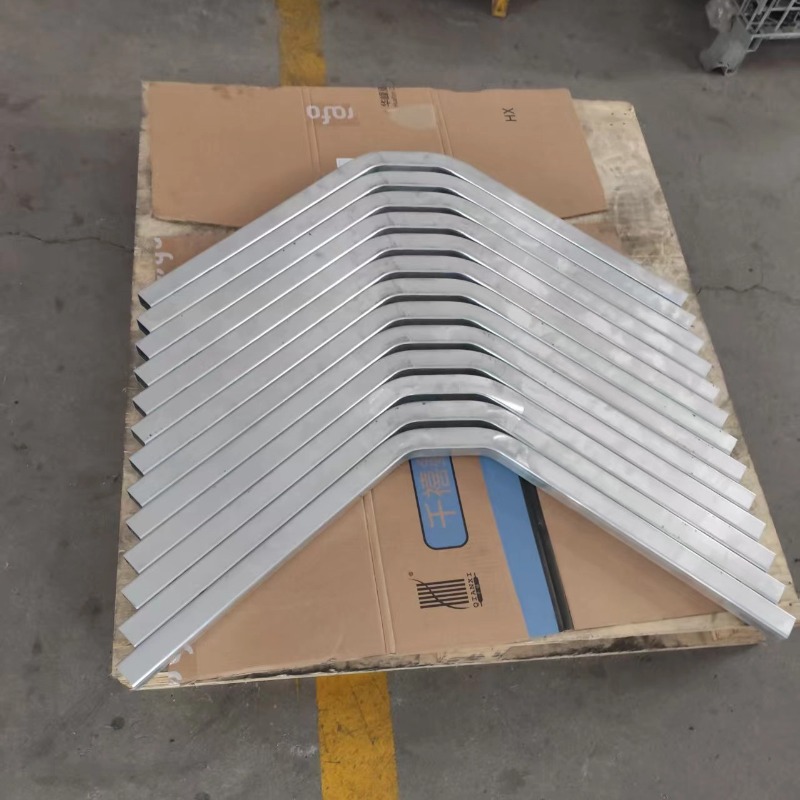
Aluminum Profile Bending
Aluminum Profile Straightening - Bow, Twist and Kink
Straightening by roller, stretch or press: 0.2-1.0 mm/m, and an honest note on stretch straightening consuming ductility before bending.
Product Details
Straightening is usually requested as a fix: a profile arrived bent, or a batch came out of the press with a bow, and someone asks to make it straight. That framing leads to disappointment, because straightening is not a correction of a defect — it is a controlled plastic deformation, and like every plastic deformation it leaves the material in a different state than it found it.
We straighten extruded aluminium profiles by roller, stretch and press methods, in 6063-T5, 6061-T6 and 6082-T6, to a reference straightness of 0.2–1.0 mm/m depending on section and length. This page is about which method fixes which defect, and what each one costs you.
Three defects, three methods
The first thing to establish is what is actually wrong, because the three common defects need three different treatments and none of them substitutes for another.
| Defect | What it looks like | Method that fixes it |
|---|---|---|
| Bow | The profile curves in one plane | Roller straightening, stretch straightening, or press |
| Twist | The profile rotates along its length | Dedicated twist correction; not fixed by roller or stretch |
| Local kink | A sharp bend at one point, often from handling | Press straightening at that point |
The second row is where most misunderstandings start. Roller straightening and stretch straightening both work by applying a bending moment along the length; neither applies a torque. A twisted profile passes through them and comes out still twisted, usually with a bow added.
Twist has to be corrected by gripping both ends and applying a controlled rotation, which is a separate operation and a separate machine. If your profile is twisted, say so — asking for "straightening" will get you a straight but twisted part.
Stretch straightening: the method with a hidden cost
Stretch straightening grips both ends, pulls the profile until the whole cross-section is above yield, and lets it spring back. Because the whole section yields, the bow is removed uniformly and the result is very straight — this is the method used for extrusions that must be straight over long lengths.
The hidden cost is that the material has now been plastically strained by 1–3 percent, permanently. Two consequences follow:
The profile gets longer. A 6 m length may grow by 60–180 mm. If the part is cut to length afterwards that is fine; if it was already cut to length, it is not.
The remaining ductility is reduced. The material has used part of its elongation reserve. A profile that has been stretch straightened and is then bent to a tight radius will crack at a radius where unstraightened material would have formed successfully. This is why a stretch-straightened extrusion is a poor input for a bending operation, and why the sequence matters: if the part will be bent, do not stretch straighten it first.
There is also a visible symptom. Stretch straightening can produce stretcher strain marks — faint diagonal lines on the surface, from Lüders band propagation. They are cosmetic and they become more visible after anodising, which makes them a problem on visible parts.
Roller straightening: repeated bending along the length
Roller straightening passes the profile through a series of offset rolls, bending it alternately in opposite directions with decreasing amplitude. Each pass reduces the residual curvature until the profile comes out straight.
It suits long, uniform sections and it is fast. Its limits:
- It works on bow, not twist. The rolls bend in one plane.
- It leaves roll marks. Contact pressure at each roll leaves a trace, which matters on a visible surface.
- It can distort the section. A thin-wall or hollow profile is squeezed by the rolls and can ovalise slightly. The distortion is small and cumulative.
- It is less effective on short parts. A profile shorter than the roll spacing cannot be straightened properly.
Because the process is repeated bending rather than a single uniform stretch, the residual stress pattern after roller straightening is more complex than after stretch straightening: some regions are left in tension and others in compression, distributed along the length. For most structural uses that is acceptable. For a part that will be machined afterwards, it is a source of movement.
Press straightening: local correction
Press straightening applies a local load at the point of maximum deviation. It is the right method for a local kink, and the wrong method for a general bow.
Its characteristics: it is fast, it needs no special tooling beyond a suitable pad, and it leaves a local stress concentration at the point of the press. On a visible face, the pad leaves a mark. On a load-bearing part, the local stress is a consideration and should be assessed rather than ignored.
On a thin-wall hollow section, press straightening can also flatten the section locally — the pad pushes the wall in before the profile bends. That flattening is permanent and is not removed by further straightening.
Why a straightened profile bends again
This is the most common complaint about straightening, and the explanation is not that the straightening was done badly.
If the original bow was caused by an uneven stress pattern — an asymmetric quench, an uneven cooling rate, a section with a thick and a thin wall — then the profile is bent because the stress pattern requires it to be bent. Straightening imposes a new deformation that makes it straight now, but the underlying stress pattern is still there, and over time it relaxes toward its preferred shape.
The part leaves straight and arrives bowed, or is straight at goods-in and bows after a few weeks in storage or after the first thermal cycle.
The correct fix is stress relief before straightening, not more straightening. That means the quench and aging route, or an annealing step for a severe case. Straightening without stress relief is treating the symptom, and it is why we ask what caused the bow before quoting a straightening job.
Specifications
| Item | Reference value |
|---|---|
| Methods | Roller straightening, stretch straightening, press straightening |
| Defects addressed | Bow and local kink; twist by dedicated correction |
| Straightness achieved | 0.2–1.0 mm/m, depending on section and length |
| Alloys | 6063-T5, 6061-T6, 6082-T6 |
| Section types | Open profiles, tube, channel, angle; hollow sections with care |
| Length range | From about 500 mm up to 6,500 mm |
| Stretch elongation | 1–3% permanent, with corresponding length increase |
| Effect on ductility | Reduced; a stretch-straightened profile is a poor bending input |
| Surface | Roll marks possible; stretcher strain marks possible |
| Standard | GB/T 6892-2023, ISO 9001 |
What each method does to the material
| Roller | Stretch | Press | |
|---|---|---|---|
| Defect fixed | Bow | Bow, over long length | Local kink |
| Straightness | Good | Best | Local only |
| Length change | Negligible | +1–3% | Negligible |
| Ductility used | Little | Significant | Local |
| Surface effect | Roll marks | Stretcher strain marks | Pad mark |
| Section distortion | Slight, cumulative | Minimal | Can flatten thin walls |
| Suits bending afterwards | Yes | No | Yes, away from the press point |
The last row is the one to check before placing an order. If the part will be bent, machined or formed after straightening, the method matters as much as the result.
Where it does not fit
- The profile is twisted. Roller and stretch straightening do not apply torque. A twisted part needs a dedicated twist correction, and it will not come out of a "straightening" order straight.
- The part is already cut to length and the length is critical. Stretch straightening elongates it by 1–3%. Straighten before cutting.
- The part will be bent to a tight radius afterwards. Stretch straightening consumes ductility and the bend will crack. Use roller straightening instead, or bend first.
- The bow is caused by residual stress that has not been relieved. It will come back. The fix is stress relief, not more straightening.
- The visible face is Class A. All three methods leave marks: roll marks, stretcher strain lines or a pad print. Anodising makes them more visible. If the face must be flawless, plan on a machined or a painted finish.
- The section is a thin-wall hollow. Rollers ovalise it and a press flattens it locally. Straightening may fix the bow and ruin the section.
- The profile is heavily bent, not slightly bowed. Straightening is a correction of a small deviation. A profile bent by 20 mm/m is not straightened; it is re-formed, and that is a different job with a different scrap risk.
What to send for a quote
Send the section drawing, the length, the alloy and temper, the measured deviation and — most importantly — how it deviates: bow, twist, or a local kink, and where. If you know what caused it, tell us; a bow from handling and a bow from an uneven quench need different treatment.
We will reply with the method we would use, the straightness we can achieve, what it will do to the length and the surface, and whether the profile is suitable for any subsequent forming. If the deformation is beyond what straightening can correct, we will say so rather than take the order and return a part that is still out.
FAQ
What is aluminium profile straightening?
A controlled plastic deformation that removes a bend from an extruded profile. It is done by passing the profile through offset rollers, by stretching it past yield, or by pressing it locally. Each method fixes a different defect and leaves a different residual state in the material.
Can twisted profiles be straightened?
Yes, but not by roller or stretch straightening — those apply bending, not torque. A twisted profile needs a dedicated twist correction with both ends gripped and rotated against each other. If you send a twisted part for "straightening" without saying it is twisted, you will get a straight but still twisted part back.
Does straightening reduce strength?
It does not change the temper, so the nominal strength stays. What it does change is the residual stress pattern and, in the case of stretch straightening, the remaining ductility — the material has used part of its elongation reserve. That is why a stretch-straightened profile is a poor input for a subsequent tight-radius bend.
Why does it bend again after a while?
Because the bow was caused by an internal stress pattern that straightening did not remove. The part is forced straight, then relaxes back toward the shape the stress pattern prefers. The fix is stress relief before straightening, not repeated straightening.
What straightness can be achieved?
Reference 0.2–1.0 mm/m depending on the section, the method and the length. These are capability references. The value on your order is set by your drawing, and for a long part the total deviation over the delivered length has to be agreed separately from the local figure — a local straightness limit does not define a total.
Can you straighten and then bend?
Roller straightening, yes. Stretch straightening, no — the ductility used by the stretch makes a subsequent tight bend crack. If the part needs both, the sequence is: stress relieve if needed, roller straighten, then bend.
What is the minimum length and quantity?
Roller straightening needs the profile to be longer than the roll spacing, so very short parts are not suitable. Stretch straightening needs enough length at both ends to grip, which means an allowance that is cut off afterwards. Small quantities are accepted; the setup is the dominant cost below a certain volume.
Send your drawing
Email the section drawing, the length, the measured deviation and how it deviates to linjunbing@truetrustlv.com, or send it on WhatsApp at +86 136 6644 0600. You will get a method recommendation and an honest statement of what straightening will and will not fix.
GET A QUOTE
Once you have submitted your requirements, we will contact you as soon as possible regarding your product inquiry.:Aluminum Profile Straightening - Bow, Twist and Kink