
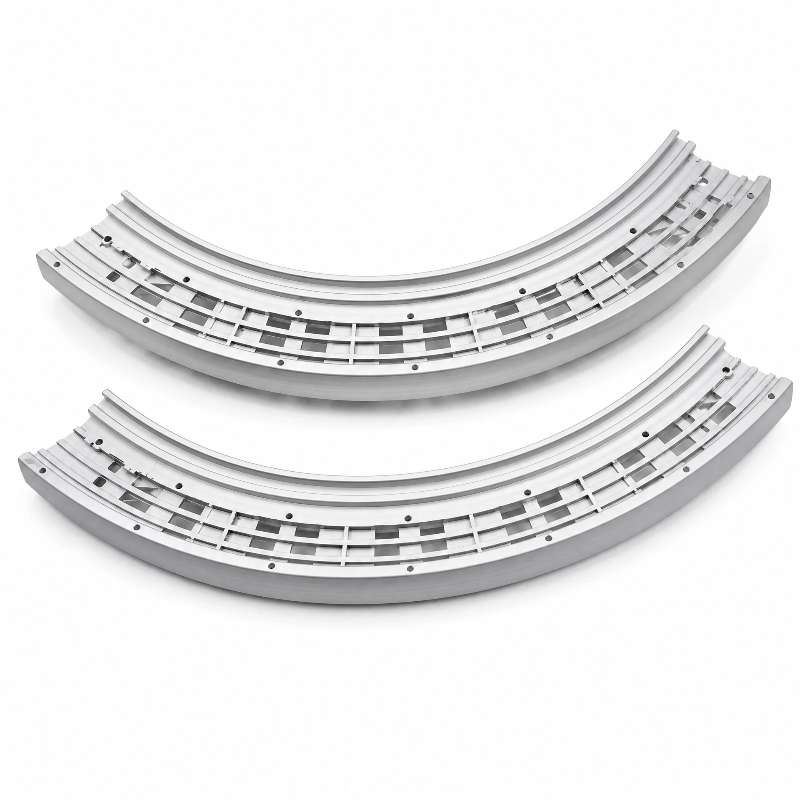
Aluminum Profile Bending
Curved Aluminum Grille - Facade and Ceiling Blades
Curved grilles for facades and ceilings: even blade spacing held by jigs, joints on architectural lines, ±0.4 mm radius, ±0.02 mm hole position.
Product Details
A curved aluminium grille is judged by the eye before it is judged by a tape measure. Two grilles can both be inside a ±0.4 mm tolerance and one reads as a smooth curve while the other reads as slightly lumpy, because what the eye picks up is not absolute position — it is the evenness of the spacing between the blades.
We form curved grilles for building facades, commercial ceilings, airport and station interiors and exhibition partitions, in stretch-bent arcs, C and S profiles, wave shapes, multi-segment arcs and double-curvature forms, with a radius error of ±0.4 mm, flatness 0.1–0.5 mm and CNC hole positions to ±0.02 mm.
Visual continuity is the real specification
A grille is a repeated element. The eye reads the rhythm of the gaps, and it is extremely sensitive to a break in that rhythm — far more sensitive than to a small absolute displacement of the whole assembly. A 1 mm variation in a 100 mm gap is visible on a reflective surface at a few metres.
That has a direct manufacturing consequence: the blades cannot be bent one at a time and then assembled, because each one carries its own small radius error, and those errors add up across the array in a way the eye reads as irregular spacing.
Three ways to hold the rhythm:
Form as an assembly. Bend the blades together in a jig that fixes their spacing, so the array is formed as one piece and the spacing is set by the jig rather than by each part. This is the most reliable method and it needs a jig per curve.
Form on a common template. Bend each blade against the same physical template rather than to a radius setting, so all of them follow the same curve by construction. Cheaper than an assembly jig and nearly as consistent.
Sort and match. Bend individually, measure each, and group them so that adjacent blades have similar deviation. It works and it is labour-intensive, and it fails when the batch has a systematic drift.
The choice is driven by how visible the grille is and how long the run is. For a facade seen from the street, form as an assembly. For a ceiling seen at an angle, matching is often enough.
Multi-segment arcs: the joint has to be designed, not discovered
Long curves are made in segments. Each segment is formed, then they are joined, and the joint is where a decorative grille fails visually.
A joint in a grille shows in two ways: a kink in the curve, and a break in the blade spacing. The first is a tangent continuity problem — the same issue as a segmented rail, but judged by eye instead of by a wheel. The second is a layout problem: the blades on either side of the joint have to line up, which means the joint has to fall on a blade or on a gap, not in between.
The practical rules:
- Put the joint on an architectural line. A column, a panel break, a structural mullion — anywhere the eye already expects a division. A joint that coincides with a visible building element is invisible; a joint in the middle of a clear run is a defect.
- Cut the joint to the tangent. Both segments are cut at the angle of the curve at that point, so the joint is a mitre rather than a butt. A butt joint on a curve produces a kink.
- Carry the blade pattern across. The blade pitch either side of the joint must be the same, and the joint should be placed so that a blade is continuous across it, or so that a gap is continuous across it. Either works; a blade meeting a gap does not.
Double curvature: where the process stops
A single-curvature grille is a cylinder: one radius, one direction. A double-curvature grille is a dome or a saddle: two radii in two directions. An extruded profile can be bent about one axis easily, and about the other only by twisting or by segmenting.
Three approaches, in order of fidelity:
Twist-forming. The blade is bent in one plane and simultaneously twisted, so a straight line along its face becomes a curve in the other direction. This produces a true double curvature on narrow blades. It is a skilled operation, and it works best on blades that are narrow relative to their depth.
Segmented approximation. The surface is divided into facets, each single-curved, joined at the facet lines. On a coarse architectural grid this reads as a smooth form. It is the standard approach for large facades and it needs the facet lines to be part of the design, not an accident.
Machined from solid. Where the form must be exact and the quantity small, a blade can be machined rather than extruded and bent. Cost per part is high; fidelity is the best available.
What does not work is asking for a double-curved extrusion to be "bent" in two directions at once. The tooling for that does not exist in this process, and a supplier who says yes is either misunderstanding the geometry or planning to segment it without telling you.
Specifications
| Item | Reference value |
|---|---|
| Forms | Stretch-bent arc, C and S profiles, wave, multi-segment arc, double curvature |
| Radius error | ±0.4 mm |
| Flatness | 0.1–0.5 mm |
| CNC hole position accuracy | ±0.02 mm |
| Alloys | 6063-T5 (standard), 6061-T6 where strength is needed |
| Surface treatment | Anodising, powder coating, fluorocarbon coating for exterior |
| Maximum length | 6,500 mm per segment |
| Standard | GB/T 6892-2023, ISO 9001 |
Choosing the forming method
| Form | Method | Spacing consistency | Watch out for |
|---|---|---|---|
| Single large arc | Roll bending or stretch bending | Good; one curve, no joints | Roll marks on the visible face |
| C or S profile | Stretch bending in one pass | Good; the transition point must not flatten | A flat spot where the curvature reverses |
| Wave or undulating | Press forming in a dedicated die | Depends on the die; one die per wave form | Die cost; not viable for a few pieces |
| Multi-segment arc | Formed in segments, joined on site lines | Requires a common template across segments | A kink at the joint if the tangent is not matched |
| Double curvature | Twist-forming on narrow blades, or faceted segmentation | Hardest to hold; needs a trial blade | Section distortion on deep blades |
Coating: the exterior-interior split
An interior grille and an exterior grille are different products even when the profile is the same.
Interior: anodising or powder coating. Anodising gives a metallic depth and a hard surface that resists handling; powder coating gives colour freedom and a uniform matte finish. Both are adequate indoors.
Exterior: fluorocarbon coating where the colour has to last, or anodising where the metallic appearance is the design intent. Powder coating fades and chalks outdoors in strong UV, and the rate depends on the pigment — a bright red degrades faster than a grey.
One thing that matters on a curved grille and not on a flat one: coating thickness at the bend. On a powder-coated part, the outside of the bend gets the same nominal thickness but the surface has been stretched; on the inside, the Faraday effect thins the coat in the concave corner. Both are places where the coating fails first, and both are checked on the part, not on a flat test panel.
Where it does not fit
- The grille has to be optically perfect on a tight curve. Extrusion lines, bending marks and coating variation all show on a reflective surface. A machined or a folded-metal grille may be the honest answer.
- The form is double-curved and the blades are deep. Twist-forming works on narrow blades. A deep blade cannot be twisted without distorting the section.
- You need a Class A finish on the inside of the curve. That is exactly where the coating thins and where forming marks land. Design the visible direction so the inside face is not the one seen.
- The joint cannot fall on an architectural line. Then the run has to be one piece, and one piece is limited by the 6,500 mm segment length and by transport.
- The quantity is a few pieces. Jigs and templates dominate the cost. For a small bespoke installation, a different construction may be cheaper.
- Nobody has defined which direction is visible. For a decorative element this is the single most important piece of information, and it is frequently missing from the drawing.
What to send for a quote
Send the blade section drawing, the curve definition — radius, arc length, number of segments, and the joint positions if they are already set by the architecture — the alloy, the finish, and the quantity. Tell us the viewing direction and the distance: a grille seen from 20 m has different acceptance criteria from one seen from 2 m.
We will reply with the forming method, the jig or template we would build, the achievable radius and spacing consistency, the joint treatment, and the tolerances we can confirm. If the form is double-curved in a way the process cannot deliver in one piece, we will say so and propose a segmentation.
FAQ
What radius and spacing tolerance can you hold?
Reference radius error ±0.4 mm, flatness 0.1–0.5 mm and CNC hole position ±0.02 mm, with blade spacing held by a jig rather than by each part. Those are capability references: the value on your order is set by your drawing, and on a decorative grille we agree a visual criterion as well — the spacing consistency and the joint positions — because a part can be inside every dimensional tolerance and still read as uneven to the eye.
What is a curved aluminium grille?
A formed aluminium profile used as a repeated decorative or screening element, bent into an arc, wave or more complex form. It is used on facades, ceilings, transport interiors and exhibition structures. The defining requirement is visual: the spacing rhythm and the smoothness of the curve, not just the radius.
How is the curve formed?
By stretch bending for accurate arcs, roll bending for large-radius runs, or press forming for wave and segment shapes. Multi-segment curves are formed in pieces and joined on an architectural line. Double-curved forms are twist-formed on narrow blades or segmented into single-curved facets.
How is even spacing maintained?
By forming the blades as an assembly in a spacing jig, or by forming each blade against a common physical template so they all follow the same curve. Bending each blade independently to a radius setting accumulates error, and the eye sees it as irregular spacing.
What tolerance can you hold?
Reference radius error ±0.4 mm, flatness 0.1–0.5 mm, CNC hole position ±0.02 mm. These are capability references. The value on your order is set by your drawing, and for a decorative element we also agree a visual criterion — the spacing consistency and the joint positions — because dimensional tolerance alone does not guarantee the appearance.
Can it be a double-curved form?
On narrow blades, by twist-forming. On deep blades, no — the section distorts. Large double-curved surfaces are usually segmented into single-curved facets, with the facet lines designed into the appearance. A supplier who offers true double-curvature on a deep extrusion is either not understanding the geometry or planning to segment it.
What finish should I use outdoors?
Fluorocarbon coating where the colour must last, or anodising for a metallic appearance. Standard powder coating chalks and fades under strong UV, at a rate that depends on the pigment. For a coastal or high-pollution site, anodising or a fluorocarbon system is the safer choice.
How is it priced?
On the section, the curve, the number of segments, the jigs and the finish. A spacing jig or a curve template is a real cost on a decorative job and it is quoted separately. Small bespoke installations carry a high setup per part; a repeating facade run brings it down sharply.
Send your drawing
Email the blade section, the curve definition, the joint layout, the finish and the viewing distance to linjunbing@truetrustlv.com, or send it on WhatsApp at +86 136 6644 0600. You will get a forming method, a joint proposal and a written tolerance statement.
GET A QUOTE
Once you have submitted your requirements, we will contact you as soon as possible regarding your product inquiry.:Curved Aluminum Grille - Facade and Ceiling Blades