
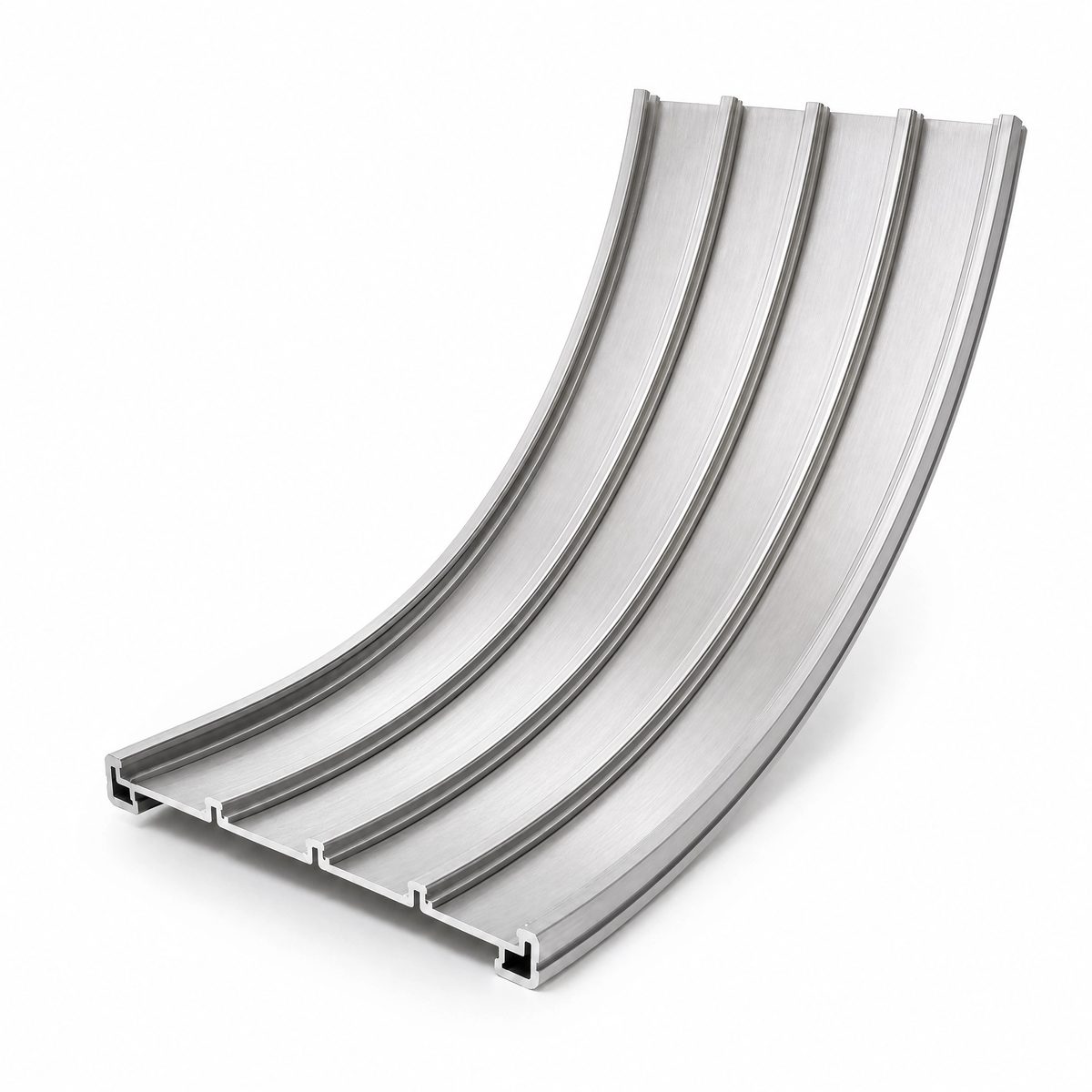
Aluminum Profile Bending
Wide-Format Aluminum Profile Bending - 400 mm and Above
Bending sections 400-600 mm wide: plate behaviour, web buckling, spiral surface from bend-line misalignment, long-bed machines, ±1° angle.
Product Details
A 500 mm wide profile does not bend like a 100 mm one, and the difference is not a scaling factor. When the width of the section approaches the width of the machine, the bending line becomes a surface rather than a line, and every error in the alignment of that surface turns into a shape error in the finished part.
We bend wide-format sections from 400 mm up to over 600 mm across, in 6061-T6, 6082-T6 and 6063-T5, with an angular tolerance of ±1° and an arc error of ±0.4 mm, in lengths up to 6,500 mm. Here is what changes at that width.
Force distribution across a wide face
On a narrow profile, the bending load is applied along a line and the section behaves like a beam. On a wide profile, the load is applied across a face, and the section behaves partly like a beam and partly like a plate.
That has two consequences. First, the load per unit width has to be uniform — if one end of the bend line is pressed harder than the other, the part comes out with a taper: a tighter curve on one side than the other. Second, a wide face can buckle. A flat web that is 500 mm wide and 3 mm thick is a plate, and a plate under in-plane compression buckles before the material yields.
The buckling shows up as an oil-can: a shallow wave across the width of the web, most visible on a reflective surface, and it does not come out with straightening.
The spiral surface effect
This is the failure that catches wide-format work, and it is worth describing precisely.
If the bend line is exactly perpendicular to the length of the profile, every point across the width travels the same path and the part curves in a plane. If the bend line is off by even a small angle, one edge of the profile is bent to a slightly different radius than the other — and worse, the two edges curve in slightly different directions.
The result is a surface that is not a cylinder but a section of a helix: the part looks curved when viewed from one edge and twisted when viewed from the other. It will not sit flat on a frame, and no amount of re-pressing fixes it, because the error is in the geometry, not in the springback.
The controls are all about alignment: a machine with a bed long enough to support the full width, a die that is parallel to the ram across its whole length, and a profile that is fed square. On a 600 mm wide part, a 0.1° misalignment is about 1 mm of differential across the width, which is enough to be visible.
Springback that varies across the width
Extruded profiles have a grain direction, and the material at one edge of a wide section is not identical to the material at the other edge — the flow pattern in the die guarantees that. The yield strength therefore varies slightly across the width, and since springback depends on yield strength, the recovery varies too.
On a narrow part this is invisible. On a wide part it produces a slight taper in the finished radius: one edge recovers a little more than the other. The effect is small, and on a visible architectural part it is the difference between a surface that reads as a smooth curve and one that reads as slightly warped.
There is no die setting that removes it. The practical answers are to accept it on a large radius, to control it by checking both edges during setup rather than only the centre, or to use a stretch-bend process where the tension equalises the strain across the width.
Specifications
| Item | Reference value |
|---|---|
| Section width | ≥400 mm, some sections over 600 mm |
| Bending types | Wide right-angle, wide arc, long-span frame bending |
| Angular tolerance | ±1° |
| Arc error | ±0.4 mm |
| Maximum length | 6,500 mm |
| Alloys | 6061-T6, 6082-T6, 6063-T5 |
| Equipment | Large-tonnage wide-bed CNC bending machines, CNC machining centres |
| Downstream | CNC milling, drilling, tapping, cutting, welding |
| Surface treatment | Anodising, hard anodising, powder coating |
| Standard | GB/T 6892-2023, ISO 9001 |
Wide-format against conventional bending
| Conventional bending | Wide-format bending | |
|---|---|---|
| Section width | ≤100 mm | ≥400 mm, up to 600 mm and beyond |
| Force state | Narrow face, even load | Wide face, uneven load, plate behaviour |
| Tooling | Universal bending dies | Dedicated wide-format dies; parallelism is critical |
| Machine | Conventional bender | Large tonnage and a long bed |
| Main defects | Springback, angle deviation | Web buckling, taper, spiral surface, long-span straightness |
The defect list is the useful part of that table. On a narrow part, the inspector measures the angle. On a wide part, the angle can be right and the part can still be unusable, because the web has oil-canned or the surface has gone helical.
Tonnage, and why width is expensive
Bending force scales with the section modulus and inversely with the die opening, and on a wide part the total force is the force per unit width multiplied by the width. Doubling the width roughly doubles the tonnage for the same thickness and radius.
That is why wide-format bending is limited by machine capacity rather than by skill. A 600 mm wide, 8 mm thick section bent to a tight radius may simply require more tonnage than a normal machine has, and the answer is not to try harder — it is a larger radius, a smaller width, or a different forming method.
There is also a bed-length constraint that is easy to overlook: the machine has to support the part across its full width, and a bed that is shorter than the part means the ends overhang, which produces a bend that is uneven across the width.
Where it does not fit
- The section is a wide flat web with thin walls. The web buckles before the bend is complete. Add a rib, thicken the web, or accept a larger radius.
- The bend line cannot be held square to the profile. A wide part turns the alignment error into a spiral surface. If the profile has no reliable straight edge to reference, this process is fragile.
- The part needs a tight radius at full width. Tonnage exceeds the machine. Reduce the width, increase the radius, or split the part.
- You need a mirror-finish anodised visible face. Wide-format bending shows every trace of oil-canning and taper under a reflective finish. If the face is Class A, expect a machined or a painted finish instead.
- The part is a one-off. A dedicated wide-format die is a significant cost. For one piece, consider a fabricated or a segmented construction.
- The length exceeds 6,500 mm. Requires a purpose-built line; tell us at enquiry rather than assuming it is available.
What to send for a quote
Send the section drawing with the width and wall thicknesses, the bend geometry, the alloy and temper, the length, and the quantity. Tell us which face is visible and whether the part is a structural member — a wide decorative panel and a wide load-bearing beam are different risk profiles.
We will reply with the tonnage requirement against our capacity, the buckling risk on the web, the alignment requirement, and the tolerances we can confirm. If the part is beyond the machine at the requested radius, that goes in the reply rather than in a trial that fails.
FAQ
What radius and angle can you hold on a wide section?
Reference ±1° on angle and ±0.4 mm on arc, in lengths up to 6,500 mm. Those are capability references at the widths we run, not a guarantee that any wide section can reach them: the value on your order is set by your drawing, and we confirm in writing what we can hold on your radius, your straightness and your web flatness before you place the order. On a wide part the angle is rarely the binding dimension — the web condition usually is.
What is the difference between wide-format and conventional bending?
Width relative to the machine and the section. Above about 400 mm the profile behaves partly as a plate, so the failure modes change from springback and angle deviation to web buckling, taper across the width, spiral surface and long-span straightness. Tooling has to be dedicated, and machine parallelism becomes a dominant error source.
Why does a wide part distort or twist?
Usually because the bend line was not square to the profile. A small angular error across a wide face sends one edge around a slightly different path than the other, and the surface becomes helical. It is a geometry error, not a springback error, so re-pressing does not fix it.
What tolerance can you hold?
Reference ±1° on angle and ±0.4 mm on arc, over lengths up to 6,500 mm. These are capability references. The value on your order is set by your drawing, and on a wide part we also agree a straightness and a web flatness figure, because the angle can be in tolerance while the web is oil-canned. We confirm all of it in writing before you order.
Which alloy should I choose?
6063-T5 for formability and surface, where the strength is adequate. 6061-T6 for structural wide members, accepting more springback and a larger minimum radius. 6082-T6 for heavy load with better toughness than 6061 and somewhat better forming behaviour.
What is the maximum width and length?
Reference width from 400 mm to over 600 mm depending on the section, and length up to 6,500 mm. Wider or longer needs a specific line, so it is worth asking rather than assuming. The practical limit is usually tonnage at the required radius, not the nominal width capacity.
How is it priced?
On the section width, the bend length, the radius and the quantity. A wide die, a long bed and high tonnage all cost more per part than a narrow job, and the difference is real capacity, not margin. The die is quoted separately so the amortisation is visible.
Send your drawing
Email the section drawing, the bend geometry, the alloy, the visible face and the quantity to linjunbing@truetrustlv.com, or send it on WhatsApp at +86 136 6644 0600. You will get a tonnage assessment, a buckling risk note and a written tolerance statement.
GET A QUOTE
Once you have submitted your requirements, we will contact you as soon as possible regarding your product inquiry.:Wide-Format Aluminum Profile Bending - 400 mm and Above