
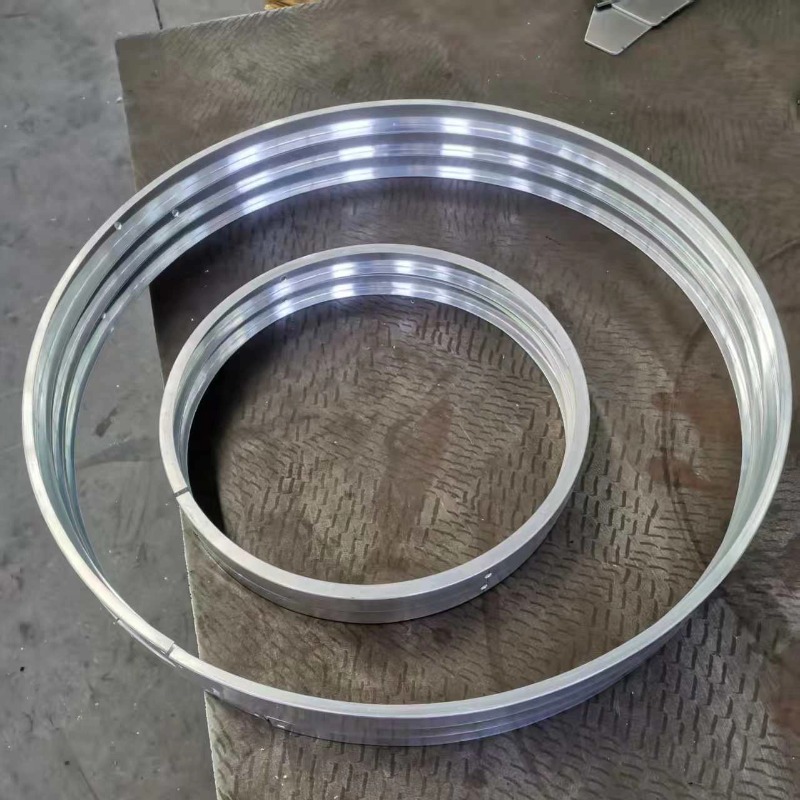
Aluminum Profile Bending
Full Circle Aluminum Bending - Closed Rings and Annular Rails
Closed ring bending to ±0.4 mm full-circle error: closure controlled by developed length, roundness stated separately, welded or stretch bent.
Product Details
A full circle sounds like the simplest case: bend until the ends meet. It is actually the hardest, because a closed ring has no free end to absorb error. On an arc, a small length error just makes the arc slightly shorter. On a ring, the same error has to go somewhere — into a gap, an overlap, or a diameter that is out of tolerance.
We form full rings in 6063-T5, 6061-T6 and 6082-T6 from round tube, square tube, channel, angle and special profiles, to a reference full-circle error of ±0.4 mm, flatness 0.1–0.5 mm, and diameters from small tubular frames to large annular guide rails. Below is what closing a ring actually demands.
Closure: where the error goes
When a ring closes, three quantities are linked: the developed length of the profile, the diameter of the ring, and the gap at the joint. Two can be specified; the third is then determined.
| What you fix | What absorbs the error | Consequence |
|---|---|---|
| Diameter and gap | Developed length must be exact; any cut error becomes a diameter error | Requires precise cut-to-length before forming |
| Diameter and length | The gap varies | Joint gap tolerance becomes the controlling dimension |
| Length and gap | The diameter varies | Ring closes neatly but the diameter is not what the drawing says |
This is why a ring specification that gives diameter, gap and length all as hard tolerances is over-constrained. Something has to be nominated as the absorbing dimension, and that decision belongs on the drawing, not at the machine.
In practice, most rings are specified on diameter and gap, with the length controlled by an accurate cut before forming. A ±0.4 mm full-circle error then corresponds to a length control of roughly π times that, about 1.2 mm on the circumference, which is achievable with a good saw and a check.
Roundness and diameter are two different things
A ring can be exactly the right diameter and visibly out of round. It can also be perfectly round and the wrong size. These are separate tolerances and both need to be stated.
Diameter is the average size. It is set by the developed length and the forming setting.
Roundness is the deviation from a true circle, measured as the difference between the largest and smallest radius. It is set by the uniformity of the forming, not by the length.
Where roundness fails on a roll-bent ring:
- Three-point forming. Three rolls produce a curve that tends toward a polygon at large radii, with slight flats between the roll contacts. The effect is small and it is real.
- Non-uniform springback. If the material's yield strength varies along the length, the ring recovers unevenly and becomes oval.
- Joint clamping. Pulling the ends together to close the gap distorts the ring locally, producing a flat or a kink near the joint.
- Handling. A ring is a spring. Lifting it by one point distorts it, and if it is stored unsupported it takes a set.
The reference ±0.4 mm full-circle error covers both diameter and roundness in a well-run process, but a drawing that only says "diameter ±0.4 mm" leaves roundness undefined. On a guide rail or a rotating ring, roundness is often the requirement that matters.
The end straight problem, and why it hits rings hardest
Roll bending leaves a straight run-out at each end, because the profile has to be gripped by all three rolls before the bending moment is applied. On an arc, those straight ends can be trimmed off. On a ring, they meet each other.
So a roll-bent ring has a straight segment at the joint, which is the worst place for one: it is where the wheel or the roller crosses, and it is where the eye goes. Three treatments:
Trim and weld. Cut the straight ends off, bring the ring to closure and weld. The weld is dressed flush. This is the standard approach for a structural ring and it gives a continuous running surface, at the cost of a weld and its finishing.
Pre-bend the ends. Form the ends to the correct curvature before roll bending, so the run-out is already curved. It works, and the transition can show a slight change of curvature.
Stretch bend the ring. Stretch bending grips the ends and forms the whole length, so there is no straight run-out at all. It is the correct process for a ring that must be continuous, and it is a different machine and a different price.
If your ring has a functional running surface and cannot take a weld, the answer is stretch bending, not roll bending with a clever fix.
Specifications
| Item | Reference value |
|---|---|
| Form | 360° closed ring, single turn |
| Full-circle error | ±0.4 mm |
| Flatness | 0.1–0.5 mm |
| Roundness | Stated separately from diameter on request |
| Joint | Welded and dressed, or mechanical with an alignment feature |
| Alloys | 6063-T5, 6061-T6, 6082-T6 |
| Sections | Round tube, square tube, channel, angle, special profile |
| Maximum developed length | up to 20 m |
| Equipment | Precision roll benders, stretch bending machines |
| In-house support | Die design, extrusion, CNC machining, welding |
| Surface treatment | Anodising, hard anodising, powder coating |
| Standard | GB/T 6892-2023, ISO 9001 |
Ring versus arc
| Ordinary arc bending | Full-circle bending | |
|---|---|---|
| Angle | Any arc, open | 360°, closed |
| Accuracy basis | General arc control | Full-circle error ±0.4 mm, plus roundness |
| Ends | Free; error absorbed by length | Joined; error must be absorbed by gap or diameter |
| Failure mode | Radius out of tolerance | Does not close, or closes oval, or steps at the joint |
| Process | Roll bending is usually fine | Stretch bending if the ring must be continuous |
Flatness: is your ring in one plane?
A ring that does not close in one plane is a single-turn helix, and it will not sit flat, will not rotate true, and cannot be corrected by pressing. The reference flatness of 0.1–0.5 mm is what keeps it planar.
Planarity is lost in three ways: uneven roll contact, uneven springback around the circumference, and handling after forming. The third is more common than the first two. A ring that is lifted by one point, or stacked on a pallet without a full-support cradle, takes a set that no straightening will fully remove.
So the packing matters as much as the forming. A large thin ring shipped flat on a pallet arrives as an oval; the same ring shipped in a cradle arrives round. If your assembly is sensitive, specify the packing.
Where it does not fit
- The ring has to be optically round and the diameter is large. Roll bending tends toward a polygon at large radii and thin sections. Stretch bending or a machined ring is the reliable route.
- The ring must have a continuous running surface with no weld. Requires stretch bending in one piece. A welded ring has a joint, and a joint on a running surface is a wear point.
- The section is a deep thin-wall hollow. It flattens at the bend and the ovality then varies around the ring. Internal support is needed, and the ring may still need a larger diameter.
- You need a tolerance on diameter, gap and length simultaneously. That is over-constrained. Nominate the absorbing dimension.
- The ring is huge and thin. Handling and transport dominate; it may be correct when it leaves and oval when it arrives. Specify the cradle.
- The ring will be anodised. Anodising racks hold the part at points, and a thin ring can distort under its own weight in the tank. Heavy rings are fine; light ones need support in the jig.
What to send for a quote
Send the section drawing, the ring diameter, the developed length if you know it, the alloy and temper, the quantity, and the joint requirement — welded, mechanical, or none. Tell us whether the ring has a running surface, and whether roundness or diameter is the dimension that actually matters at assembly. Those two answers change the process more than the diameter does.
We will reply with the process route (roll or stretch), the achievable diameter and roundness, the joint design, the expected end treatment, and the tolerances we can confirm. If the ring cannot be closed to your gap without a weld, that goes in the reply before you order.
FAQ
What is different about full-circle bending?
Closure. An arc can be a little short or a little long and still work; a ring must close, and the length error has to be absorbed by the gap or the diameter. That makes the developed length a controlled dimension, and it makes roundness a separate requirement from diameter.
What accuracy can you hold?
Reference full-circle error ±0.4 mm and flatness 0.1–0.5 mm, with roundness stated separately on request. These are capability references. The value on your order is set by your drawing, and we confirm in writing which of diameter, roundness and gap we can hold — because all three at once is over-constrained.
Why does my ring not close?
Because the developed length is wrong for the diameter, or because springback was not compensated. On a ring there is nowhere for the error to go: it becomes a gap, an overlap, or a diameter that is out of tolerance. Accurate cut-to-length before forming is what makes closure predictable.
How is the joint handled?
Welded and dressed for a structural ring with a continuous surface; a mechanical joint with an alignment feature where welding is not acceptable. A roll-bent ring has a straight run-out at the joint, so the ends are usually trimmed before welding. Where no weld is allowed at all, the ring is stretch bent in one piece.
Can a large thin ring hold its shape in transit?
Only with support. A thin ring is a spring and will take a set if it is lifted by one point or stacked flat. Specify a cradle or a full-support packing for large thin rings, and check the ring on arrival before removing it from the support.
Which alloy for a ring?
6063-T5 for formability: it bends to a smaller diameter with less springback and holds a better surface. 6061-T6 where the ring carries load, accepting a larger minimum diameter and more springback. 6082-T6 for loaded rings that still have to form.
How is it priced?
On the section, the diameter, the developed length and the joint. A welded ring costs more than an open arc because of the fit-up, the weld and its dressing. A stretch-bent ring costs more again, because it is a different machine and a different setup. We quote the process we would actually use rather than a single number.
Send your drawing
Email the section drawing, the ring diameter, the joint requirement and whether there is a running surface to linjunbing@truetrustlv.com, or send it on WhatsApp at +86 136 6644 0600. You will get the process route, the achievable roundness and diameter, and a written tolerance statement.
GET A QUOTE
Once you have submitted your requirements, we will contact you as soon as possible regarding your product inquiry.:Full Circle Aluminum Bending - Closed Rings and Annular Rails