
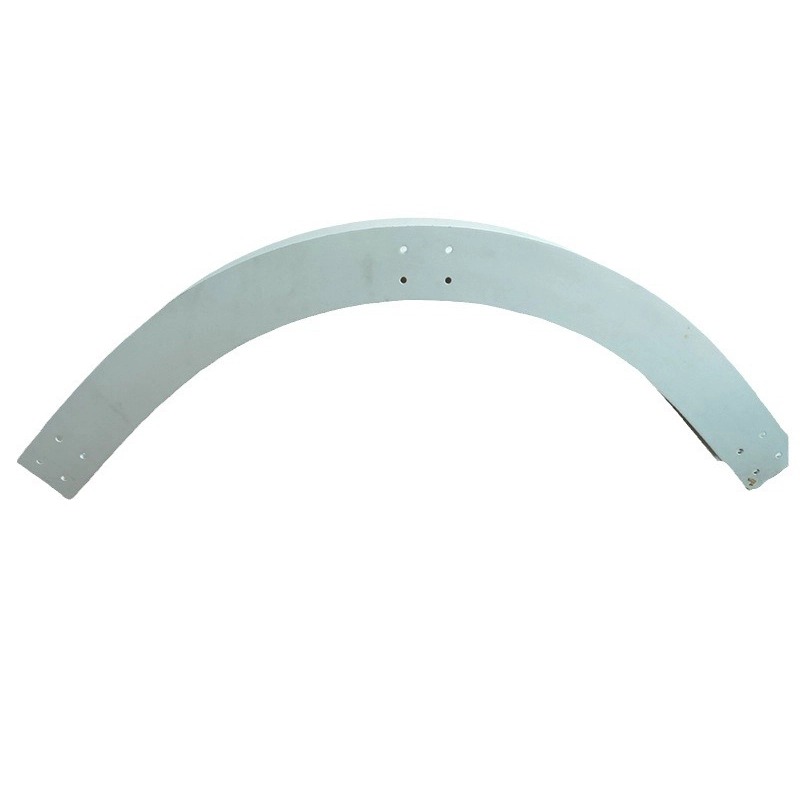
Aluminum Profile Bending
Aluminum Profile Roll Bending Service - Large Radius Arcs
Roll bending of tube, channel, angle and profiles to ±0.4 mm: uniform curvature, no creases, straight end run-outs handled by pre-bend or trim.
Product Details
Roll bending is the workhorse of profile curving: three rolls, continuous feed, a radius set by the roll positions, and a part that comes off the machine with a uniform curve. It is also the method with the most predictable defect, and the defect is at the ends.
We roll bend round tube, square tube, channel, angle and special profiles in 6063-T5, 6061-T6 and 6082-T6, with a reference curving error of ±0.4 mm and flatness of 0.1–0.5 mm, in lengths up to 20 m. This page is about how the process works, what it cannot do, and how to specify a part that will actually fit.
How three rolls make a curve
Three rolls, arranged in a triangle, with the profile passing between them. The lower two rolls support the profile; the upper roll is lowered to press the profile into a curve. As the rolls rotate, the profile is driven forward through the gap, and the curve is formed continuously along the length.
The radius is set by the position of the upper roll relative to the lower two. Lower the roll and the radius tightens. The relationship is not linear and it is not universal: the same roll position gives a different radius on a different section, and on a different alloy, because the amount of springback differs.
That is why roll bending is a setting-and-checking process, not a CNC program. The operator sets an approximate roll position from experience, runs a length, measures the radius, and adjusts. A well-run shop keeps a record of roll positions per section and per alloy, which is why the third order of the same part is cheaper and more accurate than the first.
The end straight: the defect nobody mentions in the catalogue
On a three-roll bender, the profile has to be gripped by all three rolls before the curve can be formed. That means the first part of the profile passes through the rolls before the bending moment is applied, and it comes out straight. The same happens at the trailing end.
The result is a curved section with straight run-outs at both ends. The length of the straight depends on the roll geometry, the section and the radius: typically 100–300 mm on a medium machine, and longer on a large one.
There are only three ways to deal with it:
| Method | How it works | Cost |
|---|---|---|
| Pre-bending | The end is pre-formed in a separate operation before roll bending, so the straight run-out is curved first | Extra operation; the transition can show a slight discontinuity |
| Allowance and trim | Extrude longer, roll bend, cut the straight ends off | Material waste; the part must allow trimming |
| Four-roll or CNC variable-geometry bending | The extra roll supports the end while the bend is applied | Better ends; not available everywhere, and still not perfect |
If your part has to be a closed ring, or an arc that runs right to its ends, this matters. A drawing that says "bend the full length to R500" is asking for something three-roll bending cannot do without one of the three treatments. That is not a limitation of a particular shop; it is the geometry of the process.
Springback, and why the same setting gives different radii
Roll bending forms the profile elastically and then plastically. When the roll pressure is released, the elastic part recovers, and the finished radius is larger than the roll setting. The operator compensates by over-bending.
The amount of recovery depends on:
- Yield strength — higher strength, more springback. 6061-T6 recovers more than 6063-T5.
- Section stiffness — a deep section resists bending and recovers more.
- Wall thickness — thicker wall means more plastic deformation, so relatively less recovery.
- The batch — two heats of the same temper can differ enough to shift the radius.
The practical implication is that a radius tolerance should be stated on the finished part, and the shop should be allowed to find the setting that produces it. A tolerance stated on the roll position is meaningless.
Specifications
| Item | Reference value |
|---|---|
| Process | Aluminium profile roll bending, curving, arc rolling |
| Alloys | 6063-T5, 6061-T6, 6082-T6 |
| Sections | Round tube, square tube, channel, angle, special profile |
| Curving error | ±0.4 mm |
| Flatness | 0.1–0.5 mm |
| Maximum length | up to 20 m |
| Equipment | Roll bender, stretch bending machine |
| In-house support | Die design, extrusion, CNC machining, welding |
| Surface treatment | Anodising, hard anodising, powder coating |
| Standard | GB/T 6892-2023, ISO 9001 |
| Minimum batch | 50 kg |
Roll bending against the alternatives
| Roll bending | Press bending | Stretch bending | |
|---|---|---|---|
| Forming | Continuous feed through rolls | Fixed-point angular forming | Tension plus forming die |
| Curvature uniformity | High; the same curve along the length | General; a series of local bends | High |
| Surface | Wrinkle-free, but possible roll marks | Bend creases at each point | No pressure marks |
| Section distortion | Minor | Relatively large at each bend point | Small |
| Ends | Straight run-out | Accurate | Accurate |
| Best for | Large-radius arcs, long runs | Frames and bracket corners | Rings and closed shapes |
The row that decides most projects is the last one. If the part is a long, large-radius arc with open ends, roll bending is the most economical and gives the most uniform curve. If the part has to close, or the ends have to be exact, it is a stretch bending job and the run-out problem disappears.
Roll marks, and pre-finished profiles
Roll bending contacts the profile with three rolls, and the contact pressure leaves marks on soft or visible surfaces. On an anodised part, a roll mark is a permanent defect. The standard control is a protective film, polished rolls, and a clean roll surface.
A question that comes up often: can a profile that has already been anodised or powder coated be roll bent? Mechanically yes. In practice, only on a generous radius, because the coating is brittle and will crack or craze on the outside of the bend. If the part needs a coating and a bend, the order is bend first, then coat — which also solves the coverage problem at the bend, where a pre-coated part has a stretched, thinned coating on the outer fibre.
The exception is a coating that is flexible by design, such as some powder coatings formulated for post-forming. These exist and they cost more. They are worth asking about only if the part genuinely cannot be coated after forming.
Where it does not fit
- The part must be a closed ring with a controlled closure gap. The end run-out makes this unreliable. Use stretch bending.
- The arc runs to the very ends of the profile and cannot be trimmed. Pre-bending can help, and it leaves a transition. If neither is acceptable, the process is wrong.
- The radius is tight relative to the section depth. Roll bending is a large-radius process. A tight radius distorts the section and may need a mandrel, which puts it in a different process category.
- The section is thin-wall and hollow with no internal support. It will flatten in the rolls. An elastomer or low-melting filler is needed, and that changes the cost.
- The profile is already anodised and the visible face contacts the rolls. Marks are permanent. Bend before anodising.
- You need a one-off piece with a tight tolerance. Setting up a roll bender for a single arc is expensive relative to the part. For small quantities of a simple arc, a pressed or segmented approach may be better.
What to send for a quote
Send the section drawing, the bend drawing with radius and arc length, the alloy and temper, the quantity, and whether the ends are free to be trimmed. Tell us if the part has to close, and if the face that contacts the rolls is visible — both change the process and the price.
We will reply with the achievable radius for your section, the expected end run-out and how we propose to handle it, the tolerance we can confirm on the curve, and whether the section needs internal support. If the ends cannot be trimmed and the part has to be curved to the very tip, we will tell you that before you order.
FAQ
What is the difference between roll bending, press bending and conventional bending?
Mechanics and result. Roll bending feeds the profile continuously through three rolls, producing a uniform curve with no creases but a straight run-out at each end. Press bending forms angles one at a time in a die, which is accurate at each point and leaves a crease there. Conventional bending is a general term for angle forming. For a long uniform arc, roll bending wins; for an accurate corner, press bending wins.
Which sections can be roll bent?
Round tube, square tube, channel, angle and most special profiles, in 6063-T5, 6061-T6 and 6082-T6. The limits are the radius relative to the section depth and whether the section needs internal support. A deep, thin-wall hollow section distorts more than a solid or open one.
What precision can be achieved?
Reference curving error ±0.4 mm and flatness 0.1–0.5 mm, with curvature uniformity controlled by the roll setting and feed speed. These are capability references. The value on your order is set by your drawing, and we confirm in writing what we can hold on your radius and on the end run-out before you commit.
Can a pre-finished profile be roll bent?
Mechanically yes, practically only on a generous radius and with a protective film. Anodising and powder coating are brittle, so they crack on the outside of the bend, and the rolls can mark the surface. The reliable sequence is bend, machine, then coat.
How is it priced?
On the section complexity, the radius, the length and the quantity. A tight radius on a deep section needs more setup and more trial; a large radius on a simple section runs quickly. Setup dominates small orders, which is why the price per metre falls sharply with quantity.
6063-T5 or 6061-T6?
6063-T5 for formability and surface: it bends to a tighter radius with less springback and holds a better finish. 6061-T6 where the part needs strength, accepting a larger minimum radius and a wider radius tolerance. 6082-T6 in between, for loaded parts that still have to form.
What is the minimum batch and lead time?
Reference minimum 50 kg. Lead time depends on whether the section exists: if the profile has to be extruded first, add the die and extrusion time; if the profile already exists, roll bending is a matter of days. We will quote the two cases separately rather than average them.
Send your drawing
Email the section drawing, the bend geometry, the alloy, the quantity and whether the ends can be trimmed to linjunbing@truetrustlv.com, or send it on WhatsApp at +86 136 6644 0600. You will get the achievable radius, the end run-out treatment and a written tolerance statement.
GET A QUOTE
Once you have submitted your requirements, we will contact you as soon as possible regarding your product inquiry.:Aluminum Profile Roll Bending Service - Large Radius Arcs