
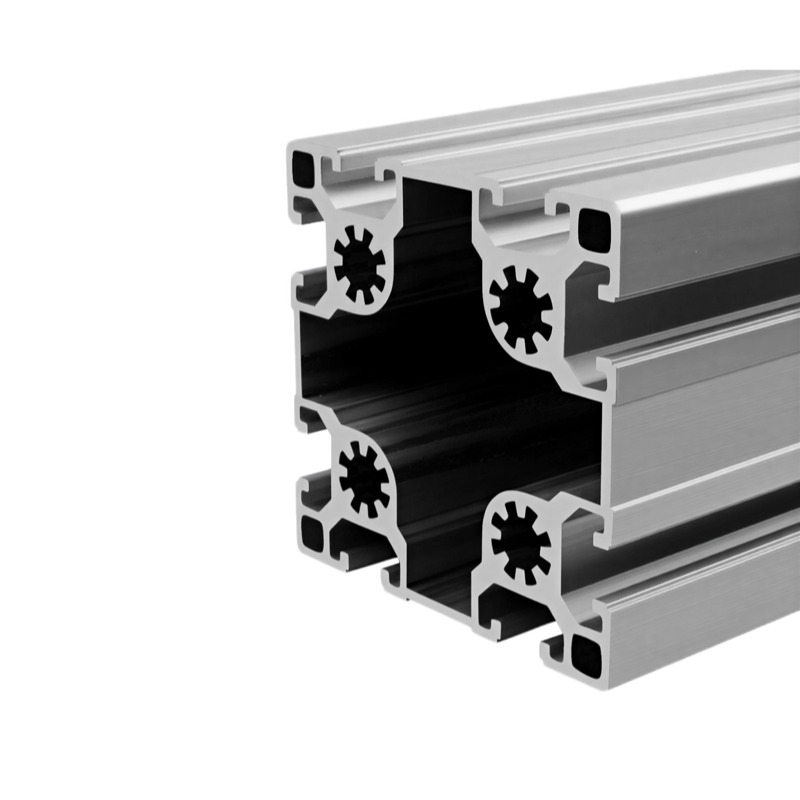
Industrial aluminum profiles
10-9090A T-Slot Aluminum Profile - 90 x 90 mm, 10 mm Slot
10-9090A profile: 90x90 mm, 10 mm slot, 6063-T5, 4.5 mm wall, 7.50 kg/m, I 110 cm4, best stiffness per kg. Per drawing.
Product Details
Short answer: 10-9090A is the largest stocked section: 90 × 90 mm square, 10 mm slot, 6063-T5, 4.5 mm wall, 7.50 kg/m, moment of inertia 110.00 cm⁴. It is used where a single upright has to carry a whole machine without intermediate support. Its stiffness per kilogram, about 14.7 cm⁴ per kg/m, is the best in the range, which runs against the instinct that a big section is wasteful. Section and tolerance are set by your drawing.
What it is used for
It carries machine columns, gantry uprights, heavy enclosure frames, robot cell structures, press and test rig frames, and the legs of large equipment that has to stand on four points without a floor frame.
The defining case is the single upright: a column that takes the whole machine load at the top and has to resist bending from an offset load, moving mass or a safety impact, with the base bolted to a floor and nothing else to help it. At 110 cm⁴ the section is stiff enough that the column stops being the governing element, and the base connection becomes the thing that decides whether the machine stands.
It belongs to the 10-series, which means a 10 mm slot and a different fitting system from the 8-series. That is a project-level decision, not a member-level one.
Specifications
| Item | Value | Note |
|---|---|---|
| Section | 90 × 90 mm square | 10-series, 10 mm slot |
| Alloy and temper | 6063-T5 | Standard for the range |
| Wall thickness | 4.5 mm | Thickest in the stocked range |
| Weight | 7.50 kg/m | |
| Moment of inertia | 110.00 cm⁴ | Equal in both directions |
| Stiffness per kg | About 14.7 cm⁴ per kg/m | Highest in the range |
| Slot width | 10 mm | 10-series fittings, heavier brackets |
| Deflection, 1 m span, 10 kg at centre | About 0.03 mm | Effectively nil at this scale |
| Machining | Cut, mill, drill, tap, base preparation | Per your drawing |
Why bigger is more efficient, not less
Moment of inertia grows with the fourth power of section size, while weight grows with the square. That means a larger square section delivers more stiffness per kilogram, and the ratio improves as the section grows. The numbers across the range show it clearly: about 2.4 cm⁴ per kg/m at 20 × 20, 5.9 at 40 × 40, 8.1 at 50 × 50, 11.3 at 60 × 60 and 14.7 at 90 × 90.
So the instinct that a big profile is an expensive over-specification is wrong when the requirement is stiffness. Per unit of stiffness, this is the cheapest section in the range. What it costs is absolute weight, absolute price per meter, handling effort and a fitting system change. Those are real constraints, but they are different constraints from efficiency, and confusing the two leads to a frame that is heavy and still flexible because it was built from several small members instead of one larger one.
Where this fits
It fits when a column has to stand alone, when the load is applied with an offset, when the frame is a machine structure rather than a cover, and when the width can be accepted.
Where it does not fit: if the load is a beam across a span rather than a column, 10-4590 with its 58 cm⁴ in the 90 mm depth is a better shape for less weight. If the project is an 8-series build, introducing one 10-series member forces a second fitting system and is rarely worth it. And if the machine is light, this section is a cost with no benefit.
What governs the design at this size
Deflection stops being the question. At 0.03 mm for a 10 kg load over 1 m, the profile barely moves. That means the design checks change: the member is no longer the flexible element, so the failure modes move to the connections, the base plates, the anchor bolts and the floor. A 90 mm column that fails will not fail by bending; it will fail at the base, at the bracket, or by the floor giving way under the anchor. It is worth saying plainly, because a customer who has paid for 110 cm⁴ of stiffness often expects that stiffness to guarantee the structure, and it does not.
Buckling replaces bending on a tall column. A slender column under axial load fails by buckling, and the load at which it does depends on the effective length, which depends on how the ends are held. A column bolted at the base and free at the top is a very different case from one braced by the frame at both ends. Section stiffness helps, but the bracing detail decides, and a tall unbraced 9090 column can carry far less than its cross-section suggests.
The 10 mm slot is a system commitment. The heavier slot takes heavier brackets, larger bolts and thicker-angle connections, which is exactly what a heavy frame needs. It also means the brackets from an 8-series frame do not fit, the T-nuts are different, and the drawings carry a second hardware list. On a project that is mostly 8-series with one heavy column, the honest answer is often a steel column rather than introducing the 10-series for one member.
And the weight becomes a handling and logistics question. At 7.50 kg/m a 3 m length is over 22 kg. That is manageable in a factory but changes how the frame is assembled, how it is packed and how it is moved on site. A frame designed as one welded 9090 structure can be impossible to get through a door, and the design has to account for that before the section is chosen.
What to send for a quote
- The frame or machine drawing with the column loads and the load offsets
- Column height and how the ends are restrained, since buckling depends on it
- Base plate and anchor details, or the floor condition if those are open
- Machining: end cuts, bracket seats, cross holes, base preparation
- Finish, and whether any joint face has to stay bare
FAQ
What tolerance can you hold?
Cut length and machined features are held to the tolerance on your drawing, with end cuts square to the axis and hole positions set from a single datum. The value on your order is set by your drawing. On a column, the cut squareness matters as much as the length, because an out-of-square end puts a lean into the machine that no amount of bracing fully removes.
Why is a bigger section more efficient per kilogram?
Because inertia grows with the fourth power of size while weight grows with the square. The stiffness per kg/m rises from about 2.4 at 20 × 20 to about 14.7 at 90 × 90. A large section is not wasteful on a stiffness requirement; it is the most efficient way to buy stiffness, at the cost of absolute weight and a heavier fitting system.
Can 10-9090A be used as a beam rather than a column?
It can, but it is the wrong shape for it. A column needs stiffness in all directions, which a square gives. A beam needs stiffness in the loaded plane, which a rectangle gives for less weight. For a long span, 10-4590 at 58 cm⁴ in the depth direction is the better choice.
Will it hold a machine on its own?
The section will, but the base is what decides. At this stiffness the machine's stability comes from the base plates, the anchor bolts and the floor, not from the profile. A design that specifies 90 mm columns and undersizes the anchors has solved the wrong problem.
Does it need special fittings?
Yes, it is a 10-series profile with a 10 mm slot, so it takes 10-series nuts, brackets and connectors. Those are heavier and rated for larger bolts, which suits a heavy frame. They are not interchangeable with 8-series parts.
What finish is usual?
Clear or black anodizing. On a large machine frame the finish is mostly about appearance and handling protection; the section is thick enough that corrosion is not the governing concern in an indoor installation.
Next step
Send the machine drawing with the column loads, the offsets and the base details. We will cut and machine to your drawing, and we will tell you if the base or the bracing looks like the governing element rather than the profile.
Email: linjunbing@truetrustlv.com | Call or WhatsApp: +86 136 6644 0600
GET A QUOTE
Once you have submitted your requirements, we will contact you as soon as possible regarding your product inquiry.:10-9090A T-Slot Aluminum Profile - 90 x 90 mm, 10 mm Slot