
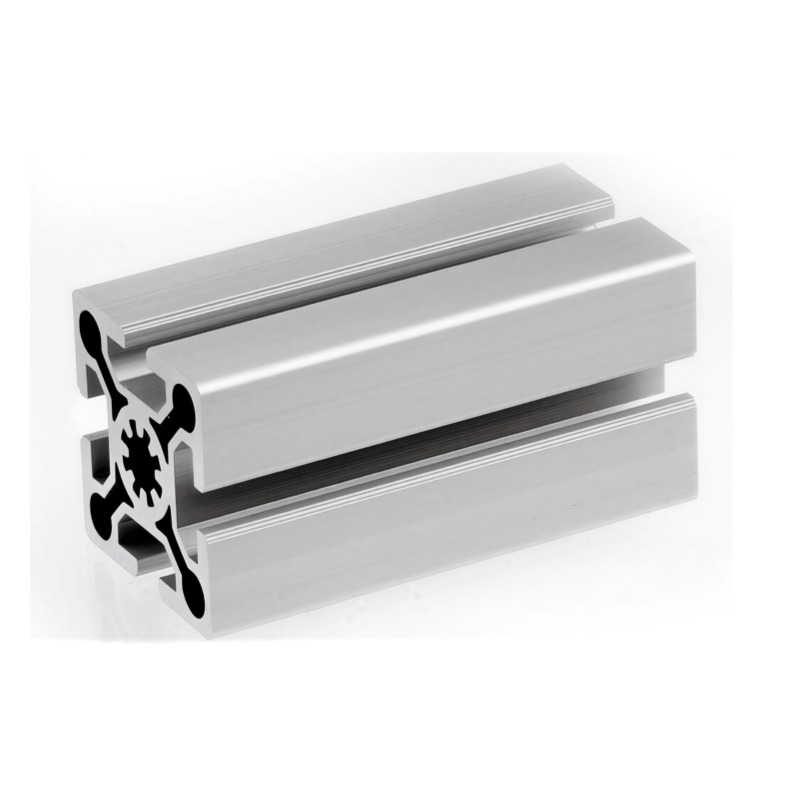
Industrial aluminum profiles
8-5050 T-Slot Aluminum Profile - 50 x 50 mm, 8 mm Slot
8-5050 profile: 50x50 mm, 8 mm slot, 6063-T5, 2.5 mm wall, 2.20 kg/m, I 17.80 cm4, 2.09x stiffer than 4040. Per drawing.
Product Details
Short answer: 8-5050 is the 50 × 50 mm square in the 8-series: 8 mm slot, 6063-T5, 2.5 mm wall, 2.20 kg/m, moment of inertia 17.80 cm⁴. Against 8-4040 it is 2.09 times stiffer for 52 percent more weight, which makes it the usual first step up from 4040 for medium to heavy frames. Working reference: about 0.16 mm deflection at 1 m span with 10 kg at the centre. Section and tolerance are set by your drawing.
What it is used for
It carries the members of a frame that has outgrown 4040 but cannot go to a much larger section: uprights on a machine that has to resist a moving load, cross members over a short to medium span, supports for a heavy enclosure, and columns where the footprint has to stay close to 50 mm.
Its typical job is a machine that is no longer light but is still built from profile rather than welded steel: packaging equipment, assembly stations, test benches with actuators, conveyor frames carrying product, and robot cells where the fence and the frame share the same section.
The reason it exists at all is the space between 40 and 60 mm. A designer who needs more stiffness than 4040 but cannot afford the 60 mm footprint, either because the machine envelope is fixed or because the visual weight would be wrong, has 5050 as the answer.
Specifications
| Item | Value | Note |
|---|---|---|
| Section | 50 × 50 mm square | 8-series, 8 mm slot |
| Alloy and temper | 6063-T5 | Standard for the range |
| Wall thickness | 2.5 mm | Same as 8-4040B |
| Weight | 2.20 kg/m | 52 percent above 8-4040 |
| Moment of inertia | 17.80 cm⁴ | 2.09 times 8-4040 |
| Slot width | 8 mm | Same fittings as 4040 |
| Deflection, 1 m span, 10 kg at centre | About 0.16 mm | Own weight excluded |
| Stiffness per kg | About 8.1 cm⁴ per kg/m | Against 5.9 for 8-4040 |
Where the gain actually comes from
The step from 4040 to 5050 adds 10 mm to each side and 0.75 kg per meter, and it more than doubles the stiffness. That is a good trade, and it is the reason this size is popular. But it is worth knowing that it is not the best trade available in the range, because a jump to 8-6060 adds another 1.0 kg/m and another 18.2 cm⁴, which is a better return per kilogram than the first step.
The comparison in numbers: 4040 to 5050 gains about 12.4 cm⁴ per added kg/m; 5050 to 6060 gains about 18.2. So if the only criterion is stiffness per kilogram, 6060 wins. The reason to stop at 5050 is not efficiency, it is the 50 mm footprint. A machine with a fixed envelope, or a frame whose visual weight has to stay modest, cannot use the 60 mm section regardless of the calculation.
That is the honest case for 5050: it is the best stiffness you can get inside a 50 mm square, not the most efficient profile in the catalogue.
Where this fits
It fits when a frame has outgrown 4040, when the member is a column or a short-to-medium span beam, and when the envelope or the appearance will not accept a 60 mm section.
Where it does not fit: if the span is long and unsupported, 8-4080 with its 39.00 cm⁴ in the depth direction is the better shape, because a rectangle puts material where the bending is. If the criterion is purely efficiency and space allows, 8-6060 is the better buy. And if the frame is light and short, 4040 remains sufficient and cheaper.
Three things to get right
Square sections are isotropic, and that is the point. A 50 × 50 has the same stiffness in both directions, so a column does not care which way it faces and a corner joint does not need orientation. A rectangular section gives more stiffness in one direction for less weight, but it has to be oriented correctly, and on a frame where the loads come from more than one direction the square is the safer choice. This is the argument for 5050 over 8-3060 in a column application, even though the rectangle is more efficient on paper.
The joint is now the weak point. At 17.80 cm⁴ the member is stiff enough that the frame's behaviour is decided by its connections. A bracket that is adequate on 4040 can be the limiting element here, because the member now transmits larger moments into the same corner. On a machine frame with a moving load, the corner detail deserves as much attention as the section, and a gusset or a heavier bracket is often the cheaper fix than another size up.
And the fittings stay the same, which is the quiet benefit. Because it is an 8-series profile with an 8 mm slot, every bracket, nut and hinge from a 4040 frame still works. Upgrading a frame from 4040 to 5050 on the members that need it, while keeping 4040 elsewhere, does not require a second hardware system. That flexibility is worth more in practice than the last few percent of stiffness.
What to send for a quote
- The frame drawing with the spans and the loads on each member
- Which members are columns and which are beams, since the shapes differ
- Machining: end taps, cross holes, bracket seats
- Finish, and whether any face has to stay bare for a structural joint
FAQ
What tolerance can you hold?
Cut length and machined features are held to the tolerance on your drawing, with end cuts set so a mitred or butted joint closes cleanly. The value on your order is set by your drawing, and on a tall frame we agree how the column lengths are measured, because a stacked length error shows up as a frame that will not stand square.
How much stiffer is 5050 than 4040?
About 2.09 times, from 8.52 to 17.80 cm⁴, for 52 percent more weight. At 1 m span with 10 kg at the centre the deflection falls from about 0.34 mm to about 0.16 mm.
Should I go to 8-6060 instead?
If the footprint allows it, the step to 6060 gives a better stiffness return per kilogram. Choose 5050 when the 50 mm envelope is a hard constraint or when the frame should not look heavier. Both are correct answers to different questions.
Can I mix 5050 and 4040 in one frame?
Yes, and it is a sensible approach: use 5050 where the load and span need it and 4040 elsewhere. Both are 8-series with an 8 mm slot, so the same fittings work throughout.
Is a square section better than a rectangle here?
For a column or a member loaded from more than one direction, yes, because it is isotropic and needs no orientation. For a beam carrying load in one plane only, a rectangle is more efficient. The choice follows the load case rather than the catalogue order.
What is the usual finish?
Clear anodizing, or black where the frame is visible. On a machine frame that will be handled during assembly, anodizing also protects the slot faces from damage.
Next step
Send the frame drawing with the spans and the member loads. We will cut, machine and finish to your drawing, and tell you if a member would be better in a different section.
Email: linjunbing@truetrustlv.com | Call or WhatsApp: +86 136 6644 0600
GET A QUOTE
Once you have submitted your requirements, we will contact you as soon as possible regarding your product inquiry.:8-5050 T-Slot Aluminum Profile - 50 x 50 mm, 8 mm Slot