
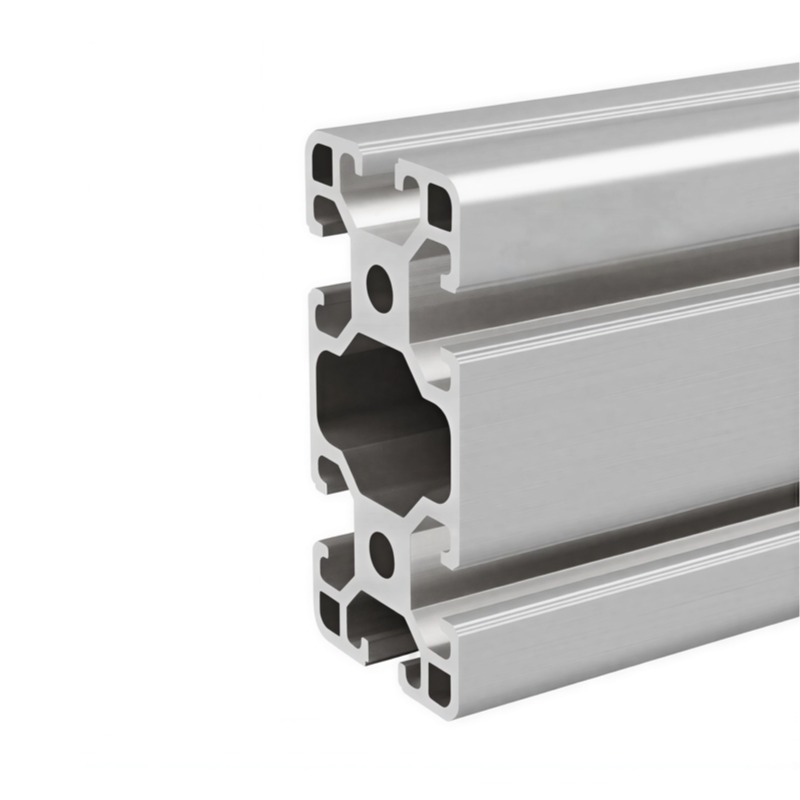
Industrial aluminum profiles
8-4080 T-Slot Aluminum Profile - 40 x 80 mm, 8 mm Slot
8-4080 profile: 40x80 mm, 8 mm slot, 6063-T5, 2.5 mm wall, 2.80 kg/m, I 39.00 cm4 on 80 mm axis. Long spans without a mid post. Per drawing.
Product Details
Short answer: 8-4080 is a 40 × 80 mm rectangle in the 8-series: 8 mm slot, 6063-T5, 2.5 mm wall, 2.80 kg/m, with 39.00 cm⁴ on the 80 mm axis and 13.20 cm⁴ on the 40 mm axis. It exists for one job: a cross member that has to span without a post in the middle. Working reference: about 0.075 mm deflection at 1 m with 10 kg on the strong axis. Section and tolerance are set by your drawing.
What it is used for
It carries long cross members in equipment frames: conveyor bridge beams, gantry crossbeams, overhead support beams, guarding frames that have to reach across an opening, and the top beam of a workstation where the operator has to pass underneath.
The design situation is always the same. The member has to cross a distance, and something prevents a support in the middle: an operator walkway, a product path, a conveyor, a door, or an access requirement. Once a mid-span post is ruled out, the only way to control deflection is depth.
Depth is what this profile sells. It puts 80 mm of section between the top and bottom fibres, which is far more effective than adding wall thickness at 40 mm. That is geometry doing the work, not material.
Specifications
| Item | Value | Note |
|---|---|---|
| Section | 40 × 80 mm rectangular | 8-series, 8 mm slot |
| Alloy and temper | 6063-T5 | Standard for the range |
| Wall thickness | 2.5 mm | |
| Weight | 2.80 kg/m | |
| Moment of inertia, 80 mm axis | 39.00 cm⁴ | 2.95 times the 40 mm axis |
| Moment of inertia, 40 mm axis | 13.20 cm⁴ | Still above 8-4040 |
| Deflection, 1 m, 10 kg, strong axis | About 0.075 mm | Own weight excluded |
| Comparison, 8-6060 | 36.00 cm⁴, 3.20 kg/m | Less stiff and heavier on the strong axis |
The real trade is not section size, it is whether to add a post
Engineering a frame with a long cross member comes down to two options. Add a post in the middle, which is cheap in profile but costs floor space, blocks a path or obstructs an access, and often has to be moved again later. Or leave the span clear and buy depth, which costs money in section but keeps the space usable.
The 4080 is the answer to the second option. On a 2 m span with 100 kg at the centre it deflects roughly 6 mm, which is often acceptable for a static frame and not acceptable for a moving axis. On the same span, 8-6060 at 36.00 cm⁴ deflects about 6.5 mm and weighs 14 percent more, so the deeper rectangle is the better buy when the height is available.
What makes the decision hard is that the post is invisible in the quotation and the section is not. The post looks free until it blocks a walkway, and the 4080 looks expensive until the alternative is a redesign. It is worth putting both numbers on the table at the design stage rather than discovering the constraint at installation.
Where this fits
It fits when a span must stay clear, when height is available and width is not, and when the load is in the vertical plane.
Where it does not fit: if the beam also has to resist a side load, the 40 mm axis at 13.20 cm⁴ is much weaker and a square 8-6060 may be safer. If the span is beyond about 3 m, the section stops being enough and the answer is a truss or steel. And if a post is acceptable, a 4040 with a post is far cheaper than a 4080 without one.
Three things that decide whether it works
Orientation is the whole design. With a 2.95-to-1 ratio the profile must have the 80 mm dimension vertical. Fitted on its side it behaves like a heavy 4040, and the span that was calculated to work will sag visibly. On a beam this is easy to see in the finished frame but hard to correct afterwards, so the orientation belongs on the drawing for every member.
The end connection has to take the moment. A long span beam does not simply rest on its supports; it rotates at the ends and delivers a moment into the corner. At 39.00 cm⁴ the member is stiff enough that a light corner bracket can become the weak link, and the frame will deflect more than the section calculation suggests because the joint is moving. On a long span, a gusset, a double bracket or a bolted side plate is often needed, and it should be part of the design rather than an assembly improvisation.
Self-weight matters over a long span. At 2.80 kg/m, a 3 m beam carries over 8 kg of its own before any load. Over a long span that contributes to the sag, and unlike the payload it cannot be reduced by changing the process. The calculation should include it, and on long spans the practical limit is often set by self-weight rather than by the payload.
And 8-4080 is not the only shape that does this. 10-4590 gives 58.00 cm⁴ at 4.50 kg/m in a 90 mm depth, which is 49 percent stiffer but in a heavier system with a 10 mm slot and different fittings. The choice between them is usually decided by whether the project is already 8-series or 10-series, not by the last few percent of stiffness.
What to send for a quote
- The frame drawing with the span, the supports and the orientation of the beam
- Load including the beam's own weight, and the deflection you can accept
- Whether a mid-span post is possible, since it changes the answer completely
- End connection detail, or the bracket type you intend to use
FAQ
What tolerance can you hold?
Cut length and machined features are held to the tolerance on your drawing, with the beam ends cut square and true to the axis. The value on your order is set by your drawing. On a long beam the cut squareness matters because an out-of-square end tilts the beam and shows up as a level error at the far support.
How far can 8-4080 span?
It depends on the load and the deflection you accept, not on a fixed number. As a guide, at 100 kg at the centre a 2 m span gives roughly 6 mm and a 3 m span roughly 20 mm, before self-weight. Send the load and the limit and we will run the number rather than quote a span.
Why not use 8-6060?
On the strong axis 8-4080 is stiffer: 39.00 against 36.00 cm⁴, at 2.80 against 3.20 kg/m. So the rectangle is both stiffer and lighter for a vertical load. The 6060 is the better choice when the beam is also loaded sideways, because its 40 mm axis is much stronger.
Can it be used as a column?
It can, but a rectangle as a column is orientation-sensitive and the weak axis becomes the governing case. For a column that has to resist loads from any direction, a square section is the safer choice.
Is a mid-span post really cheaper?
Usually yes on material, and often more expensive overall once the post blocks a walkway or an access. The comparison is worth making explicitly at the design stage, because the post tends to appear as a free option until someone has to work around it.
What finish is usual?
Clear or black anodizing. On a beam that is part of a visible machine, black is common because the deep section is less conspicuous in a dark colour.
Next step
Send the span, the load and the deflection limit, plus whether a post is possible. We will check the section and come back with a recommendation against your drawing.
Email: linjunbing@truetrustlv.com | Call or WhatsApp: +86 136 6644 0600
GET A QUOTE
Once you have submitted your requirements, we will contact you as soon as possible regarding your product inquiry.:8-4080 T-Slot Aluminum Profile - 40 x 80 mm, 8 mm Slot