
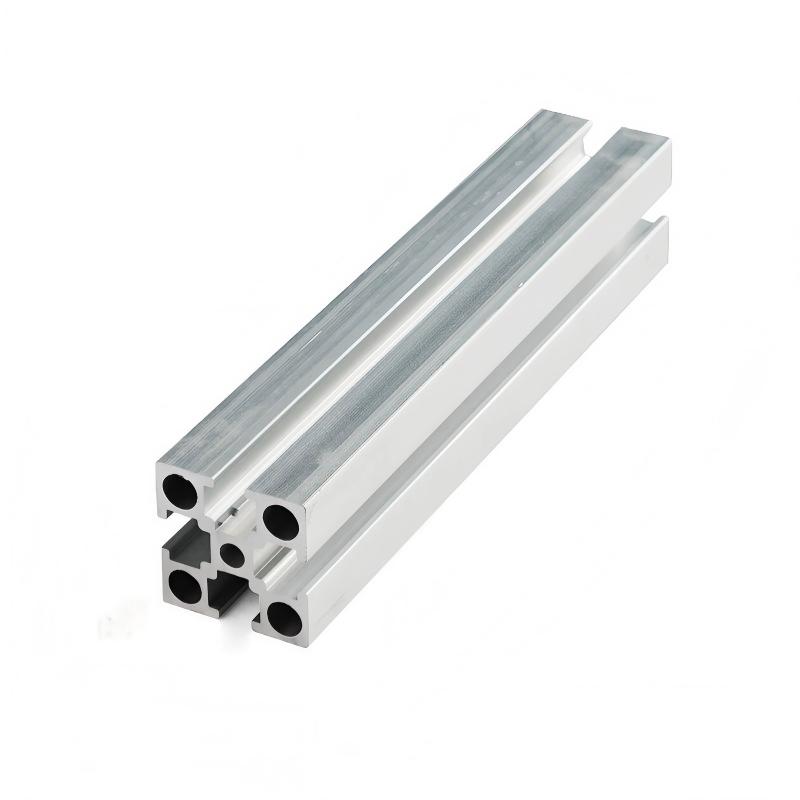
Industrial aluminum profiles
8-4040B Reinforced Profile - 40 x 40 mm, 2.5 mm Wall
8-4040B profile: 40x40 mm, 2.5 mm wall vs 2.0, 1.80 kg/m, I 10.20 cm4. For dense drilling and repeated assembly, not for spans. Per drawing.
Product Details
Short answer: 8-4040B is the reinforced 40 × 40 mm version of the 8-series general profile: 8 mm slot, 6063-T5, 2.5 mm wall against 2.0 mm, 1.80 kg/m and 10.20 cm⁴. That is about 20 percent more stiffness for 24 percent more weight, so it is not a rigidity upgrade. Its value is in joints that have to keep a 40 mm outline while taking dense drilling and repeated assembly. Section and tolerance are set by your drawing.
What it is used for
It goes where a 40 mm square has to do more work at the joint rather than in the span: brackets that are drilled and re-drilled, frame corners that are opened for access, mounting plates that take a pattern of tapped holes, adjustable fixtures that are reset every shift, and adaptation plates that carry a bought-in component with its own bolt pattern.
It is also used where a thread has to live in the profile itself rather than in a T-nut, because the extra wall gives the thread more material to bite.
The distinction matters because most people who ask for the B version are trying to solve a span problem, and that is the one thing it is not good at.
Specifications
| Item | 8-4040 | 8-4040B |
|---|---|---|
| Section | 40 × 40 mm square | 40 × 40 mm square |
| Wall thickness | 2.0 mm | 2.5 mm |
| Weight | 1.45 kg/m | 1.80 kg/m (+24%) |
| Moment of inertia | 8.52 cm⁴ | 10.20 cm⁴ (+20%) |
| Slot width | 8 mm | 8 mm |
| Deflection, 1 m, 10 kg | About 0.34 mm | About 0.29 mm |
| Stiffness per kg | About 5.9 | About 5.7 |
| Best use | General frames and spans | Joints, drilling, repeated assembly |
Why the weight gain beats the stiffness gain
The numbers are close enough that the conclusion is easy to state: 20 percent more stiffness for 24 percent more weight means the stiffness per kilogram goes down slightly, from about 5.9 to 5.7 cm⁴ per kg/m. So as a structural upgrade, adding wall thickness is a worse deal than moving up a section size. A step to 8-5050 gives 2.09 times the stiffness for 52 percent more weight, which is a far better return.
That is not an argument against the B version. It is an argument against using it for the wrong reason. Wall thickness buys something different from section size: it buys material at the surface, where drilling, tapping and clamping happen, and it buys a stiffer local region around a fastener. Section size buys global stiffness. Those are separate problems and they have separate answers.
Where this fits
It fits when the outline must stay 40 mm, when the joint takes repeated drilling or repeated assembly, and when the profile itself has to hold a thread.
Where it does not fit: if the problem is a span that sags, go to 8-5050 or 8-6060 and get real stiffness. If the problem is a joint that slips, the answer is a better bracket or a gusset, not a thicker wall. And if the frame is a one-off that will never be re-drilled, the standard 8-4040 is the cheaper correct answer.
What the extra wall actually buys
A thread that survives being refreshed. In a 2.0 mm wall a tapped hole is mostly thread in the internal rib, and once it is stripped there is little left. At 2.5 mm there is more material, so a thread can be cleaned up and re-cut once, which on a fixture that is disassembled every shift is the difference between a repair and a new part.
More bearing area under a bolt head. A clamped joint on a thin wall can dish locally, and the bolt loses preload. The thicker wall resists that, which keeps the preload where it was set. On a vibrating machine this is a real failure mode, and it looks like a loose bolt rather than a material problem.
Resistance to a hole pattern that lands close to the slot. Dense drilling on a 40 mm face leaves little material between holes and the slot. At 2.0 mm the remaining ligament can be thin enough to deform when a bolt is tightened; at 2.5 mm there is more margin. This is the specific case the profile was made for, and it is worth checking the hole layout against the wall before ordering.
Nothing about the section's global behaviour. The bending stiffness rises 20 percent, which on a 1 m span changes the deflection from 0.34 to 0.29 mm. Nobody can see that. If the design was marginal at 0.34 mm it is still marginal at 0.29.
And it costs weight everywhere. The 24 percent weight increase applies to every meter of the frame, not only the joint that needed it. On a large frame the right approach is usually to use standard 4040 for the members and the B version only for the plates and brackets that take the drilling, which keeps the weight where it does some good.
What to send for a quote
- The drawing, with the hole patterns and any tapped positions marked
- Which parts are re-drilled or repeatedly disassembled, since that is the selection criterion
- Cut lengths and machining
- Whether the frame also has a span requirement, so the section can be checked for that separately
FAQ
What tolerance can you hold?
Cut length and machined features are held to the tolerance on your drawing, including hole position within a pattern. The value on your order is set by your drawing. Where a pattern is dense, we check the remaining wall between holes before machining rather than discovering it at the drill.
Is 8-4040B stiffer than 8-4040?
By about 20 percent, from 8.52 to 10.20 cm⁴, for 24 percent more weight. The deflection at 1 m with 10 kg falls from about 0.34 to about 0.29 mm. That is real but small, and it is not the reason to choose this profile.
When should I use it?
When the joint takes dense drilling, repeated assembly or a thread in the profile, and the outline has to stay 40 mm. It is a joint specification, not a span specification.
What if I need more stiffness over a span?
Go up a size. 8-5050 gives 17.80 cm⁴, more than twice the 4040, for 52 percent more weight. That is a much better return than adding wall thickness, and it is the correct answer to a sagging beam.
Can I mix standard and B profiles in one frame?
Yes, and it is usually the right approach: standard 4040 for the members, B for the plates and brackets that take the drilling. Both are 8-series with an 8 mm slot, so the fittings are the same.
Does the thicker wall affect the slot?
The slot width is still 8 mm and takes the same fittings. What changes is the amount of material around the slot, which is exactly what makes the joint stronger.
Next step
Send the drawing with the hole patterns and the parts that get re-drilled. We will cut and machine to your drawing and tell you if a member needs a larger section rather than a thicker wall.
Email: linjunbing@truetrustlv.com | Call or WhatsApp: +86 136 6644 0600
GET A QUOTE
Once you have submitted your requirements, we will contact you as soon as possible regarding your product inquiry.:8-4040B Reinforced Profile - 40 x 40 mm, 2.5 mm Wall