
Industrial aluminum profiles
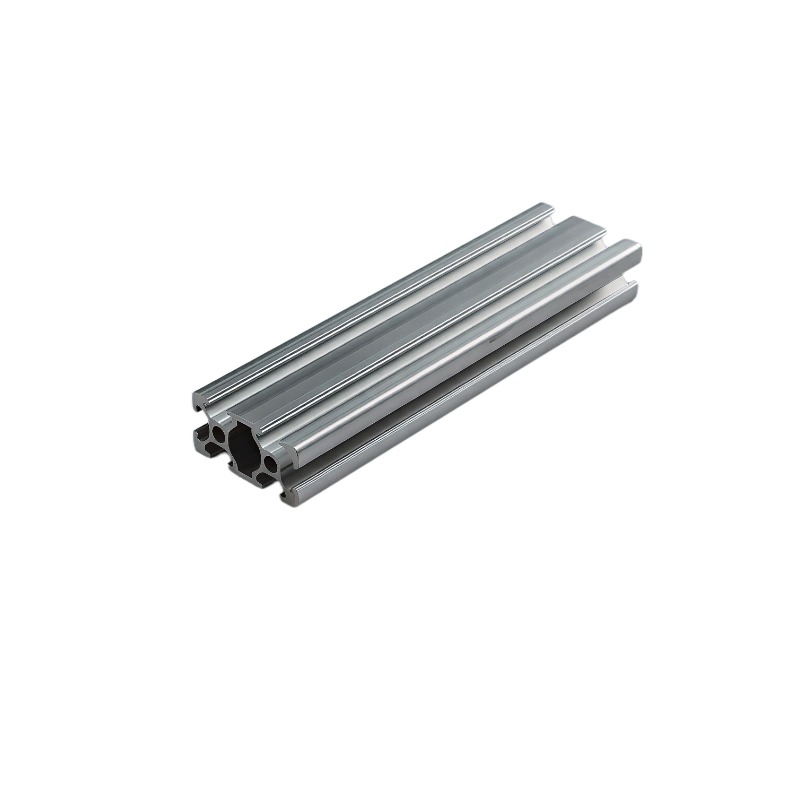
6-2040 T-Slot Aluminum Profile - 20 x 40 mm, 6 mm Slot
6-2040 profile: 20x40 mm, 6 mm slot, 6063-T5, 1.8 mm wall, 0.80 kg/m, I 3.80 cm4 on the 40 mm axis. Oriented beams and columns. Per drawing.
Product Details
Short answer: 6-2040 is a 20 × 40 mm rectangular profile in the 6-series: 6 mm slot, 6063-T5, 1.8 mm wall, 0.80 kg/m, moment of inertia 3.80 cm⁴ in the 40 mm direction. That is more than three times 6-2020 in that one direction, which makes it a column or a one-way beam for light structures. The gain exists only if the profile is oriented correctly; turned 90 degrees it behaves like a 2020. Section and tolerance are set by your drawing.
What it is used for
It builds light structures that need stiffness in one plane: the uprights of a guard frame, a shelf column, a one-way beam carrying a light panel, a bracket arm, a stand for an instrument, and the frame of a small enclosure that has to resist a push rather than a load.
It is also the practical answer when a 2020 frame needs one member that does not sag. Instead of moving the whole frame up to 4040, the member that carries the load becomes a 2040 and the rest stays 2020, which keeps the section size consistent and the fittings unchanged.
The 20 mm face keeps the frame visually light. That matters on a product where the frame is visible, and it is the reason a rectangle is chosen over a larger square even when the square would be simpler to specify.
Specifications
| Item | Value | Note |
|---|---|---|
| Section | 20 × 40 mm rectangular | 6-series, 6 mm slot |
| Alloy and temper | 6063-T5 | Standard for the range |
| Wall thickness | 1.8 mm | Above the 2020 wall |
| Weight | 0.80 kg/m | 60 percent above 6-2020 |
| Moment of inertia, 40 mm axis | 3.80 cm⁴ | 3.2 times 6-2020 |
| Slot width | 6 mm, on all four faces | 6-series fittings |
| Deflection, 1 m, 10 kg, 40 mm axis | About 0.77 mm | Own weight excluded |
| Deflection, same load, 20 mm axis | Materially worse | Orientation decides |
How the numbers work
On the 40 mm axis this profile is three times stiffer than 6-2020, so the deflection for the same load over the same span falls from about 2.4 mm to about 0.77 mm. That is a real improvement for 60 percent more weight.
On the 20 mm axis it is a different story. The section is only as deep as the 2020 in that direction, so it is close to a 2020 in behaviour while carrying more material. The profile is therefore a directional investment: it gives stiffness where you point it and little where you do not.
That is not a flaw, it is the whole point of a rectangle. Material placed far from the neutral axis does the most work, and a 40 mm depth puts it twice as far out as a 20 mm depth. The price is that the other direction gets nothing.
Where this fits
It fits when the load direction is known and fixed, when a 2020 frame needs one or two stiffer members, and when the visual weight has to stay at 20 mm.
Where it does not fit: if the frame is loaded from varying directions, a square section is the safer choice. If the span over 1 m carries much more than 10 kg, move to the 8-series. And if the frame will be assembled by someone who may not follow the drawing, a directional section is a risk.
The risk that comes with a rectangle
Orientation is not a detail, it is the function. A 2040 installed with the 40 mm face horizontal instead of vertical is a 2020 with extra weight, and the frame that was calculated to be stiff will sag. This is the single most common error with rectangular sections, and it is invisible in a finished assembly: the frame looks right and behaves wrong. The mitigation is on the drawing, with the orientation marked on each member, and in the assembly sequence, so the member cannot be turned without the mistake being visible.
Joints have to respect the direction too. A bracket that spans the 20 mm face and the 40 mm face is loaded differently depending on which way the member runs. On a corner where a 2040 upright meets a 2040 beam, the two members may need different orientations, and the bracket has to suit both. That is a drawing question, not a fitting question, and it is worth resolving before the cut list is issued.
And the slots on all four faces are what make it usable. A rectangle with slots only on two faces forces the orientation and removes the design freedom that made it attractive. All four faces slotted means a panel can be fixed to the 40 mm face while the member is oriented for load, which is why this profile is specified with slots on every side.
Compared with going up to 8-4040: the 4040 has 8.52 cm⁴ in both directions and weighs 1.45 kg/m. So it is more than twice as stiff as the 2040 on its strong axis and equal on its weak axis, for 80 percent more weight. If the frame needs stiffness in both directions or the load direction is uncertain, the square 4040 is the better buy. The 2040 wins where one direction is clearly enough and the 20 mm face matters.
What to send for a quote
- The frame drawing with the orientation of each member marked
- Span and load, and which axis carries them
- Cut lengths, plus any end taps or cross holes
- Finish, if the frame is visible
FAQ
What tolerance can you hold?
Cut length and machined features are held to the tolerance on your drawing, with end cuts square to the axis. The value on your order is set by your drawing. On a rectangular member we also mark the orientation on the part where the drawing requires it, because a member fitted the wrong way round is a silent failure.
How much stiffer is it than 6-2020?
About 3.2 times on the 40 mm axis, which takes the deflection at 1 m with 10 kg from about 2.4 mm to about 0.77 mm. On the 20 mm axis it is close to a 2020, because the depth in that direction is the same.
Can I use it as a beam rather than a column?
Yes, that is one of its main jobs, provided the 40 mm dimension is vertical so it acts as the beam depth. As an upright it works the same way: the 40 mm face should be in the plane where the load pushes.
What happens if it is installed the wrong way round?
It behaves like a 2020 with more weight, so a frame calculated to be stiff will sag and the error will not be obvious by looking at it. The drawing should show the orientation and the assembly should be checked against it.
Should I use 8-4040 instead?
If the frame needs stiffness in both directions, or if the load direction may change, yes. The 4040 is more than twice as stiff on the strong axis and equal on the weak one, for 80 percent more weight. The 2040 is for the case where one direction is enough and the 20 mm face matters.
Are the slots on all four faces?
Yes, which is what allows the member to be oriented for load while a panel or bracket is still fixed to any face. A two-face rectangle would remove most of the design freedom.
Next step
Send the frame drawing with each member's orientation and load marked. We will cut and machine to your drawing and flag any member where the orientation is not clear.
Email: linjunbing@truetrustlv.com | Call or WhatsApp: +86 136 6644 0600
GET A QUOTE
Once you have submitted your requirements, we will contact you as soon as possible regarding your product inquiry.:6-2040 T-Slot Aluminum Profile - 20 x 40 mm, 6 mm Slot