
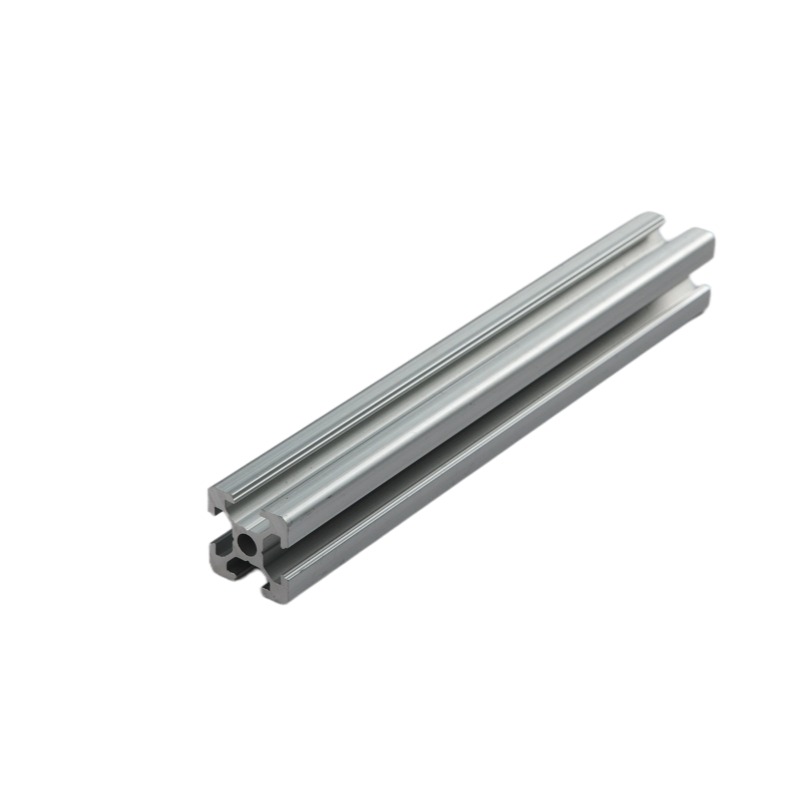
Industrial aluminum profiles
6-2020 T-Slot Aluminum Profile - 20 x 20 mm, 6 mm Slot
6-2020 profile: 20x20 mm, 6 mm slot, 6063-T5, 1.5 mm wall, 0.50 kg/m, I 1.20 cm4. Light parts and covers, not load bearing. Per drawing.
Product Details
Short answer: 6-2020 is the smallest profile in the 6-series range: a 20 × 20 mm square section with a 6 mm slot, 6063-T5, 1.5 mm wall, 0.50 kg/m and a moment of inertia of 1.20 cm⁴. Its correct job is light parts and appearance work: cover frames, instrument brackets, guards, display structures. It is not a load-bearing beam. Put 10 kg at the centre of a 1 m span and it deflects about 2.4 mm, which is usually more than the application allows. Section and tolerance are set by your drawing.
What it is used for
It suits frames that hold a panel or a cover rather than a machine: protective guarding frames, machine viewing windows, sensor and camera brackets, instrument enclosures, display and exhibition structures, small doors, cable and hose guides, and light shelving for parts trays.
It is also the section people reach for when the requirement is visual rather than structural. A 20 mm square edge reads as a finished product detail, while a 40 mm edge reads as industrial framing. On a control cabinet surround or a desktop instrument, that difference matters.
Where it does not belong is under load. A 2020 frame carrying a motor, a gearbox, a moving carriage or a stack of tooling will sag between its supports, and the sag appears as misalignment at the joints rather than as an obvious failure.
Specifications
| Item | Value | Note |
|---|---|---|
| Section | 20 × 20 mm square | 6-series, 6 mm slot |
| Alloy and temper | 6063-T5 | Standard for the range |
| Wall thickness | 1.5 mm | Thinnest in the series |
| Weight | 0.50 kg/m | Lightest standard size |
| Moment of inertia | 1.20 cm⁴ | Same in both directions, square section |
| Slot width | 6 mm | 6-series fittings only |
| Deflection, 1 m span, 10 kg at centre | About 2.4 mm | Calculated, own weight excluded |
| Cutting and machining | Cut, drill, tap, mill | Per your drawing |
How the numbers work
The deflection of a beam loaded at the centre is proportional to the load and to the cube of the span, and inversely proportional to the moment of inertia. For 6-2020 that gives a practical rule: at 1 m with 10 kg in the middle, the sag is about 2.4 mm. Halve the span and it drops to roughly 0.3 mm, because the span is cubed. Halve the load and it halves.
That cube is the reason a short 2020 frame feels rigid while a long one feels springy, and it is the single most useful thing to know about this size. If your design has a 1.2 m unsupported run carrying any real mass, the answer is a larger section or an intermediate support, not a thicker wall.
Where this fits
It fits when the load is a panel or a cover, when spans are short or supported, when the visual weight of the frame has to stay small, and when the assembly is handled by hand rather than by a machine.
Where it does not fit: if the frame carries a drive, a moving axis or a heavy component, move up to 8-4040 and check the deflection rather than the stress. If the structure has to be moved as a unit, a 2020 frame will rack unless it is triangulated. And if the joint has to survive repeated disassembly, the 1.5 mm wall limits how many times a thread can be refreshed.
Three things to get right
Deflection, not strength, is the limit. Aluminum at this size almost never breaks; it bends. The stress in a 1 m 2020 beam under 10 kg is trivial compared with the alloy's capacity, yet the deflection is already visible. Designing against yield strength here is the wrong check, and it is why a frame can feel "strong enough" and still be unusable.
The slot is a system decision, not a dimension. A 6 mm slot takes 6-series nuts, brackets and hinges. Moving to an 8-series profile for a small gain in stiffness means changing every fitting on the frame, and the fittings often cost more than the profile. If a design starts in 6-series, stay in 6-series unless it genuinely has to move.
Thin walls limit rework, not just load. At 1.5 mm there is not much material for a thread, and a tapped hole in a 2020 end is really a thread in a 1.5 mm wall plus the internal rib. It works for a cover, and it does not work for a joint that is opened and closed every week. Where repeated assembly is expected, use a bracket or a T-nut rather than a direct tap.
What to send for a quote
- Cut lengths and quantities, or the frame drawing
- Machining: drilled holes, tapped ends, milled features
- Finish, if the frame is visible
- The load it will carry and the span, so the section can be checked rather than assumed
FAQ
What tolerance can you hold?
Cut length and machined features are held to the tolerance on your drawing; for frame work the usual reference is a cut length within a fraction of a millimeter and hole positions set from a single datum per part. The value on your order is set by your drawing, and where a tighter cut is needed for a mitred joint we say so before production.
Can 6-2020 be used for a machine frame?
For a light machine with short spans and a support under the load, yes. For anything carrying a drive, a moving carriage or a heavy component, no, and the reason is deflection rather than strength. Moving to 8-4040 multiplies the stiffness by about seven for a modest weight increase.
How much does it deflect over 1 m?
About 2.4 mm with 10 kg at the centre, and that excludes the profile's own weight. Because deflection scales with the cube of the span, a 0.5 m span gives roughly 0.3 mm. This is the calculation to run before choosing the size.
Can I mix 6-series and 8-series in one frame?
Mechanically you can join them with an adapter, but the fittings do not interchange and the slot depths differ. In practice a frame that mixes series needs two sets of hardware and two sets of drawings, and it is usually cheaper to standardize on one.
Is 6063-T5 strong enough for a guard frame?
Yes. A guard carries a panel and resists accidental contact, which is well within the section. The check that matters is whether the frame is stiff enough not to rattle or deflect visibly, not whether the alloy can take the load.
What finish is usual?
Clear anodizing for indoor frames, and black anodizing where the frame is part of the product appearance or has to match dark equipment. Anodizing also protects the slot faces, which are handled during assembly.
Next step
Send the frame drawing or the cut list with the load and span. We will cut, machine and finish to your drawing, and we will flag it if the section looks undersized for what it is carrying.
Email: linjunbing@truetrustlv.com | Call or WhatsApp: +86 136 6644 0600
GET A QUOTE
Once you have submitted your requirements, we will contact you as soon as possible regarding your product inquiry.:6-2020 T-Slot Aluminum Profile - 20 x 20 mm, 6 mm Slot