
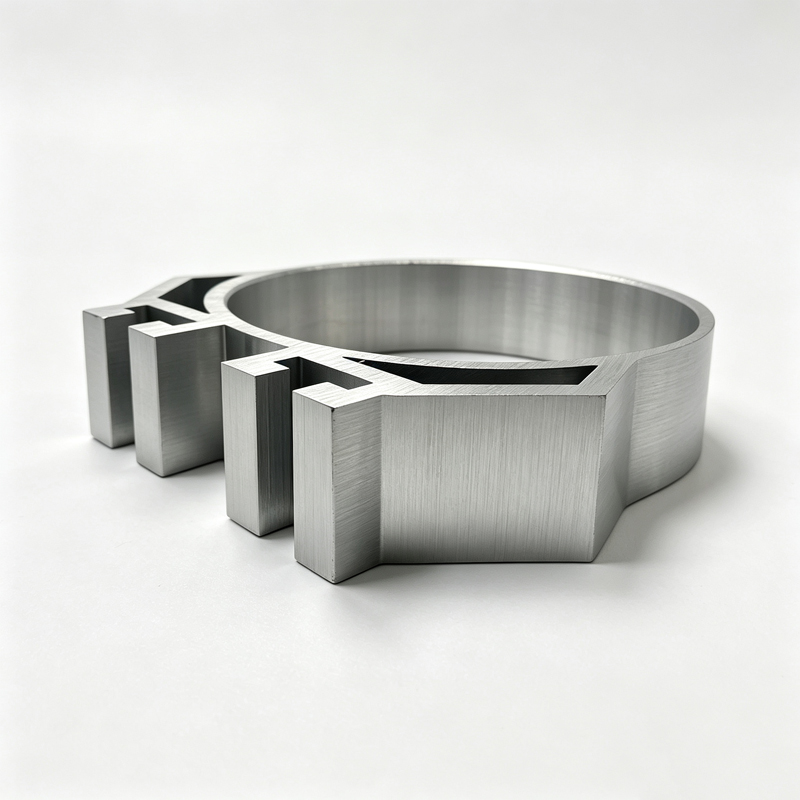
Custom Aluminum Profiles
Medical Equipment Aluminum Profiles - Custom Extrusion
Extruded aluminum profiles for CT, MRI, DR and surgical robots: 6063/6061/5083, key positions ±0.02-0.03 mm, clean-grade anodized finish.
Product Details
Short answer: a medical equipment profile has to do three things that industrial profiles do not: hold an imaging chain in alignment, survive being wiped down with aggressive chemistry every shift, and be documentable. We extrude frames, gantry and detector structures in 6063-T5, 6061-T6 and 5083, hold key assembly positions to ±0.02–0.03 mm and flatness to 0.03 mm per 300 mm, and finish in clean-grade anodising with no dye where the surface touches a patient zone. The value on your order is set by your drawing, and we confirm what we can hold before tooling.
What makes a medical profile different
Three requirements separate this work from ordinary equipment frames, and each one removes options rather than adding them.
- Alignment over a long chain. In CT the tube, the detector and the patient axis have to stay in a fixed relationship through a rotating gantry. In DR the detector column and the tube head have to stay square over a 1.5–2 m travel. The error that matters is not the error in one part; it is the sum along the chain, and it grows with every joint you add.
- Cleanability. Hospital surfaces are wiped with alcohol, quaternary ammonium, chlorine-releasing disinfectants and sometimes hydrogen peroxide vapour. An anodised surface handles those well; a powder coat can chalk, and a bare machined edge is a place where residue collects. Radii, drainage and the absence of blind crevices matter more than the alloy.
- Documentation. A medical OEM is audited on its supply chain, so the material certificate, the dimensional report and the traceability have to exist before the parts do. A supplier who can only provide a packing list is a problem the OEM inherits.
Non-magnetic is not the same as non-ferrous
MRI is where aluminium earns its place and where the wrong alloy causes trouble. An MRI suite cannot tolerate ferromagnetic mass anywhere near the bore, and it also cannot tolerate a conductor that will carry eddy currents in a switching gradient field. Aluminium is non-ferromagnetic, which is why MRI frames, patient tables and gradient-coil supports are aluminium rather than steel.
What is less well known is that not every aluminium alloy behaves identically. 6061 contains magnesium and silicon with small amounts of copper and iron; 5083 is a magnesium-manganese alloy with essentially no copper. For a part that sits in the gradient field, 5083 is the safer choice, because it is both more corrosion resistant in a cleaned environment and less prone to the slight paramagnetic response that trace copper produces. Where the part is outside the field envelope, 6061-T6 is fine and gives better strength and machinability.
The same logic kills 7075 for most medical work. It is a copper-bearing alloy: it corrodes readily without coating, it cannot be brought to a clean bright anodised finish, and its strength advantage is rarely needed on a frame that is stiffness-limited. Specifying 7075 on a medical frame usually signals that the drawing was copied from an aerospace part.
Specifications
| Item | Range and note |
|---|---|
| Alloys | 6063-T5 frames and covers, 6061-T6 precision structures, 5083 for MRI-adjacent and corrosion-critical parts |
| Circumscribed circle | Up to 700 mm |
| Key assembly tolerance | ±0.02–0.03 mm on critical positions, per drawing |
| Machined tolerance | ±0.01 mm typical, ±0.005 mm on a five-axis centre |
| Straightness | ≤ 0.2 mm/m standard, 0.1 mm/m on request |
| Flatness | ≤ 0.03 mm per 300 mm on mounting faces |
| Maximum length | 6,500 mm machined |
| Surface, patient zone | Clear anodising 10–15 µm, no dye, sealed; edges broken and de-burred |
| Surface, structure | Anodised, hard anodised, or powder coated in RAL colours |
| Cleaning compatibility | Sealed anodic film withstands alcohol, quaternary ammonium and chlorine-releasing wipes |
| Inspection | CMM dimensional report, material certificate, batch traceability |
| Reference standard | GB/T 6892-2023 high-precision grade; process control aligned to ISO 9001 |
| Trial quantity | From 50 kg for a development build |
| Location | Qingpu, Shanghai — extrusion, machining and anodising in one plant |
Application by application
| Equipment | Typical alloy | What actually governs the design |
|---|---|---|
| CT gantry and slip-ring support | 6061-T6 | Roundness and flatness of the rotating datum; thermal stability through the warm-up cycle |
| MRI frame and patient access structure | 5083 / 6061-T6 | Non-magnetic and eddy-current behaviour; stiffness without mass near the bore |
| DR / CR detector column and tube arm | 6061-T6 | Squareness over full travel; deflection at the detector end |
| Ultrasound cart and probe holders | 6063-T5 | Low mass, cleanable surface, cosmetic finish |
| Surgical robot links and base | 6061-T6 / 6082-T6 | Repeatability; residual stress control; joint bore roundness |
| Monitor and ventilator housings | 6063-T5 | Radii, drainage, no crevices, colour consistency |
| Laboratory analysers | 6063-T5 / 6061-T6 | Chemical resistance, dimensional stability, sample-handling accuracy |
Getting the imaging chain to line up
Alignment is a stack-up problem and it is won at design stage, not at assembly. Three practices make the difference.
First, machine as many features as possible in one setup. Every re-fixturing re-introduces the error the fixture was meant to prevent, and a part that is bored, then flipped, then milled has two datums where the drawing promised one. On a detector arm we will bore the pivot and mill the mounting face from the same setup even if it means a longer cycle, because the alternative is a shim at assembly and a permanent question mark over the machine.
Second, keep the metrology loop in one material or give it a way to float. Aluminium expands at 23.6 µm/m·K against about 12 for steel and 17 for stainless. A 1.5 m column that carries a stainless scale fixed at both ends will move 10 µm per kelvin of mismatch, and a hospital room is not a metrology lab. Fixed at one end, floating at the other, is the standard fix.
Third, allow the frame to settle. A welded or heavily machined frame relaxes for days after it is made. For the tightest instruments we recommend rough machining, a pause, then finish machining — a routine that costs a few days and saves a re-calibration in the field.
Clean-grade finishing, and where it goes wrong
Anodising is the right finish for a medical surface: it is hard, it does not chip like paint, it can be wiped repeatedly, and it is integral to the metal rather than a film sitting on top. Two details decide whether it is actually clean-grade.
The dye is the first. Coloured anodic films are porous and dyed before sealing, and some organic dyes are not intended for skin contact. On a part in the patient zone — a table edge, an armrest, a control housing — specify clear anodising and no dye. Colour belongs on the structure, not on the touch surface.
The second is geometry. A sealed film over a sharp edge is a thin film over a stress concentration: it cracks first at the corner and that crack is where corrosion starts and where a wipe cannot reach. Every external edge should carry a 0.5 mm radius minimum, and every internal corner more. This is a drawing change that costs nothing and eliminates a whole class of complaints.
The third is the machined face after coating. If a bore is reamed to size after anodising, the bare aluminium exposed inside it is unprotected. On a medical device that is usually acceptable if the bore is a dry fit, and not acceptable if it sits in a wash-down path. Mark which is which and we will mask accordingly.
Where it does not fit
- Sterile or implant-contact parts. Those are titanium or medical-grade polymer; an extruded aluminium frame is not in that conversation.
- Parts that must be autoclaved repeatedly at 134 °C in saturated steam. The anodic film survives, the temper does not, and a sealed hollow section will collect condensate unless it is vented.
- Radiation shielding. Aluminium is transparent to X-rays, which is an advantage for a detector window and useless for shielding; that is lead or tungsten.
- Wear surfaces under continuous sliding load. Anodising gives 200–300 HV, a linear rail gives far more, and a medical slide should use a rail.
- Very low volume with no repeat build. A die is justified by a product family; a one-off instrument prototype is usually machined from plate.
What to send for a quote
- The assembly drawing and the stack-up that has to close, not only the individual part
- Which positions are critical and what the allowed error is at the end of the chain
- The alloy, or the field environment if the part sits near an MRI bore, since that decides 5083 versus 6061
- The cleaning chemistry the device will see, so the finish can be checked against it
- Whether the part is in the patient zone, which decides clear versus coloured anodising
- The documentation you need: material certificate, dimensional report, batch traceability, or a full PPAP-style package
- Volume, and whether the device family will use several lengths from one section
- The surface finish and colour, with a physical sample if colour match matters
FAQ
What tolerance can you hold on a medical frame?
Reference ±0.02–0.03 mm on key assembly positions, flatness of 0.03 mm per 300 mm and straightness of 0.2 mm/m, with ±0.005 mm on features finished on a five-axis centre. The value on your order is set by your drawing, and we state in writing what we can confirm for your part before production. On an imaging chain, tell us the error allowed at the end of the stack and we will apportion it across the parts rather than holding every dimension equally tight.
Which alloy should I use near an MRI?
5083 for anything inside the field envelope, because it carries no copper and is non-ferromagnetic. 6061-T6 is workable for structures outside the field and gives better strength and machinability. Avoid 7075 anywhere in the device: it is copper-bearing, it corrodes without coating and it cannot be finished to a clean bright anodised surface. Steel fasteners near the bore are the more common mistake — check them too.
Will the anodised surface survive hospital disinfectants?
A sealed anodic film handles alcohol, quaternary ammonium compounds and chlorine-releasing wipes well, which is why it is the standard finish on medical frames. What it does not like is an unsealed film, a dyed film on a patient-contact surface, or a sharp edge where the film is thin. Specify sealed, specify clear where skin contact occurs, and radius the edges; those three choices cover most of the risk.
Can you supply the documentation a medical OEM needs?
Material certificates, dimensional reports and batch traceability come as standard on this work, and we can hold a first-article package against your drawing. What we do not do is claim a medical device certification we do not hold — we are a component supplier, and the device qualification sits with you and your quality system. Say what your audit needs and we will tell you honestly whether we can produce it.
Do you make welded medical frames?
Only when there is no alternative, and never on a part where alignment matters most. Welding 6xxx loses most of the temper in the heat-affected zone and puts 200–300 °C into a material with three times the expansion of steel. A bolted frame with machined datums is more accurate and can be re-squared after shipping. Where a weld is required for sealing or enclosure integrity, it is done before final machining and the critical faces are cut afterwards.
What is the smallest quantity that makes sense?
A development build from 50 kg, which is enough to machine and validate a real frame. Below that, a profile machined from stock tube or plate will be faster and cheaper, and we will say so rather than sell a die. Medical products usually move from prototype to a stable design within a few builds, and the die is worth cutting at the point where the section stops changing.
Send your drawing
Email linjunbing@truetrustlv.com with the part drawing, the assembly stack-up and the cleaning chemistry the device will see. If the section is not settled, send the envelope and the alignment you need to hold, and we will propose a section and a machining sequence rather than quote a shape that will not close. You will get a section proposal, a finish recommendation and a price — reviewed by an engineer.
WhatsApp: +86 136 6644 0600
GET A QUOTE
Once you have submitted your requirements, we will contact you as soon as possible regarding your product inquiry.:Medical Equipment Aluminum Profiles - Custom Extrusion