
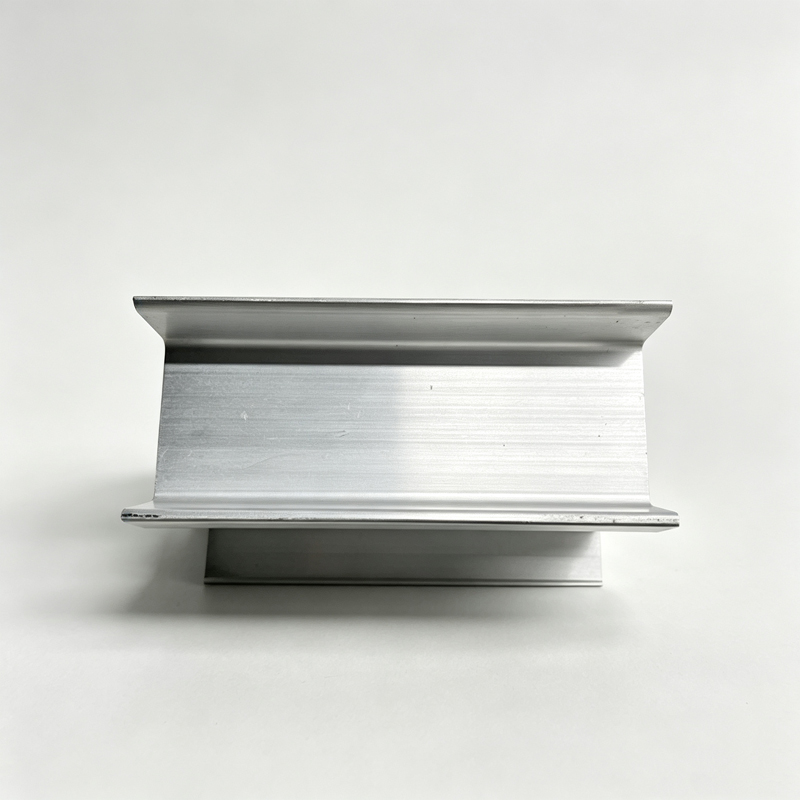
Custom Aluminum Profiles
Automation Equipment Frame Aluminum Profiles - Custom Extrusion
Custom extruded aluminum frames for automation equipment: 6063-T5, 6061-T6, 6005A. Section ±0.02-0.04 mm, machined to ±0.01 mm, anodized.
Product Details
Short answer: an automated equipment frame is a metrology part wearing the clothes of a structure. What decides whether your machine holds tolerance is not yield strength but deflection and thermal growth, and both are set by geometry and alloy modulus, not by temper. We extrude frame sections on 600–12,500 t presses up to a 700 mm circumscribed circle, in 6063-T5, 6061-T6, 6005A-T6 or 7075-T6, hold ±0.02–0.04 mm on the extruded section and ±0.01 mm on machined features, and confirm the achievable value against your drawing before the die is cut.
What the frame actually has to do
A machine frame has one job that matters: keep two points in the same relative position while a load pushes on them. Every other requirement — appearance, cable routing, guarding — is secondary. That reframing matters because it changes which number you optimise. A frame does not fail by yielding; it fails by moving. A gantry that sags 0.15 mm under cutting load has lost its tolerance long before any part of it is close to its yield point.
For a beam under uniform load, deflection goes as the fourth power of span:
δ = 5wL4 / (384EI)
Read that again as a purchasing decision. Double the span and deflection rises sixteen times. Double the depth of the section and it falls eight times. Halve the wall thickness and it roughly doubles. So when a frame is not stiff enough, the fix is almost never "thicker material" — it is a deeper section, a shorter span, or an extra support. Buying thicker walls to solve a stiffness problem is the most common and most expensive mistake in frame design.
The one thing temper does not change
Young's modulus of every 6xxx and 7xxx alloy sits at about 69 GPa. T5, T6, T651 — it does not move more than a percent or two. Heat treatment raises yield strength and hardness, which decides whether the frame survives a crash or a bolt pulled too hard, but it does not make the frame one bit stiffer.
This is worth stating plainly because drawings frequently specify 7075-T6 for a frame that is failing on deflection. 7075-T6 gives roughly 500 MPa yield against 240 MPa for 6061-T6, and identical stiffness. If the problem is sag, 7075 buys nothing and costs a great deal: it extrudes poorly, cannot be press-quenched to a usable temper, welds badly and cannot be brought to a bright anodised finish. Stiffness problems get solved with geometry. Strength problems are where alloy selection earns its money.
Specifications
| Item | Range and note |
|---|---|
| Alloys | 6063-T5, 6061-T6, 6005A-T6, 7075-T6; 6063 for long straight runs, 6061 where strength governs |
| Presses | 600–12,500 t, up to a 700 mm circumscribed circle |
| Wall thickness | 0.6–50 mm depending on section, alloy and circumscribed circle |
| Extruded dimensional tolerance | ±0.02–0.04 mm on critical dimensions, per drawing |
| Machined tolerance | ±0.01 mm typical, ±0.005 mm on a five-axis centre where the feature allows |
| Straightness | 0.2 mm/m as standard, 0.1 mm/m on request for long beds |
| Twist | Controlled by die bearing balance and by stretching after quench |
| Maximum machined length | 6,500 mm |
| Surface | Anodised 10–15 µm, hard anodised, powder coated, or left mill finish |
| Reference standard | GB/T 6892-2023, high-precision grade; ISO 9001 process control |
| Tooling | H13 hot-work die steel, nitrided; die life ≥ 50,000 press cycles |
| Trial quantity | From 50 kg for a development build |
| Location | Qingpu, Shanghai; extrusion, machining, anodising and assembly under one roof |
Choosing the section: where the material goes
Stiffness per kilogram is a geometry question, and the answer is always the same: get material away from the neutral axis. A 40 × 80 section used with its 80 mm face in the bending plane is roughly four times stiffer in that direction than the same section turned 90°, at identical mass and identical cost. Frames that vibrate or deflect are frequently correct in section and wrong in orientation.
The second lever is the joint. A bolted T-slot corner behaves as a pin unless there is a gusset or an internal connector carrying moment across it. A frame that computes as stiff in the middle and rocks at the corners will still lose the tool position; the corner is where the load path is interrupted, and it is the part of the design most often left to a catalogue bracket.
| Design question | What governs it | What we change at the die |
|---|---|---|
| Gantry sags under cut | Section depth in the bending plane, span | Deeper box, internal rib on the tension and compression faces |
| Frame rings under acceleration | Mass distribution, joint stiffness | Hollow core with ribbed walls; mass kept low and central |
| Cables and pneumatics need routing | Slot geometry | Closed slot with a machined access face, or a twin-slot section |
| Frame ships in pieces | Joint repeatability | Machined datum faces and dowel locations instead of slot-only alignment |
| Frame runs in a temperature swing | 23.6 µm/m·K expansion | Single-material construction, slotted fixings at one end |
| Frame must look finished | Surface | Anodised after machining; die lines kept on a non-visible face |
Where the tolerance actually goes
An extruded frame does not arrive accurate because the die was accurate. It arrives accurate because of the order the operations run in. The sequence we use is: saw cut with a stop, machine the two datum ends square, drill and tap from those datums, then surface treat last. Anodising grows the surface by roughly half the film thickness per face — around 7–8 µm at a 15 µm film — so any bore, slot or face that has to receive a bearing, a dowel or a locating pin is either masked or cut oversize by that allowance. A frame that fits perfectly before anodising and binds afterwards was machined in the wrong order.
The second half of the same problem is internal stress. A profile that is straightened by stretching after the quench is stable; one that is straightened by roller bending carries locked-in stress that releases when a face is milled away. On a long bed, that shows up as a bow of a few tenths after machining. We age after extrusion and, on long or asymmetric sections, machine in two passes so the first pass releases stress and the second cuts to size.
Welded or bolted
Both are correct, for different reasons, and the choice is usually made on the wrong grounds.
A bolted T-slot frame can be disassembled, re-squared on site, extended later and shipped flat. Its weakness is the joint: bolted corners are compliant, so a bolted frame is a good machine base and a poor vibrating structure unless it is triangulated. A welded frame is monolithic and much stiffer at the corners, but welding puts 200–300 °C into a material with an expansion coefficient of 23.6 µm/m·K and a third of the stiffness of steel, and it will move. Distortion is controlled by sequence — balanced, back-step welding, symmetrical passes, rigid fixtures — not by welding more slowly.
The practical rule we give customers: if the frame has to be re-aligned after installation, or will be reconfigured, bolt it. If it carries a spindle or a high-frequency actuator and never comes apart, weld it and then machine the critical faces after welding, not before.
What changes when the frame gets warm
Aluminium expands at 23.6 µm/m·K, roughly twice steel. A 2 m frame that warms by 10 K grows 0.47 mm. If that frame carries a linear encoder scale mounted on steel and a carriage mounted on aluminium, the mismatch is 0.23 mm over the same length — an order of magnitude more than the machining tolerance you paid for. Two fixes work: keep the metrology loop in one material, or mount the scale with a compensation that lets it float. A third, cheaper fix is to control the room, which is why machine frames that must hold microns live in temperature-controlled cells rather than being built from more expensive alloy.
Where it does not fit
- A frame that must hold sub-micron geometry over a 1 m envelope. Cast iron, granite or a welded stress-relieved steel structure will do it at lower cost per unit of stiffness; aluminium's modulus is simply too low.
- A frame inside an oven or a curing tunnel above roughly 150 °C. The temper starts to overage and the frame loses the strength you specified.
- A frame that sees continuous impact, such as a drop-test rig or a scrap-handling station. Extruded aluminium is stiff but not tough; a steel weldment absorbs that energy better.
- A frame that has to conduct heat away from a hot process. Aluminium will do it well, but a dedicated heat sink section will do it better than a structural frame with fins bolted on.
- A one-off frame with no repeat need. Cutting a die for a single unit rarely pays; a bolted frame from stock sections will be cheaper, and just as accurate if it is machined on the datums.
What to send for a quote
- The frame assembly drawing, or at minimum the section drawing with the critical dimensions marked
- The load the frame carries and where it acts, so the section can be checked on deflection rather than guessed
- The alloy and temper, or the duty the frame sees, if the alloy is still open
- The tolerance that matters and on which features — "±0.02 mm everywhere" is not a specification, it is a cost
- Whether the frame ships assembled or flat, which decides the joint design
- The surface finish and colour, and any face that must stay bare for electrical contact or a ground path
- The ambient temperature range if the frame is going into a cell, a cleanroom or an outdoor enclosure
- Volume and repeat frequency, since a section that will be re-ordered justifies a better die than a one-off
Send a photograph of a frame you already build and are unhappy with, and say what it does wrong. That single sentence usually tells us more than a page of specification.
FAQ
What tolerance can you hold on a frame section?
Reference ±0.02–0.04 mm on critical extruded dimensions and ±0.01 mm on machined features, with ±0.005 mm available on a five-axis centre where the geometry allows. The value on your order is set by your drawing, and we state in writing what we can confirm for your section before the die is cut. Where a callout cannot be met — typically a thin wall opposite a heavy mass, or a fit that has to survive anodising — we say so at quotation stage rather than shipping a concession.
Does specifying T6 make the frame stiffer?
No. Modulus is a property of the alloy family, not the temper: every 6xxx and 7xxx sits near 69 GPa whether it is T5, T6 or T651. What T6 changes is yield strength and hardness. If the frame deflects too much, change the geometry — depth, span, rib placement. If the frame dents, cracks at a bolt hole or needs to survive an overload, then temper is the right lever.
Extruded aluminium frame or a steel weldment?
Steel wins on stiffness per unit of volume and on cost per kilogram at high stiffness: its modulus is about three times higher, so a steel beam of the same depth is three times stiffer. Aluminium wins on mass — a third of the density — on corrosion without coating, on dimensional consistency because it is extruded and machined rather than welded, and on the ability to integrate slots, cable routes and mounting faces into the section itself. For a moving gantry or a robot cell, the mass saving usually dominates. For a fixed bed that never moves, steel is often the better engineering answer and we will say so.
Can the frame be machined after anodising?
It can, but the cut face will be bare metal and will show. The order that works is: machine everything that has a tolerance, mask the fits, anodise, then assemble. If a bore must be reamed to final size after coating, that is possible and normal for bearing seats — the coating is cut back locally and the bore is protected with a sealing washer. Tell us which features are fits and we set the allowance before the parts go to the bath.
How large a frame section can you produce?
Up to a 700 mm circumscribed circle on the 12,500 t press, with lengths to 6,500 mm machined. Beyond that the frame is designed as a bolted or welded assembly of smaller sections, which is usually the better answer anyway: a 700 mm hollow section is expensive to extrude, expensive to straighten and awkward to ship, while four 200 mm sections bolted into a box give the same stiffness with a fraction of the tooling risk.
What does opening a die commit me to?
One tool, charged once, built in H13 nitrided steel with a working life of 50,000 press cycles or more. Trial quantities start at 50 kg for a development build, which is enough to machine and test a real frame rather than a coupon. The die stays with the project for repeat orders, and where the section is likely to evolve we design it so that a wall or a slot can be revised without cutting a completely new die.
Send your drawing
Email linjunbing@truetrustlv.com with the frame or section drawing, the load case and the tolerance that matters. If the section is not settled, send the assembly envelope and the deflection you can tolerate, and we will propose a section rather than quote against a shape that cannot meet it. You will get a section proposal, a tooling position and a quotation reviewed by an engineer.
WhatsApp: +86 136 6644 0600
GET A QUOTE
Once you have submitted your requirements, we will contact you as soon as possible regarding your product inquiry.:Automation Equipment Frame Aluminum Profiles - Custom Extrusion