
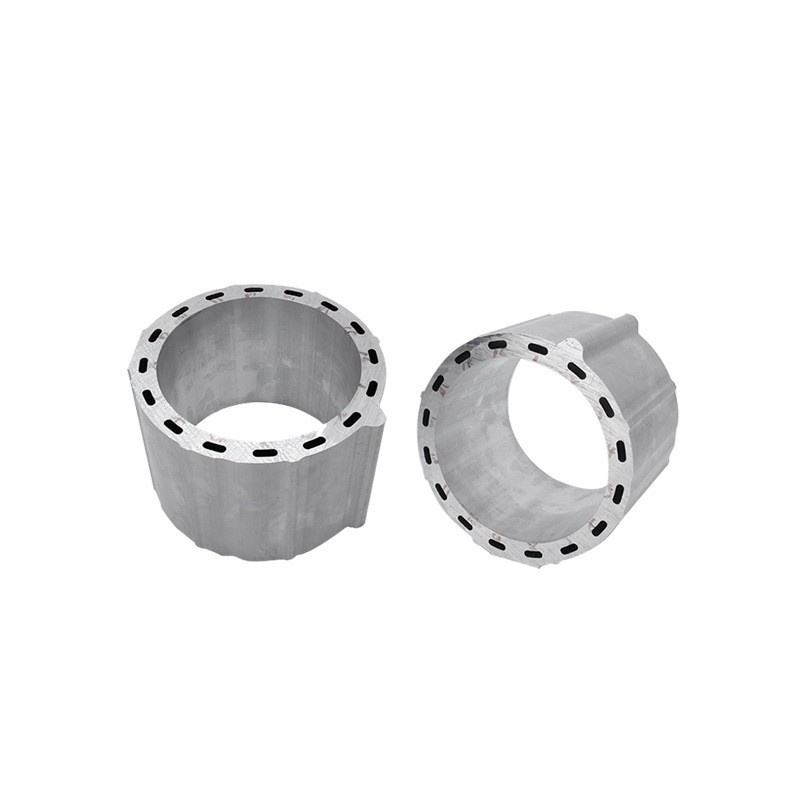
Custom Aluminum Profiles
Motor Housing Aluminum Profile Die - Extruded vs Die Cast
Motor housing dies in 6063/6061/6005: extruded for T6 strength and pressure tightness, bearing bores ±0.03 mm, H13 die, one-setup boring.
Product Details
The decision that matters on a motor housing is not the wall thickness or the fin shape. It is whether the housing is extruded or die cast, and that decision is usually made before anyone talks to a profile supplier. Get it wrong and no amount of die work recovers it: a die-cast housing with porosity cannot be heat treated to T6, and an extruded housing cannot have radial fins.
We open dies for motor housings in 6063-T5, 6061-T6 and 6005-T6, with a circumscribed circle up to 600–700 mm, walls from 1.5 to 20 mm, bearing bores held to a reference ±0.03 mm. This page is about the tooling decision and its economics rather than the housing design itself.
Extrusion or die casting: the real dividing line
Both processes make an aluminium motor housing. They produce different material, and that difference decides which applications each one can serve.
| Property | Extruded housing | Die-cast housing |
|---|---|---|
| Internal soundness | Dense, wrought, no gas porosity | Gas and shrinkage porosity is inherent to the process |
| Heat treatable to T6 | Yes | Generally no: porosity blisters during solution treatment |
| Strength after heat treatment | Yield ~240 MPa in 6061-T6 | Lower, and limited by cast structure |
| Pressure tightness | Good; can be sealed and tested | Requires impregnation for sealing duty |
| Fin geometry | Axial only, straight along the extrusion direction | Radial, curved, and complex fin patterns possible |
| Wall thickness freedom | Uniform along the length by nature | Variable wall and local bosses |
| Feature integration | Limited; machined afterwards | High; bosses, ribs and mounts formed in the die |
| Tooling cost | Lower | Higher, and rises steeply with part size |
| Economic batch | Lower volumes viable | Needs higher volume to amortise the die |
The two rows that decide most projects are the second and fifth. Heat treatment: if the housing has to be strong — a servo motor with high torque density, an EV drive motor, anything where the housing is part of the structural path — extrusion is the only route to a real T6. Fin geometry: if the cooling requirement needs radial or curved fins around a short housing, extrusion cannot form them, because an extruded fin runs the full length in one direction.
So the honest split is: long, uniform housings with axial cooling and a strength requirement go to extrusion. Short, complex housings with radial cooling go to casting, and the strength comes from oversizing rather than from temper.
The fin direction constraint, stated plainly
This point is often missed until the thermal simulation comes back. An extruded fin is a straight prism. It runs from one end of the housing to the other, it has a constant cross-section, and it cannot turn a corner.
That is fine for a motor housing that is cooled by axial airflow or by a jacket along its length. It is not fine for a housing where the heat has to spread radially from a short stator into fins that wrap around it, or where the fin pattern has to follow a complex outer contour.
The usual workaround is a hybrid: an extruded body with the axial fins formed in the die, plus a machined or cast end bell that handles the radial path. That is often cheaper than a fully cast housing and gives better material in the load-bearing body. It does mean two parts and a joint, which is a design decision rather than a manufacturing one.
Bearing bores: one setup, both ends
A motor housing locates two bearings, and the shaft runs between them. The critical dimension is not the bore diameter — that is a straightforward boring operation. It is the coaxiality of the two bores, because any misalignment shows up as vibration, bearing noise and shortened bearing life.
If the two bores are machined in two setups, each carries its own positioning error, and the errors add. A reference ±0.03 mm on each bore can become 0.06 mm of misalignment between them.
The fix is to machine both bores in one setup on a long-bed machine, which is why the capacity to reach 6,500 mm matters even for a housing that is 400 mm long: the machine has to hold the part once and reach both ends without releasing it. It also means the extrusion has to arrive straight and with enough wall stock, because there is no second chance to re-datum.
Related: the end cap mating face. A reference flatness of 0.02 mm on that face is what keeps the end cap square to the bore. If the face is machined in a separate setup from the bore, the squareness error is whatever the fixture allowed, not what the machine can do.
Specifications
| Item | Reference value |
|---|---|
| Applications | Servo, stepper, EV traction, industrial, robot joint, medical, telecom |
| Alloys | 6063-T5 general; 6061-T6 high power and EV; 6005-T6 heavy duty and vibration |
| Maximum circumscribed circle | 600–700 mm |
| Wall thickness range | 1.5–20 mm |
| Bearing bore tolerance | Reference ±0.03 mm |
| General dimensional tolerance | Reference ±0.02 to ±0.04 mm |
| End cap mating face flatness | Reference 0.02 mm |
| CNC machining accuracy | Reference ±0.005 to ±0.01 mm |
| Maximum machined length | 6,500 mm |
| Extrusion press | 600 T to 12,000 T |
| Die material | H13 hot-work die steel, reference life ≥50,000 pieces |
| Surface treatment | Anodising, hard anodising, powder coating, sandblasting, brushing |
| Downstream | CNC milling, boring, drilling and tapping, end face grinding |
| Die lead time | 7–10 days to sample for conventional structures |
| Batch lead time | 10–15 days after sample approval |
| Minimum batch | 50 kg, R&D builds supported |
| Standard | GB/T 6892-2023 high precision, ISO 9001 |
The economics of the die, honestly
A motor housing die is a H13 tool steel die with a reference life of at least 50,000 pieces. That number matters for the cost calculation, because it sets the amortisation: divide the die cost by the pieces you will actually run before the die is worn or the product is superseded, not by the theoretical life.
Three things reduce the effective cost per part:
Running a family on one die body. A range of frame sizes often shares an envelope and differs in bore and length. A common die body with interchangeable details covers the family at less than the cost of separate dies, provided the envelope really is shared.
Volume before variants. Adding a second housing size doubles the die cost and halves the volume per die. If the product line is still expanding, it is often better to launch one size and machine the second from the same extrusion until volume justifies a second die.
Machining stock, not a new die. If a design change only moves a mounting boss or a cable entry, it can be machined rather than re-died. Keep enough wall stock in the envelope to absorb one round of feature changes — that is cheap insurance and it is decided at the die review.
On the die fee itself, terms vary by project and are stated in the quotation: where a programme reaches an agreed production volume, part or all of the die cost can be credited. Ask for that in writing rather than assuming it, and check what the volume threshold is.
Where it does not fit
- The housing needs radial or curved fins. Extrusion forms straight axial fins only. Use casting, or an extruded body plus a separate end bell.
- You need complex internal bosses and mounts formed in one piece. Extrusion cannot form a closed undercut or an internal pocket. Those become machining operations, and if there are many of them a casting may be cheaper overall.
- Your volume is a few hundred pieces a year. A die plus machining setup does not amortise. Machine from tube or standard section, or use an existing near-net shape.
- The housing is short and the design is dominated by features rather than by length. The economic advantage of extrusion comes from uniform cross-section over length. A 60 mm housing with twelve bosses is a casting.
- You need pressure tightness in an as-cast comparison. Extrusion is denser and seals better, but if the housing is a coolant jacket with internal galleries, those galleries cannot be extruded — they have to be machined or the part has to be a different construction.
- The design is not frozen at the bore and the mounting pattern. Those are the two things that must be right in the die. If they are still moving, wait.
What to send for a quote
Send the housing drawing with the bore diameters and their tolerances, the bore-to-bore distance, the mounting pattern, the wall thicknesses, the fin geometry, the alloy and temper, and the annual volume. Tell us whether the housing is in the structural load path, and whether the cooling is axial or radial — those two answers decide the process before anything else does.
We will reply with a die review covering the fin geometry that can be extruded, the walls that will cause flow problems, the bores that can be machined in one setup, and a written statement of the tolerances we can confirm. If casting is the better process for your part, we will say so at that stage rather than quote a die that cannot make it.
FAQ
Why aluminium instead of cast iron for a motor housing?
Weight first: an aluminium housing is roughly a third of the mass of an equivalent iron casting, which matters for a moving axis or a hand-held tool. Second, thermal conductivity is several times higher, so the same fin area removes more heat. Third, it does not rust, which removes a coating step. The trade is that aluminium is softer and its damping is lower, so a housing that has to absorb vibration may need more wall or a different design.
What is the difference between an extruded and a die-cast housing?
Soundness and geometry. Extruded material is wrought and dense, so it can be heat treated to a real T6 and can be made pressure tight. Cast material has inherent porosity, which limits heat treatment and sealing, but it can form radial fins, internal bosses and complex outlines. The choice usually comes down to whether the housing needs strength (extrude) or shape freedom (cast).
What accuracy can you hold on the housing?
Reference: bearing bore ±0.03 mm, general dimensions ±0.02 to ±0.04 mm, end cap mating face flatness 0.02 mm, CNC finishing ±0.005 to ±0.01 mm. These are capability references. The value on your order is set by your drawing, and we confirm in writing which dimensions we can hold — in particular the bore-to-bore coaxiality, which is the one that decides whether the motor runs quietly.
Which alloy should I choose?
6063-T5 for general industrial and stepper motors: it extrudes well, finishes well and is the most economical. 6061-T6 for high-power servos and EV traction, where yield around 240 MPa is needed. 6005-T6 for heavy duty and high-vibration duty, where fatigue resistance matters more than peak strength. The alloy choice follows the load case, not the price list.
What is the die lead time and the minimum batch?
Reference 7–10 days to first sample, 10–15 days for the batch after approval. Minimum batch 50 kg, and R&D quantities are supported. The die cost does not scale with the batch, so cost per piece falls steeply as the batch grows; ask for the crossover volume if you are planning a ramp.
Can the die be changed later if the design moves?
Partly. A bearing adjustment or a bearing-length change is a die modification and is inexpensive. Moving a cavity, adding a rib or changing the envelope is effectively a new die. That is why the wall stock in the envelope matters: leaving 0.5–1 mm of machining stock on the features that might move lets you absorb one design iteration with a machining change instead of a die change.
What post-processing do you do?
CNC milling, boring, drilling and tapping, end face grinding, then anodising, hard anodising, powder coating, sandblasting or brushing. Machining and extrusion are quoted in one tolerance chain so the bore datum is not lost between suppliers — that handover is where most housing accuracy problems actually originate.
Send your drawing
Email the housing drawing, the bore and mounting data, the fin geometry and the annual volume to linjunbing@truetrustlv.com, or send it on WhatsApp at +86 136 6644 0600. You will get a die review that covers what can be extruded, what has to be machined, and the tolerances we can confirm before you commit.
GET A QUOTE
Once you have submitted your requirements, we will contact you as soon as possible regarding your product inquiry.:Motor Housing Aluminum Profile Die - Extruded vs Die Cast