
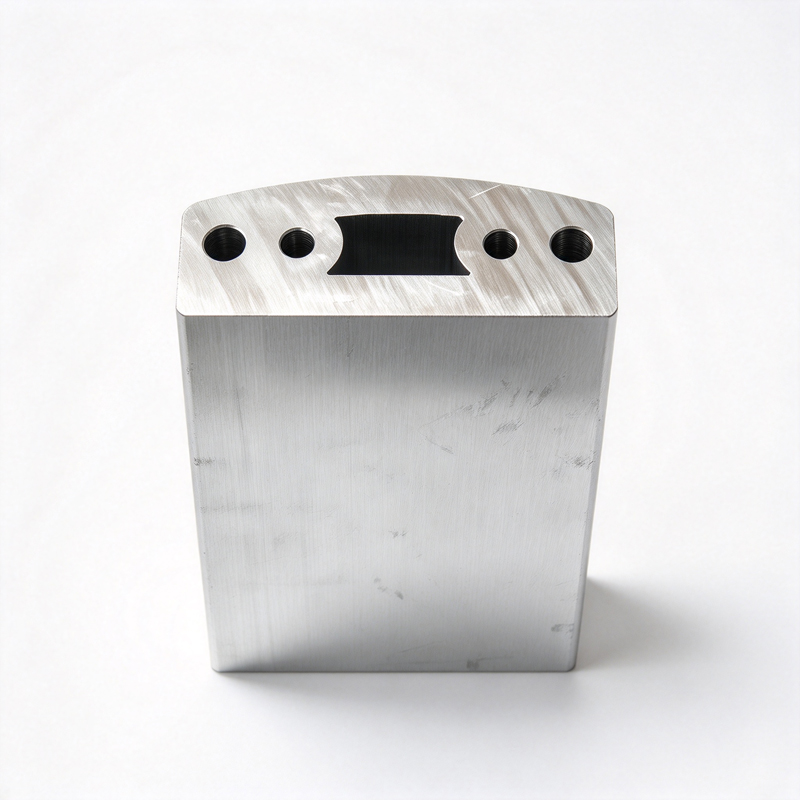
Custom Aluminum Profiles
Ultra-High-Strength Aluminum Profiles - 7075 and 7050 Sections
Ultra-high-strength aluminum sections in 7075-T6, T73 and 7050: yield from 455 MPa, ±0.02-0.03 mm, ultrasonic and penetrant inspected.
Product Details
Short answer: ultra-high-strength aluminium is worth its cost only when the part is genuinely strength-limited and the mass it saves is worth more than the process risk it adds. 7075-T6 gives about 455 MPa yield at a third of steel's density, which beats structural steel on strength-to-weight — but not on stiffness, not on cost, and not on temperature. We extrude and machine these sections up to a 700 mm circumscribed circle at ±0.02–0.03 mm on critical positions, and we will tell you when 6082 or a steel fabrication is the better answer.
Three ways a part can be limited, and only one of them wants this alloy
Before choosing a 7xxx section, identify what actually decides the design. There are three regimes and they respond to completely different things.
- Yield-limited. The part must not permanently deform under peak load. This is the only regime where ultra-high strength pays directly, because yield is the number that changes.
- Stiffness-limited. The part must not deflect too much, or must not buckle, or must hold a natural frequency. Modulus is 69–72 GPa for every aluminium alloy, so strength buys nothing here — geometry does.
- Fatigue-limited. The part sees millions of cycles and must not crack. This is about surface condition, notch geometry and alloy system, and here 2xxx usually beats 7xxx on crack growth while 7075's higher strength gives it a higher notch sensitivity.
Most parts that arrive specified in 7075 turn out to be stiffness-limited. That is not a criticism of the drawing so much as an observation about how specifications travel: a strong alloy gets copied into the next project because it worked in the last one, and nobody re-runs the calculation.
Against steel, honestly
The comparison that matters is not aluminium versus aluminium, it is 7075-T6 against the steel it is meant to replace. On specific strength, aluminium wins clearly: 455 MPa at 2.81 g/cm³ is about 162 kN·m/kg, against roughly 45 for S355 structural steel at 7.85 g/cm³. On specific stiffness, steel wins: 210 GPa at 7.85 is 26.8 MN·m/kg against 25.5 for aluminium. In other words, a steel part and an aluminium part of the same shape and the same mass are almost equally stiff — and the aluminium one is three and a half times stronger.
That asymmetry explains everything about where aluminium is used. If the requirement is "do not break", aluminium wins and the mass saving is real. If the requirement is "do not bend", an aluminium part of the same mass is not stiffer, and matching the steel part's stiffness needs more depth — which is usually available, because aluminium parts are permitted to be bulkier.
Two further points of honesty. Steel is cheaper per kilogram and much cheaper per unit of stiffness. And steel keeps its properties at 300–400 °C where aluminium has long since overaged. A part near an engine, a furnace or a weld is not an aluminium conversation.
Specifications
| Item | Range and note |
|---|---|
| Alloys | 7075-T6 / T73, 7050-T7451, 2024-T351, with 6082-T6 as the practical fallback |
| 7075-T6 | Tensile ≥ 524 MPa, yield ≥ 455 MPa, elongation ≥ 11%, around 150 HB |
| 7075-T73 | Roughly 10% lower yield, markedly better stress-corrosion resistance under sustained load |
| 7050-T7451 | Tensile 500–562 MPa, best combination of strength and corrosion resistance in thick section |
| 2024-T351 | Tensile ≥ 420 MPa, yield ≥ 265 MPa; the fatigue choice, not the strength choice |
| Circumscribed circle | Up to 700 mm |
| Key position tolerance | ±0.02–0.03 mm |
| Machined tolerance | ±0.01 mm typical, ±0.005 mm on a five-axis centre |
| Maximum length | 6,500 mm machined |
| Surface | Hard anodising, chromate conversion, plating, or primer systems |
| Inspection | CMM, ultrasonic, liquid penetrant, hardness and conductivity |
| Reference standard | GB/T 6892-2023 ultra-high-precision grade |
| Trial quantity | From 50 kg for a development build |
Designing a section that uses the strength
A high-strength alloy in a badly proportioned section gives away most of its advantage, because the failure moves from yielding to local buckling. Four rules carry most of the benefit.
Support thin walls. A 2 mm wall in compression at 300 MPa will buckle locally long before it yields. Internal ribs and closed cells raise the local buckling stress far more cheaply than adding wall thickness, and they cost nothing in mass if the material is taken from the wall.
Radius the corners. 7xxx is notch-sensitive, and elongation of 11 percent leaves little room for a stress concentration. Every internal corner should carry a radius, and every change of section a taper.
Watch the fastener holes. A bolt hole removes material exactly where the load is highest. In a high-strength, low-ductility alloy the net-section stress and the bearing stress at the hole become the design case, not the gross section. Thicken locally at the holes, or use more, smaller fasteners.
Do not weld it. This is not a preference. 7xxx is not production-weldable, and the heat-affected zone of a 6xxx weld loses roughly half its strength, so a welded high-strength assembly is a contradiction. Bolt, bond or redesign.
Strength versus toughness, and why T73 exists
7075-T6 is the strongest common temper and the least resistant to stress corrosion cracking. T73 gives up around 10 percent of yield and buys a large improvement in SCC resistance by over-ageing the grain boundaries. For a part under sustained tensile load — a bolted joint, a press fit, a preloaded strut — T73 is usually the right temper and the strength loss is cheap insurance.
The second half of the same issue is direction. A 7xxx extrusion is most susceptible to SCC in the short-transverse direction, which is the direction a bolt preload or an interference fit loads the material. Orient the part so sustained loads run along the extrusion direction, and where they cannot, specify the T73 temper. This is not a theoretical concern: SCC failures happen months after installation, on parts that passed every inspection.
The matching coating decision matters too. An uncoated 7075 part in a humid or chloride-bearing environment will corrode, and the corrosion is pitting that turns into a crack starter under fatigue. Chromate conversion plus a primer, or a hard anodic film, is standard for anything that sees weather.
Where it does not fit
- Any part whose real limit is deflection, buckling or natural frequency. Modulus does not change with temper; a stronger alloy of the same section is exactly as flexible.
- Anything welded. 2xxx and 7xxx are not production-weldable, and the strength advantage disappears at the joint even if a process exists in a laboratory.
- Service above roughly 120–150 °C. The temper overages and you lose the property you paid for.
- Parts that must present a bright uniform anodised finish. Copper-bearing alloys give a dark, patchy film.
- Cost-driven structures at moderate stress. 6082-T6 with a deeper section is cheaper, welds, anodises bright and carries most of the load cases people specify 7075 for.
- Highly dynamic impact loading where ductility matters more than strength. Elongation of 11 percent is not much energy absorption; a 5xxx or a steel part will do better.
What to send for a quote
- The part drawing with the load case, and what the failure mode is allowed to be
- The alloy and temper, or the stress and environment if both are open
- The section drawing with wall thicknesses, rib layout and hole positions
- The environment: humidity, chloride, chemical exposure, and the sustained load if any
- Any heat in the process after extrusion — welding, brazing, cure cycles
- The inspection requirements, since these alloys need ultrasonic and penetrant as well as dimensional checks
- The coating system, and any face that must stay conductive for grounding
- Volume and the number of variants, since one section across a family is what pays for the tooling
FAQ
Is 7075-T6 stronger than steel?
Per unit of weight, yes — about 162 kN·m/kg against roughly 45 for S355 structural steel. Per unit of volume it is not: 455 MPa against 355, and the steel is far more ductile. So a 7075 part can be much lighter for the same load, but a steel part of the same size is stronger and much cheaper. Whether the swap makes sense depends on whether mass is worth money in your application.
Will a stronger alloy make my part stiffer?
No. Modulus is 69–72 GPa for all aluminium alloys regardless of temper. Going from 6061-T6 to 7075-T6 raises yield from about 240 to about 455 MPa and changes deflection not at all. If the part sags or rings, the fix is geometry — depth, ribs, span — not alloy.
Should I specify T6 or T73?
T73 if the part carries a sustained tensile load in a humid or marine environment, or if a bolt preload or an interference fit loads the material across its thickness. You give up about 10 percent of yield and gain a large improvement in stress-corrosion resistance. For intermittent loads in a dry plant, T6 is fine and the extra strength is real.
What tolerance can you hold on these sections?
Reference ±0.02–0.03 mm on critical positions and ±0.01 mm on machined features. The value on your order is set by your drawing, and we confirm it before tooling. On high-strength alloys the practical constraint is stability rather than machine capability: a part machined from a stressed blank will move, so the quench, straighten, stress-relieve and machine sequence has to be agreed as part of the tolerance.
Can it be welded or repaired?
Not in production. 7xxx and 2xxx are effectively unweldable because the alloy system that gives them strength does not survive fusion, and the heat-affected zone would lose most of its properties even if a sound weld could be made. If an assembly needs a weld, it is a 6xxx assembly. Repairs are limited to mechanical methods.
Do I need special inspection?
Yes, beyond dimensional. Ultrasonic for internal soundness, liquid penetrant for surface-breaking cracks at fillets, and a hardness or conductivity check as evidence that the temper is what the certificate says. A CMM report proves the shape and says nothing about whether a quench crack is waiting. Tell us which standard you inspect to and it is quoted in.
Send your drawing
Email linjunbing@truetrustlv.com with the part drawing, the load case and the environment. If the alloy is still open, send what the part must survive and we will name the cheapest alloy that does it — including 6082 or a steel fabrication when that is the honest answer. You will get a section proposal, a temper and coating recommendation, and a price — reviewed by an engineer.
WhatsApp: +86 136 6644 0600
GET A QUOTE
Once you have submitted your requirements, we will contact you as soon as possible regarding your product inquiry.:Ultra-High-Strength Aluminum Profiles - 7075 and 7050 Sections