
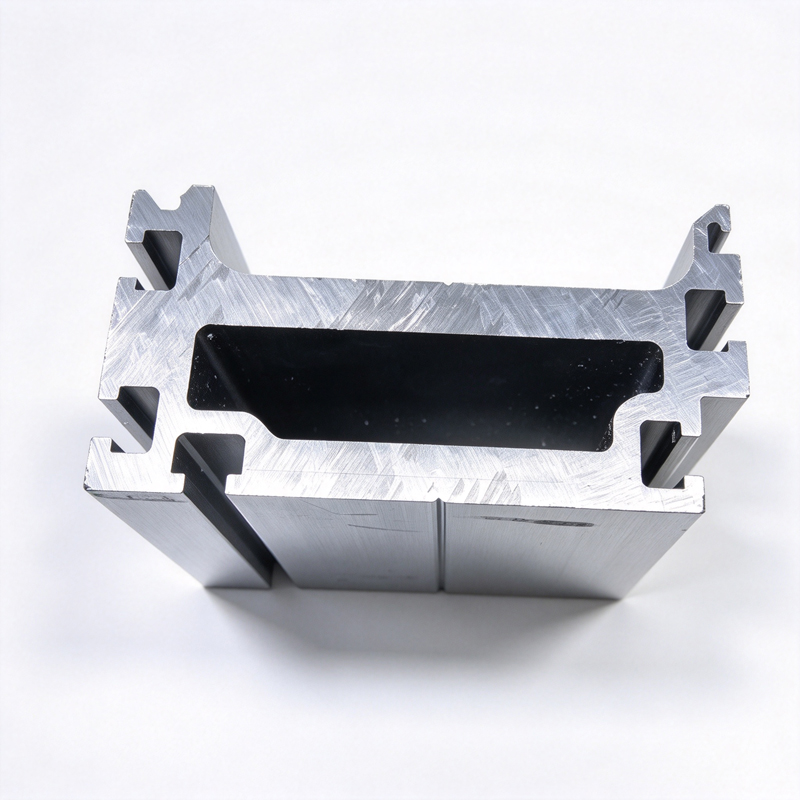
Custom Aluminum Profiles
Warehouse Equipment Aluminum Profiles - Stacker Mast and Rail
Extruded profiles for stacker masts, shuttle rails and shelf columns: 6061/6005A/6082, straightness 0.2 mm/m, integrated guide and rack slots.
Product Details
Short answer: warehouse equipment is tall, slender and repetitive, so the profile has to be straight over its whole length rather than accurate in one spot, and it has to carry a rack, a guide and a cable run in one part. We extrude stacker masts, shuttle rails and shelf columns from 6061-T6, 6005A-T6, 6082-T6 and 6063-T5, up to a 700 mm circumscribed circle, with straightness at 0.2 mm/m and integrated guide slots, wiring cavities and mounting points. The value on your order is set by your drawing, and we confirm the achievable straightness before tooling.
A stacker mast is a column, not a beam
The mistake that shows up most often in warehouse drawings is treating the mast as a beam and checking its bending strength. A stacker mast is a slender column in compression with a moving load at the top, and it fails in three ways that a strength check does not catch.
- Buckling. The critical load falls with the square of the effective length. Double the height and the buckling capacity drops by four, whatever the alloy. This is a stiffness problem, and no amount of extra yield strength fixes it.
- Sway. The mast has to be stiff enough that the carriage does not oscillate when the machine stops. Sway frequency depends on stiffness and on the mass at the top — the carriage, the load and the mast's own upper section — and a mast that sways at 2 Hz will limit the machine's cycle time regardless of how fast the drives are.
- Straightness amplification. An initial bow is not just a cosmetic defect in a column; it is an eccentricity, and an eccentric compressive load produces additional bending moment. A 3 mm bow in a 12 m mast produces a moment the designer did not put in the calculation, and the machine's positioning accuracy at the top degrades with height for the same reason.
That is why the straightness callout on this work is tighter than on a general structural profile, and why it is specified over the full length rather than per metre.
Why one piece, and what to do when it cannot be
A joint in a mast is a stiffness discontinuity and a permanent source of sway and misalignment. Where the height allows, the mast should be one extrusion, cut to length, with the guide faces machined after cutting so the datum runs the whole way.
When the height exceeds what can be transported or machined as one piece, the joint has to be designed rather than improvised: a machined end face, a dowel for location, a splice that is stiffer than the parent section, and alignment checked against a straight edge across the running face. A butt joint held by bolts in slotted holes will move, and at the top of a 12 m mast that movement is amplified.
The same logic applies to the shuttle rail and the shelf column, at smaller scale: fewer pieces and better joints beat tighter tolerances on individual pieces.
Specifications
| Item | Range and note |
|---|---|
| Alloys | 6061-T6 stacker masts and AGV frames, 6005A-T6 heavy shelf columns, 6082-T6 high-load masts, 6063-T5 beams and conveyor |
| Circumscribed circle | Up to 700 mm; mast sections commonly 150–400 mm |
| Straightness | ≤ 0.2 mm/m, checked over the full length |
| Twist | Controlled by die balance and post-quench stretching; specified separately where it matters |
| Section tolerance | ±0.02–0.04 mm on critical dimensions |
| Machined tolerance | ±0.01 mm typical, ±0.005 mm on a five-axis centre |
| Maximum length | 6,500 mm machined and inspected as one piece |
| Integrated features | Guide slot, rack channel, wiring cavity, mounting T-slot, connection points, cable entry |
| Surface | Anodised 10–15 µm, hard anodised on guide faces, powder coated |
| Inspection | CMM report including straightness over full length; material certificate per batch |
| Reference standard | GB/T 6892-2023 high-precision grade |
| Trial quantity | From 50 kg for a development build |
| Location | Qingpu, Shanghai |
Component by component
| Component | Typical alloy | What governs the section |
|---|---|---|
| Stacker mast / column | 6061-T6 / 6082-T6 | Buckling and sway stiffness; full-length straightness; guide face parallelism |
| Top rail and sky rail | 6005A-T6 / 6061-T6 | Span deflection, straightness, wind load on an outdoor rail |
| Shuttle / mother-car guide rail | 6063-T5 / 6061-T6 | Wear face hardness, low friction, straightness over the run |
| High-bay shelf column | 6005A-T6 / 6082-T6 | Compression capacity, fatigue from repeated pallet impacts, splice design |
| Shelf beam and connector | 6063-T5 | Deflection under load, hook geometry, ease of assembly |
| AGV / RGV track frame | 6061-T6 | Flatness, wear resistance, integrated guidance |
| Conveyor side profile | 6063-T5 | Integrated mounting slots, low mass, smooth surfaces |
Integration is where the accuracy comes from
A stacker crane's positioning accuracy at the top depends on the sum of every interface between the drive and the carriage. Each interface is an error and a compliance. Extruding the guide slot, the rack channel and the mounting faces into one section removes interfaces, and removing interfaces is more effective than tightening any single tolerance.
What is worth putting in the section: the guide slot or rail seat, with a machined reference face; the rack channel, positioned in the same tolerance chain as the guide face; a wiring cavity large enough for the energy chain; and the mounting pattern, so brackets do not need to be drilled and aligned on site. What is not worth it: features that change along the length, which are machined anyway, and slots that will be used once.
The complementary argument is mass. Everything above the base of a mast is mass that the mast has to carry and accelerate, and mass at the top lowers the sway frequency. A well-designed mast section is deep in the bending direction, hollow, and as light as the stiffness allows at the top — which is why taper and wall thinning toward the tip appear in good designs and not in copied ones.
Where a warehouse profile goes wrong
Three failure patterns are common enough to name.
Straightness specified per metre. A mast that is straight within 0.2 mm in any metre but accumulates bow will still put the carriage off position at the top. Specify the full-length value.
Guide face not machined after cutting. If the guide face is the as-extruded surface, its straightness is the extrusion's straightness, and the extrusion has been handled, cut and anodised since it left the press. Machine the running face after cutting, then coat.
Hard anodising the guide face without allowing for growth. A hard film of 40 µm adds about 20 µm per face. On a guide slot that is a fit, that is the difference between sliding and binding. Mask, pre-compensate, or finish after coating.
Where it does not fit
- Masts above the transportable and machinable length where a joint would fall in a high-moment region. A steel fabrication or a truss mast is the better answer there.
- Very high lift with heavy loads, where buckling dominates so completely that a larger steel section is cheaper than a very large aluminium one.
- Racking that has to resist fire for a rated period. Aluminium loses strength quickly above 200 °C; structural steel or a protected section is the correct choice.
- Guide surfaces under high contact stress. A hardened steel rail bolted to an aluminium beam will outlast an anodised aluminium guide face.
- One-off installations. A die is justified by a product family, not by a single aisle.
What to send for a quote
- The section drawing with the guide face, rack channel and mounting pattern dimensioned
- The lift height, the load and the carriage mass, so buckling and sway can be checked
- The straightness you need, over what length, and whether twist is specified
- The guidance method: roller, slide, linear rail, or an integrated slot
- The alloy, or the duty if it is still open
- The surface treatment, and which faces are wear faces
- The maximum transportable length, which sets whether the mast is one piece
- Volume, and whether one section serves several machine sizes — that is what makes the tooling pay
FAQ
What straightness can you hold on a mast?
Reference 0.2 mm/m, checked over the full length and reported as a full-length value rather than a per-metre one. The value on your order is set by your drawing, and we confirm it in writing before tooling. On a mast, ask for the full-length number: a per-metre specification can be met by a profile that will still put the carriage off position at the top.
Why does straightness matter so much in a mast?
Because a column with an initial bow is a column with an eccentric load, and eccentric compression produces additional bending that the design calculation probably did not include. The same bow also multiplies into a positional error at the top of the lift. In a beam, straightness is cosmetic; in a column, it is a load case.
Can the mast be supplied in more than one piece?
Yes, but the joint has to be designed. A machined end face, a dowel for location and a splice stiffer than the parent section, with the alignment checked across the running face. Bolts in slotted holes at a mast joint will allow movement, and at height that movement is amplified. Where the height allows, one piece to 6,500 mm is always better.
Which alloy for a stacker mast?
6061-T6 for most machines, 6082-T6 where the load or the height pushes the buckling calculation. Both are stiffness-equivalent, so the choice between them is about strength at the joints and about how much the section has to resist local bearing. 6005A-T6 is common on high-bay shelf columns where a large section and good extrusion behaviour matter more than peak strength.
Can the guide slot and rack be part of the section?
Yes, and it is the main reason to extrude rather than fabricate. A guide seat and a rack channel produced by the die sit in the same tolerance chain as the section's reference face, so the rack and the guide cannot drift apart. Machining them afterwards adds a second setup, a second fixture and a second error.
Does anodising affect the guide fit?
It does, by roughly half the film thickness per face. A standard 15 µm film adds about 7–8 µm per face, and a hard film of 40 µm adds about 20 µm. On a sliding guide that is significant. Specify which faces are fits and the allowance is built in, masked, or the face is finished after coating.
Send your drawing
Email linjunbing@truetrustlv.com with the section drawing, the lift height and the load. If the section is not settled, send the envelope, the carriage mass and the sway you can tolerate, and we will propose a mast section rather than quote a shape that will buckle or ring. You will get a section proposal, a straightness and coating plan, and a price — reviewed by an engineer.
WhatsApp: +86 136 6644 0600
GET A QUOTE
Once you have submitted your requirements, we will contact you as soon as possible regarding your product inquiry.:Warehouse Equipment Aluminum Profiles - Stacker Mast and Rail