
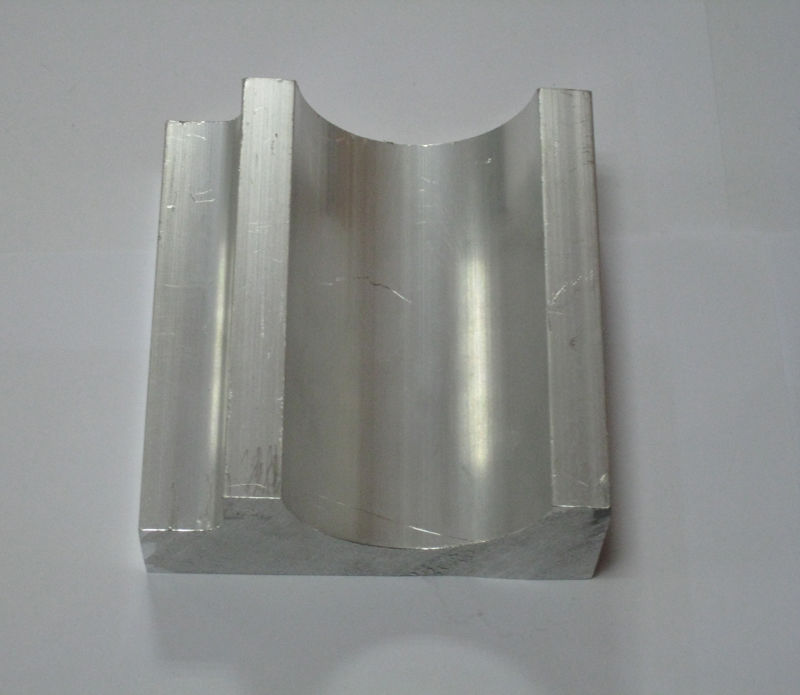
Custom Aluminum Profiles
Special Alloy Aluminum Profile Extrusion - 7075, 2024, 7050
Special alloy aluminum sections in 7075-T6, 2A12 and 7050: ±0.02-0.03 mm on critical positions, ultrasonic and penetrant inspected.
Product Details
Short answer: a special-alloy section is not a 6xxx section in a different metal. 7075, 2A12 and 7050 need more press pressure, run in a narrower temperature window, wear the die faster and cannot be quenched to temper in the press — so the section design rules change, not just the alloy callout. We extrude these alloys up to a 700 mm circumscribed circle with ±0.02–0.03 mm on critical positions, and we will tell you when 6082 would do the same job for less risk. The value on your order is set by your drawing, and we confirm what the alloy can hold before the die is cut.
The pressure budget is what actually limits the section
Extrusion is a pressure process. The press has to push metal through a die, and the pressure required rises with the alloy's flow stress, with the reduction ratio, and sharply with the length of thin wall the metal has to fill. 7075 needs roughly 1.5 to 2 times the pressure of 6063 for the same section, so a shape that runs comfortably on a 2,500 t press in 6063 may need 5,000 t or more in 7075.
That has three practical consequences you can see on a drawing.
- Thin walls get thicker. A 1.0 mm wall that is routine in 6063 is a difficult wall in 7075, and 0.6 mm is out of reach. The minimum wall on a hard alloy is set by the pressure needed to fill it, not by the die's ability to be cut.
- Long thin features are limited. Fins, tongues and slender ribs are pressure-hungry and die-weak at the same time. An aspect ratio that works in 6063 will break the die in 7075.
- Die stress rises. The die carries the same pressure over a smaller safety margin, so bearings wear faster and die life falls. A 6xxx die that lasts 50,000 cycles may be a fraction of that in a hard alloy, and the tooling cost per part rises accordingly.
The window is narrower in both directions
Every alloy has an exit temperature band: below it the metal is too stiff to fill and the surface tears, above it the structure coarsens and the properties you paid for are lost. For 6063 that band is forgiving. For 7075 it is narrow, and the penalties for leaving it are not recoverable by heat treatment afterwards, because the damage is in the metallurgical structure.
Then comes the quench. 6xxx can be press-quenched — cooled by air or water spray as it leaves the die, then aged. Hard alloys often cannot: the quench rate needed at the core of a thick section is higher than a press quench delivers, so the part is solution treated and quenched as a separate operation. That quench distorts the section, the distortion is corrected by stretching or rolling, and the correction leaves residual stress. Every one of those steps is a cost and a source of variation that a 6xxx part does not have.
Specifications
| Item | Range and note |
|---|---|
| Alloys | 7075-T6, 2A12 (2024), 7050, with 6061-T6 and 6082-T6 as the practical alternatives |
| 7075-T6 properties | Tensile ≥ 524 MPa, yield ≥ 455 MPa, elongation ≥ 11%, hardness around 150 HB |
| 7050 properties | Tensile 500–562 MPa, better stress-corrosion and exfoliation resistance than 7075 |
| 2A12 (2024) properties | Tensile ≥ 420 MPa, yield ≥ 265 MPa, around 120 HB, excellent fatigue behaviour |
| Circumscribed circle | Up to 700 mm |
| Key position tolerance | ±0.02–0.03 mm |
| Section tolerance | ±0.02–0.04 mm on critical dimensions |
| Machined tolerance | ±0.01 mm typical, ±0.005 mm on a five-axis centre |
| Maximum length | 6,500 mm machined |
| Presses | 600–12,000 t including partner lines for heavy sections |
| Surface | Anodising, hard anodising, conductive anodising, plating where specified |
| Inspection | CMM report, ultrasonic, liquid penetrant, hardness and conductivity |
| Reference standard | GB/T 6892-2023 ultra-high-precision grade; AMS and GJB documentation can be supported |
| Trial quantity | From 50 kg for a development build |
Which alloy, and what each one costs you
| Alloy | Strength | Choose it when | Accept this |
|---|---|---|---|
| 7075-T6 | Tensile ≥ 524 MPa, yield ≥ 455 MPa | The part is strength-limited and machined from a section, with no welding | Highest extrusion risk, no bright anodise, SCC sensitivity in T6, unweldable |
| 7050-T7451 | Tensile 500–562 MPa | Thick section, sustained load, corrosion resistance matters alongside strength | Cost and availability; tighter process control |
| 2A12 / 2024 | Tensile ≥ 420 MPa, yield ≥ 265 MPa | Fatigue is the design driver — cyclic loading, crack-growth critical | Poor atmospheric corrosion resistance without cladding or coating |
| 6082-T6 | Yield around 260–310 MPa | A 6xxx that extrudes well and gives more strength than 6061 | Less strength than 7xxx; still weldable, still bright-anodisable |
| 6061-T6 | Yield around 240–276 MPa | The requirement is stiffness or corrosion resistance, not strength | Nothing much — it is the honest default |
The substitution question worth asking first
Before a die is cut in 7075, one question is worth asking: is the part actually strength-limited? Modulus is 69–72 GPa for every alloy in the list, so a part that fails on deflection gains nothing from 7075 — it needs a deeper section in 6082, which is cheaper, extrudes better, welds if it has to, and anodises bright.
Where 7075 genuinely earns its place: a fitting or bracket where a bolted joint carries high load in a small envelope; a machined component where the wall cannot be thicker because of the space; a part whose weight is the dominant system cost. In each of those, strength is the binding constraint and the alloy is doing real work.
Where it usually does not: frames, housings, rails, covers, anything welded, anything that must look like bright metal, and anything whose load case is "it must not bend". Those are 6xxx parts that were specified as 7075 because the drawing was copied from an aerospace assembly.
There is a middle path worth knowing about: 6082-T6. It extrudes nearly as freely as 6061, gives 10–25 percent more yield strength, welds and anodises normally, and costs far less than 7xxx. For a large share of parts specified in 7075, 6082 with a slightly deeper section does the job.
Design rules that change with a hard alloy
Four rules, all of which are free at drawing stage and expensive after tooling.
Keep it symmetric. Hard alloys are less forgiving of unbalanced metal flow, and an asymmetric section in 7075 will twist in a way that stretch straightening cannot fully remove.
Keep the wall even. A thick-to-thin transition concentrates both die stress and quench distortion. A gradual taper costs nothing; a step costs straightness.
Radius every internal corner. Hard alloys are more notch-sensitive than 6xxx, and a sharp corner in the die is where the die cracks and where the part cracks in service.
Design for the machining allowance. A quenched and straightened hard-alloy section will not be straight to the tolerance you need; leave 1–2 mm on the faces that will be machined, and plan the sequence of rough, stress-relieve, finish.
Where it does not fit
- Any welded assembly. 2xxx and 7xxx are not production-weldable; if a weld is in the process, the alloy is 6xxx.
- Any part that must show a uniform bright anodised finish. The copper content makes the film dark and patchy.
- Thin-wall sections. Below roughly 1.2–1.5 mm in a hard alloy, the pressure and die life make the part uneconomic — the same function is served by a 6xxx section.
- Marine and wash-down service without a full coating system, particularly for 2024.
- Prototypes and one-offs. Separate solution treat, quench, straighten and stress relief are all setup-dominated; a machined-from-plate part is usually cheaper at low volume.
What to send for a quote
- The part drawing with the alloy and temper, and whether the temper is open to discussion
- The load case, so it is clear whether strength, stiffness or fatigue is binding
- The environment: indoor, marine, chemical, or high humidity, which affects temper choice
- The section drawing with wall thicknesses and radii — this is what decides whether the alloy can run at all
- The inspection requirements: ultrasonic, penetrant, hardness, conductivity, or dimensional only
- Any heat in the process after extrusion: welding, brazing, high-temperature cure
- Which faces will be machined, so allowance and stress relief can be planned
- Volume, and whether the section is likely to change after the first build
FAQ
Why is 7075 harder to extrude than 6063?
Because it needs far more pressure to flow and it has a much narrower temperature window in which it flows without tearing. Add the quench problem — 7075 usually cannot be press-quenched to temper, so it is solution treated and quenched separately, which distorts it — and you have a process with more steps, more scrap risk and a shorter die life. The section design has to account for that, which usually means thicker walls and simpler features.
What tolerance can you hold on a 7075 or 2024 section?
Reference ±0.02–0.03 mm on critical assembly positions and ±0.02–0.04 mm on section dimensions, with machined features at ±0.01 mm. The value on your order is set by your drawing, and we state what we can confirm in writing before tooling. On these alloys the limiting factor is usually part stability rather than machine capability, so the stress-relief sequence has to be agreed as part of the tolerance.
Can I get 7075 anodised to a bright finish?
No. Copper-bearing alloys produce a dark, grey, non-uniform film that cannot be polished back to a bright metallic look. If the appearance is a requirement, the alloy moves to 6061 or 6082. If the strength is a requirement, the finish expectation moves. Resolve that on the drawing — it is not something that can be corrected in the bath.
Is 2A12 the same as 2024?
Effectively yes for engineering purposes: 2A12 is the Chinese designation for the same Al-Cu-Mg family, with closely comparable properties. Its defining characteristic is fatigue performance, which is why it dominates aircraft structure, and its defining weakness is atmospheric corrosion resistance, which is why it is normally clad or coated. It is not weldable in production.
When should I choose 6082 instead?
Whenever the part is stiffness-limited rather than strength-limited, whenever a weld is involved, whenever a bright anodised finish is wanted, or whenever the section has thin walls or long slender features. 6082-T6 gives 10–25 percent more yield than 6061 and extrudes nearly as easily. It covers a large part of the ground that gets specified as 7075 by default.
Do you supply the inspection certificates these alloys need?
We supply the material certificate as standard and can add ultrasonic, liquid penetrant, hardness and conductivity checks. Dimensional inspection alone does not prove a hard-alloy part is sound — a quench crack or a coarse recrystallised band will pass a CMM and fail in service. Tell us which standard you are inspecting to and it is quoted in rather than assumed.
Send your drawing
Email linjunbing@truetrustlv.com with the part drawing, the alloy and the load case. If the alloy is still open, say what the part has to survive and we will name the cheapest alloy that does it — including "6082 will do" when that is the honest answer. You will get a feasibility note on the section, a process plan and a price — reviewed by an engineer.
WhatsApp: +86 136 6644 0600
GET A QUOTE
Once you have submitted your requirements, we will contact you as soon as possible regarding your product inquiry.:Special Alloy Aluminum Profile Extrusion - 7075, 2024, 7050