
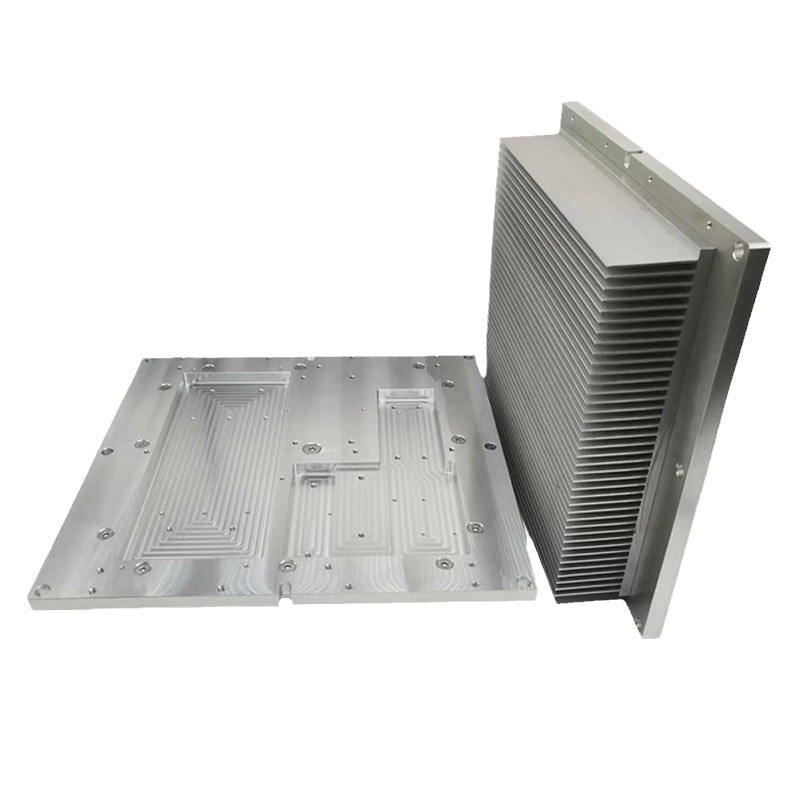
Custom Aluminum Profiles
Liquid Cooling Plate Aluminum Profiles - Extruded Channels
Extruded liquid cold plates with internal channels from 3 mm: 6061-T6 and 3003, flatness 0.03 mm/100 mm, helium leak tested, passivated.
Product Details
Short answer: a liquid cold plate made from an extrusion is a hollow section with internal channels — the die has to hang a mandrel inside the profile and feed metal around it, which sets the minimum channel width at about 3 mm and the wall uniformity at about ±0.1 mm. Everything after that, flatness and leak-tightness, is machining and joining discipline. We extrude 6061-T6 and 3003 sections from 50 to 600 mm wide, hold channel dimensions to ±0.05 mm and base flatness to 0.03 mm per 100 mm. The value on your order is set by your drawing, and we confirm the achievable channel geometry before the die is cut.
Two ways to make a cold plate, and what each one costs
There are two production routes for an aluminium cold plate, and the choice is usually made on unit price when it should be made on channel tolerance and on leak risk.
Skived or machined plate. A solid plate is skived to raise fins, a cover is bonded or welded on, and the channel is formed between them. This is flexible — any channel layout is possible — but the channel is defined by a secondary operation and the joint is a full-perimeter seal. Every millimetre of that seal is a potential leak path.
Extruded hollow section. The channel is part of the extrusion, so it is continuous along the length and its dimensions are set by the die. The number of sealed joints drops to two ends. The channel geometry is limited to what can be drawn along the extrusion direction, which rules out serpentine paths inside a single plank — but a manifold at each end turns parallel channels into a single circuit.
The extruded route wins wherever the thermal design can be met with parallel channels, which covers most inverter, IGBT, server and battery cooling. It loses where the design needs a serpentine path in a small footprint, because that geometry cannot be extruded.
What the die has to do
A hollow section with internal channels is made on a porthole or bridge die. The metal is split into several streams, flows around a mandrel that forms the channel, and re-joins before the exit. Three consequences follow directly from that mechanism, and they set the limits on the drawing.
- The mandrel is a finger of hot steel. It is surrounded by flowing metal at 480–520 °C and it is only supported at one end. Its length-to-width ratio limits how small and how deep a channel can be. Below about 3 mm of channel width, the mandrel is too slender to survive the press and to hold position.
- The weld lines land in the wall. Where the split streams re-join, they form a weld line. It is sound metal joined under pressure, but it is a structural discontinuity and a corrosion consideration, and its position is chosen deliberately — away from the sealing face and away from the highest stress.
- Wall thickness uniformity is a die problem. Getting ±0.1 mm around a channel means balancing the metal feed so the wall does not run thin on one side. A wall that is thin on the base side is a hotspot; a wall that is thin on the channel side is a burst risk.
Specifications
| Item | Range and note |
|---|---|
| Alloys | 6061-T6 for structural and pressure duty, 3003 for corrosion resistance, high-conductivity grades where the thermal path is critical |
| Section width | 50–600 mm |
| Minimum channel width | About 3 mm, limited by mandrel strength |
| Channel layout | Single or multiple parallel channels, manifold at each end; serpentine requires a different route |
| Wall thickness uniformity | ±0.1 mm around a channel |
| Channel dimensional tolerance | ±0.05 mm |
| Mounting datum tolerance | ±0.03 mm |
| Base flatness | ≤ 0.03 mm per 100 mm |
| Overall warpage | ≤ 0.05 mm |
| Joining | Friction stir welding or vacuum brazing for end manifolds; adhesive bonding where pressure is low |
| Leak test | Helium mass spectrometry or pressure decay, at the pressure your specification calls for |
| Internal surface | Passivated or conversion coated; not anodised inside the channel |
| External surface | Hard anodised, conductive anodised, or coated for coolant resistance |
| Machining | Five-axis channel finishing, sealing-face grinding, drilling and tapping, deburring |
| Maximum length | 6,500 mm; plate length cut from the extrusion |
Flatness is a thermal parameter, not a cosmetic one
The base of a cold plate sits on a die or an IGBT module through a thermal interface material. That material is a poor conductor relative to aluminium — a typical gap pad is under 5 W/m·K against 170–200 for the alloy. Its performance depends entirely on how thin the bond line is, and the bond line is set by flatness.
A base that is flat within 0.03 mm per 100 mm with a 50 µm pad gives a bond line of roughly that order. A base that bows 0.15 mm in the middle has a gap in the centre that the pad has to fill, and the thermal resistance there can double. This is why the flatness callout on a cold plate is tighter than on any other extrusion we make, and why it is checked after joining and after coating rather than before.
Two process consequences: the base is machined after the manifold is joined, because joining moves it; and it is stress-relieved before final machining, because a plate that relaxes after grinding will not stay flat in service. Coating adds roughly half the film thickness, so a hard-anodised face is either masked or pre-compensated.
Keeping the coolant inside
Leak-tightness in an extruded plate comes from three things, and none of them is inspection.
The first is that the channel is a continuous extrusion with no seam along its length, which is the structural advantage over a skived-and-bonded plate. The second is the end joint: a manifold welded or brazed to a machined face. That face has to be flat and the weld has to be full penetration, because a partial-penetration weld at a pressurised port is a fatigue crack waiting for a thermal cycle. Friction stir welding is preferred here for the same reason as in battery trays — solid-state, low distortion, no porosity. The third is the internal surface condition: a channel with a burr or a machining chip is a place for debris to collect, and a blocked parallel channel means the flow redistributes and the plate stops doing its job.
Internal passivation matters more than people expect. Aluminium in a water-glycol loop is protected by its own oxide, but a channel with residual machining oil or a chloride-bearing cleaner will pit. Clean, passivate, dry, cap — four steps that cost little and prevent the failure mode that gets blamed on the extrusion.
Coolant, and why the inside of the channel is not anodised
An anodic film is an insulator, and inside a channel it is worse than useless: it is brittle, it can crack under thermal cycling, and a cracked film is a crevice where corrosion concentrates. Internal surfaces are passivated or conversion coated, not anodised. External surfaces can be hard anodised for wear or conductive anodised where a ground path is needed.
Coolant chemistry belongs in the specification too. Deionised water is aggressive to aluminium unless it is inhibited; a water-glycol mix with the correct inhibitor package is the normal choice; and a loop that is topped up with tap water will eventually block a 3 mm channel. If the customer's loop chemistry is not known at design stage, the channel size should carry a margin for fouling.
Where it does not fit
- A serpentine path inside a single plank. Extrusion runs straight; a serpentine needs a machined or skived plate, or a manifold that turns the flow outside the section.
- Channels narrower than about 3 mm. The mandrel cannot be made slender enough to survive the press and hold position.
- Very high internal pressure with thin walls. A cold plate is a cooling component, not a pressure vessel; if the loop can see water hammer, the wall and the joint have to be designed for it explicitly.
- Applications needing a channel that changes cross-section along the length. That is a casting or a machined part.
- Single prototypes where a die cannot be justified. A machined plate will be faster and cheaper for one unit.
What to send for a quote
- The plate drawing with the channel layout, channel width and wall thickness called out
- The heat load in watts, the coolant and the flow rate, so the channel count and width can be checked thermally rather than guessed
- The flatness and the module footprint, since flatness only matters where the die contacts
- The working pressure and the leak-test specification
- The coolant chemistry, which decides the internal surface treatment
- The manifold and port design, and whether they are welded, brazed or bonded
- Which faces need coating and which must stay conductive
- Volume, and whether one section can serve several plate sizes by cutting to length
FAQ
What is the narrowest channel you can extrude?
Reference about 3 mm of channel width, set by the strength of the die mandrel rather than by the aluminium. The value on your order is set by your drawing, and we confirm the achievable geometry in writing before the die is cut. Below 3 mm the mandrel is too slender: it deflects under the metal flow, the channel wanders, and in the worst case it breaks and takes the die with it.
Extruded plate or skived-and-bonded plate?
Extruded if the thermal design can be met with parallel channels, because the channel has no lengthwise seam and the tolerance comes from the die. Skived or machined if the design needs a serpentine path or a channel that changes section along its length. The extruded plate usually wins on leak risk and on channel consistency; the machined plate wins on layout freedom.
Why does base flatness have to be so tight?
Because the thermal interface material is far less conductive than the aluminium, and its resistance is proportional to bond-line thickness. A base that bows 0.1 mm has a gap in the middle that a 50 µm pad cannot close, and the thermal resistance there can double. Flatness on a cold plate is a thermal specification written in millimetres.
How do you guarantee the plate will not leak?
By design rather than by inspection: a continuous extruded channel with no lengthwise seam, a machined face at each port, and a full-penetration friction stir or braze joint. Then a helium mass-spectrometry test on every unit at the pressure your specification states. Inspection catches a process that has already gone wrong; the design is what stops it going wrong.
Can the inside of the channel be anodised for corrosion resistance?
It should not be. An anodic film inside a channel is an insulator that cracks under thermal cycling, and a cracked film is a crevice that concentrates corrosion. Internal surfaces are cleaned and passivated or conversion coated. Corrosion resistance inside the loop comes from the coolant chemistry and from the alloy — 3003 is the choice where the coolant is aggressive.
Which alloy should I specify?
6061-T6 for structural plates and anything under pressure, because it machines well and gives the strength the manifold joint needs. 3003 where corrosion resistance dominates and the pressure is low. A high-conductivity grade where the thermal path through the base is the limiting resistance — but check that first, because on most plates the interface material is a bigger resistance than the alloy.
Send your drawing
Email linjunbing@truetrustlv.com with the plate drawing, the heat load and the coolant. If the channel layout is not settled, send the module footprint and the watts, and we will propose a channel count and width that can actually be extruded rather than quoting a section that cannot be tooled. You will get a section proposal, a joining and leak-test plan, and a price — reviewed by an engineer.
WhatsApp: +86 136 6644 0600
GET A QUOTE
Once you have submitted your requirements, we will contact you as soon as possible regarding your product inquiry.:Liquid Cooling Plate Aluminum Profiles - Extruded Channels