
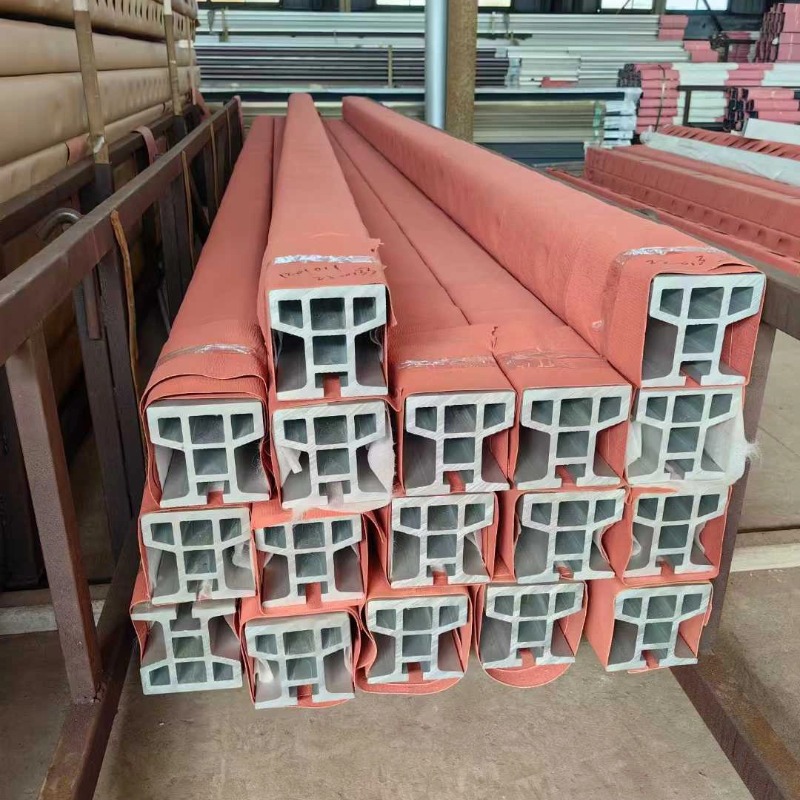
Automated logistics
Light-Load AGV Rail - Fixing and Relocatability
On a 3C line the rail is equipment, not infrastructure. Adhesive fixing without drilling, handling at the quarter points, and joints that re-assemble true.
Product Details
On a 3C production line, the track is not a permanent structure. A phone model changes, an SMT line is rebalanced, a test station moves — and the rail has to come up and go back down somewhere else. That changes what the rail has to be good at. A light-load track that is accurate but cannot be lifted is worse than one that is slightly less accurate and can be re-laid in a shift.
The main light-load rail page deals with the space problem and the low-profile section. This page is about the other half: how the rail is fixed, how it comes apart, and what it costs to put it back.
Why light rails get replaced instead of repaired
A heavy RGV rail is designed for a service life measured in decades and a layout that will not change. A 3C line rail is designed for a product cycle measured in months. When the line changes, three things usually happen at once: the route changes, the vehicle count changes, and the floor layout changes.
That means the rail is bought as equipment, not as infrastructure. It should be possible to dismantle it without cutting, move it without a crane, and re-install it without a surveyor. Any of those three failing turns a two-day changeover into a two-week one, and the cost of the changeover is usually larger than the cost of the rail.
Specifications
| Item | Reference value | Notes |
|---|---|---|
| Alloy and temper | 6063-T5 | Light, stable, adequate for light vehicles |
| Density versus steel | About one third | 2.7 vs 7.8 g/cm³ |
| Straightness | Reference ≤ 1.0 mm over 10 m | Held through handling, not only at machining |
| Machined tolerance | Reference ±0.02 to ±0.04 mm | Guide groove and joint faces |
| Repeat positioning | Reference ±3 mm | System figure, vehicle and encoder included |
| Section types | Straight, light-load curve | Curves supplied as matched segments |
| Surface | Anodised, low friction | Dust and corrosion protection for clean areas |
| Handling | 6 m section liftable by two people | Around 15 to 20 kg depending on section |
Reference values are from shipped sections. The value on your order is set by your drawing, and we confirm the achievable straightness and machined tolerance in writing before you order.
Fixing without damaging the floor
In an SMT or assembly area the floor is usually an epoxy or PU coating over a slab, and the coating is both expensive and part of the contamination control. Drilling through it creates dust, leaves a hole that has to be patched, and every patch is a potential lifting point later.
There are three fixing approaches, each with a different floor consequence:
- Adhesive fixing. The rail is bonded to the floor with a structural adhesive. No holes, no dust, and removal is by controlled heating and peeling rather than by drilling. The limitation is load: an adhesively fixed light rail is fine for a 100 to 300 kg vehicle and not fine for anything heavier.
- Anchored fixing with a setting plate. A small plate is anchored to the slab and the rail bolts to the plate. The floor is drilled once, but the plate stays when the rail moves, and the next rail can reuse it. This is the usual compromise where some load has to be carried.
- Free-standing frame. The rail is carried on a bolted frame that stands on adjustable feet, so the floor only sees distributed bearing pressure. No drilling at all, and the whole assembly can be moved as a unit.
The choice usually comes down to how much load the floor can take at a point without marking. On a coated slab over a thin screed, a point load of a few hundred newtons is enough to leave a permanent depressions, so a free-standing frame with spreader feet is safer than an anchored plate.
Two people, one shift
The handling question is not usually about weight in absolute terms — a 6 m aluminium section weighs 15 to 20 kg, which two people can carry easily. It is about stiffness during handling. A long slender section lifted at the ends will sag in the middle under its own weight, and if it is lifted unevenly it can take a permanent set that shows up as a straightness error after installation.
Two practices make handling safe:
- Lift at the quarter points, not the ends. This reduces the sag by roughly a factor of four compared with lifting at the ends, and keeps the section from taking a set.
- Ship in a carrying frame rather than loose. Sections stacked loose in a truck take a set from whatever is on top of them. A frame that supports at the quarter points costs little and eliminates the problem before it starts.
This is also why we would rather supply a rail in 2 to 3 m modules with positive joints than one 6 m piece where the layout allows it. A shorter module is easier to handle, easier to store, and easier to replace when one part of the line changes.
What modularity actually requires
A rail is modular if the joints can be made and unmade without losing accuracy. That needs three things, and they are all in the detail:
- A repeatable joint. A dowel pair and a machined face. Bolted butt joints with no dowel will re-assemble in a slightly different position each time, and after three moves the line is visibly kinked.
- A joint that does not sit at a support. Standardising on a module length that matches the support pitch means the joints always land on a support, which is where they are least sensitive to re-assembly error.
- Loose cable, not cast-in routing. If the vehicle's power and communication run in a channel inside the rail, changing the layout means changing the rail. If they run in a clip-on duct, the duct moves with the rail and the rail can be re-cut.
None of these is expensive, but all of them have to be decided when the section is designed. A rail that was not designed for re-assembly is a rail that gets thrown away when the line changes.
What happens to accuracy after a move
Repeated re-installation degrades accuracy, and it is worth knowing where. The rail itself does not change if it is handled properly. What changes is the relationship between the rail and the floor — the datum is lost.
On the first installation the line is set against the building or against the equipment. On the second, it is set against whatever marks survived. Within two or three moves, the accumulated position error is typically a few millimetres, which is comparable to the vehicle's own repeat positioning of ±3 mm.
The practical countermeasure is to fix the datum to something that does not move — a machine frame, a column line, or a set of floor inserts that stay in place — and to record the rail's position relative to that datum each time. A layout drawing with a reference point is more valuable than a tighter rail tolerance.
Where it does not fit
Four cases where a light modular rail is the wrong choice. If the vehicle is above about 500 kg, the section needed for stiffness is no longer liftable by two people and the modularity argument disappears — go to a fixed heavy rail. If the line runs continuously for years without change, the modular joint detail is unnecessary cost and a continuous rail is better. If the floor is uneven enough that a free-standing frame cannot be levelled within its adjustment range, the rail has to be grouted and it stops being movable. And if contamination control forbids any adhesive on the floor, the adhesive option is out and the floor has to be drilled or the rail carried on a frame.
What to send for a quote
- The vehicle weight, load and travel speed, and how often the layout is expected to change.
- The floor construction and coating, and whether drilling is permitted.
- The support or frame arrangement, if one already exists, and its adjustment range.
- The route, including whether curves will move with the line or stay fixed.
Send those and we can propose a module length, a joint detail and a fixing method that can be undone, rather than a rail that has to be cut out when the line changes.
FAQ
What straightness and tolerance can you hold?
Reference 1.0 mm over 10 m straightness, ±0.02 to ±0.04 mm on machined features, with the section delivered in a carrying frame so the tolerance survives transport. The ±3 mm repeat positioning figure is a system result including the vehicle. The value on your order is set by your drawing, and we confirm the achievable figures in writing before you order.
Can the rail be fixed with adhesive?
Yes for light vehicles, and it is the cleanest option in a coated floor area. The adhesive has to be a structural type with a defined shear strength, and the floor has to be abraded and primed. Load capacity is the limit — it is not a substitute for anchors on anything heavy.
How many times can a modular rail be re-installed?
The rail itself, many times, provided the joints are dowelled and the sections are handled at the quarter points. What degrades is the position relative to the building, so keep a fixed datum and re-survey against it each time.
Does anodising survive repeated handling?
On the running face, yes. On the ends and edges, the coating will chip where the rail is set down or clamped. That is cosmetic and does not affect the running surface, but it is another reason to ship and handle in a frame.
Why does my rail take a set after moving?
Because it was lifted at the ends or stored with weight on the middle. A long aluminium section sags under its own weight when supported only at the ends, and if the sag exceeds the elastic range at any point it stays. Lift at the quarter points and store on a flat rack.
Can I cut a module on site to fit a layout change?
You can cut it, but a site cut end is not a joint — it has no machined face and no dowel. It will work as a temporary fix and it will not hold accuracy. Order a short module for the change instead.
Next step
Send the vehicle data, the floor type and how often the line is expected to change. We will come back with a module length, a joint detail and a fixing method that can be undone in a shift without damaging the floor.
Email: linjunbing@truetrustlv.com | Call or WhatsApp: +86 136 6644 0600
GET A QUOTE
Once you have submitted your requirements, we will contact you as soon as possible regarding your product inquiry.:Light-Load AGV Rail - Fixing and Relocatability