
Automated logistics
Overhead Suspended Rail - Hangers and Building Interface
A suspended rail is bought as a track and installed as a structural connection. Hanger reactions, sway above 1 m, and why only one point should be fixed.
Product Details
An overhead rail is usually bought as a track and installed as a structural connection. Those are two different problems, and the second one is the one that fails. The rail can be perfect and still be unusable because the ceiling it hangs from cannot take the point loads, or because the hangers are so long that the whole run sways.
The main overhead rail page covers the section and its stiffness. This page is about the connection to the building: what the hangers deliver to the structure, how long they can be before sway becomes the controlling problem, and how a suspended run deals with thermal movement.
What the rail hands to the building
A suspended track does not carry its load to a foundation. It collects the trolley load at the running flange, spreads it along the rail to the hanger points, and hands each hanger a concentrated vertical reaction plus a horizontal component every time the trolley accelerates or the load swings.
For a 500 kg trolley load on a rail with hangers at 2 m pitch, the static reaction per hanger is a little over 2.5 kN once the rail's own weight is included. Apply a dynamic factor for hoisting and travel — typically 1.3 to 1.5 — and the design reaction is around 3.5 to 4 kN. That number has to be checkable against the structure above, and it is the number a rail supplier should be able to give before the building works are finished.
Where this goes wrong is when the rail is priced per metre and the reaction is never calculated. The rail arrives, the installer picks the nearest purlin, and the load lands on a member designed for roof sheet and wind. Nothing fails immediately. It shows up as a sagging line, a cracked weld at a purlin, or a trolley that runs uphill towards mid-span.
Specifications
| Item | Reference value | Notes |
|---|---|---|
| Alloy and temper | 6063-T5 or 6061-T6 | 6061-T6 for long hanger spans or heavy trolleys |
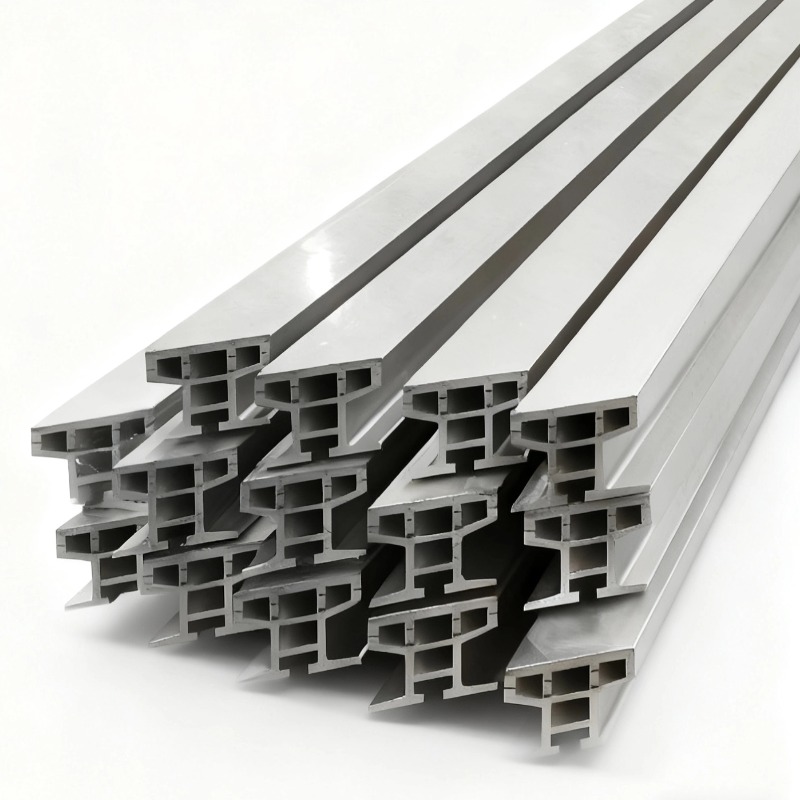
| Section families | I-section, top-hat, custom | Top-hat (Wang-shaped) gives a closed top for hanger fixing |
| Straightness | Reference ≤ 1.0 mm over 10 m | Measured on the running face |
| Machined tolerance | Reference ±0.02 to ±0.04 mm | Mounting faces, slots, joint interfaces |
| Weight range | 0.05–100 kg/m | Across the full section range, not one profile |
| Section envelope | 5–700 mm circumscribed circle | Practical limit of the extrusion presses we run |
| Surface | Anodised | Running face hardness is the functional part |
| Hanger reaction | Calculated per project | Given as a number, not a range, before order |
Reference values above come from shipped work. The value on your order is set by your drawing, and we confirm achievable straightness, tolerance and the hanger reactions in writing before you order.
Hanger spacing is a building question before it is a rail question
The spacing between hangers sets three things at once: the bending moment in the rail, the deflection between supports, and the point load delivered to the structure. Tightening the spacing improves the first two and makes the third worse, because the same total load is now delivered at more points — which is fine on a heavy beam and not fine on thin roof decking.
In practice the spacing is chosen by whichever of these is most restrictive:
- Rail deflection — usually span over 500 for a runway, tighter if the trolley has to position accurately.
- Structure capacity — the reaction per hanger against what the purlin or beam can take, including any existing load.
- Practical fixing — there has to be something to bolt to. A hanger that lands between purlins needs a spreader beam, and a spreader beam needs two fixing points.
A useful discipline is to mark the hanger positions on the layout before the rail drawing is released, and to have the structural engineer sign off those positions. It costs an hour and it prevents the situation where the rail arrives and there is nowhere legal to hang it.
Long hangers and sway
Hangers are usually steel rods or folded channels, and their length is set by how far the rail has to sit below the structure. Short hangers behave as rigid supports. Long ones do not.
A rod hanger has almost no lateral stiffness. A 1.5 m rod swings with a natural period of about 2.4 seconds, which is long enough that a trolley accelerating along the rail, or a load swinging on the hoist, will excite it. The result is a rail that oscillates sideways, a trolley that hunts, and in the worst case a load that contacts adjacent equipment.
There are three ways to control it, and they are usually combined:
- Keep hangers short. Under about 600 mm, sway is not a practical problem. Above 1 m it has to be designed for.
- Add diagonal bracing between hangers, in the plane of the rail and across it, so that the hanger group acts as a truss rather than a set of pendulums.
- Use a frame instead of individual rods where the hanger length exceeds about 1.5 m — a welded goalpost frame gives lateral stiffness that rods cannot.
Seismic and wind-induced building movement fall into the same category. The rail is a mass hung from a structure that moves, and the hangers are the only path for the horizontal force. A rail designed only for vertical load has no answer to a horizontal acceleration of 0.2 g.
A suspended run can absorb its own thermal movement
Aluminium moves about 23.6 µm per metre per kelvin. A 20 m overhead rail therefore changes length by roughly 4.7 mm over a 10 °C swing, and by more than 9 mm over a 20 °C swing in a workshop that is not climate-controlled.
On a floor rail that movement has to be accommodated in sliding joints, because the rail is anchored down. On a suspended rail there is a simpler option: hang the run from hangers that are free to swing slightly, and fix only one point along the length. The rest of the run moves by a fraction of a degree of hanger rotation, which is invisible and costs nothing.
The detail that matters is that only one point should be fixed longitudinally. Two fixed points on a long run put the thermal movement into the rail as compression, and a slender aluminium section in compression over a long length will bow rather than stay straight.
Joints, alignment and the trolley's experience
On a suspended rail the joint is doubly important, because the rail has no floor to hold it in line. A joint that is bolted through the web only will allow the two ends to rotate relative to each other under a passing load, and the trolley will feel a dip at every crossing.
The joints we machine are made with a matching face on both ends, a dowel pair to locate them, and a hanger placed close to the joint so that the joint is not carrying a bending moment. On a long overhead conveyor the joint is the single most common source of noise complaints, and it is entirely a design detail rather than a manufacturing limit.
Where it does not fit
Four situations where an overhead rail is the wrong answer. If the building structure cannot take the hanger reactions at reasonable spacing, a floor-mounted system is cheaper than reinforcing the roof. If the hanger length would exceed about 4 m, the sway and the bracing cost usually outweigh the space saving, and a gantry is the better structure. If the environment has heavy overhead services — large ducts, sprinkler mains, cable trays — the rail will end up fighting for the same space, and the routing becomes the dominant cost. And if the rail has to carry a person-riding trolley or a load above people, the design falls under lifting-equipment rules where an aluminium section is rarely the accepted solution.
What to send for a quote
- The layout in plan with the available support positions marked, and the height from the rail line to the structure.
- The trolley load and whether the load is lifted, traversed, or both.
- The building member the hangers will attach to, and its capacity if that has been assessed.
- Whether the area is climate-controlled, and the temperature range it sees.
With those we can return a hanger layout with the reaction at each point, which is the drawing the structural engineer actually needs.
FAQ
What straightness can you hold on a suspended rail?
Reference 1.0 mm over 10 m on the machined rail, with ±0.02 to ±0.04 mm on mounting faces and slots. On site the installed line is what matters, and the hanger adjustment has more influence on it than the rail's own tolerance. The value on your order is set by your drawing, and we confirm the achievable straightness in writing before you order.
How much load can one hanger take?
That is a building question, not a rail question. We calculate the reaction and give it to you as a number per hanger; whether the member above can take it depends on the structure. As an order of magnitude, most industrial purlins and secondary beams handle 2 to 5 kN at a point without additional strengthening.
Can I hang the rail from a suspended ceiling grid?
No. A ceiling grid carries its own weight and nothing else. Hangers have to reach a structural member, which usually means the rail sits lower than the ceiling and the ceiling is cut around it.
Do I need to fix both ends of the rail?
Fix one point and let the rest float. Fixing both ends of a long run puts thermal movement into the rail as compression and the run will bow. If the layout requires two structural anchor points, put a sliding connection at one of them.
How do I stop the rail swaying when the trolley stops?
Brace the hangers. Diagonal bracing in two planes turns a row of pendulums into a stiff frame, and it is much cheaper than increasing the hanger size. Below 600 mm hanger length it is usually unnecessary.
Can you supply the hangers and bracing too?
We supply the rail, the joint hardware and the machined interfaces. Hanger brackets and bracing are normally made to the site's structural detail, and we will machine the rail's top face to match whatever fixing pattern that detail uses.
Next step
Send the layout with the support positions and the hanger length. We will return the rail section, the hanger spacing and the reaction at each hanger, so the structure can be checked before anything is ordered.
Email: linjunbing@truetrustlv.com | Call or WhatsApp: +86 136 6644 0600
GET A QUOTE
Once you have submitted your requirements, we will contact you as soon as possible regarding your product inquiry.:Overhead Suspended Rail - Hangers and Building Interface