
Automated logistics
Dense-Storage Shuttle Rail
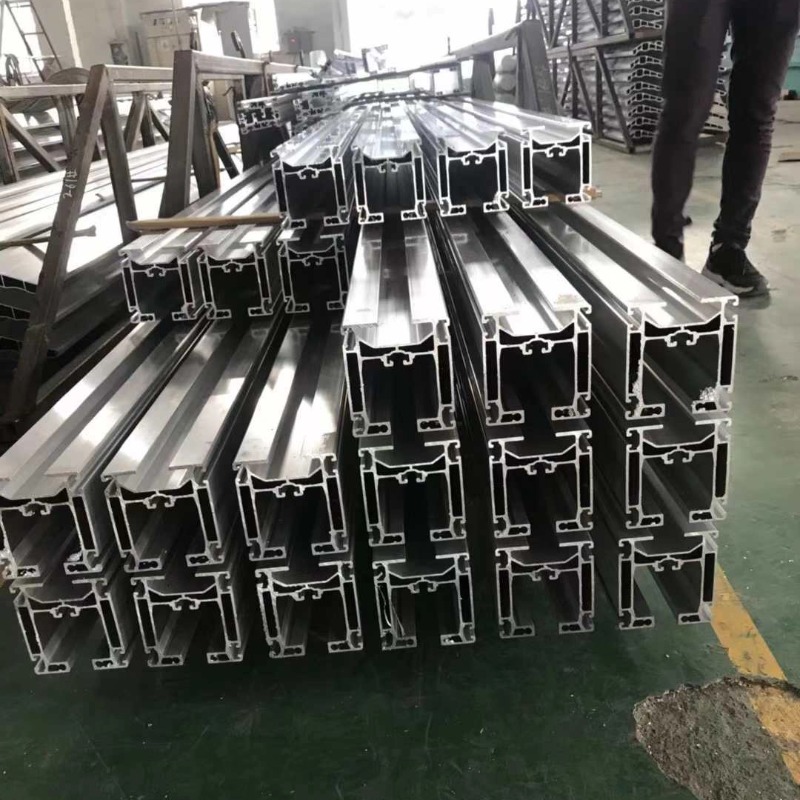
Dense storage shuttle rails, straightness 1.0 mm over 10 m, HV300 hard anodized, 10-2000 kg shuttles, level sets matched. Section per drawing.
Product Details
Short answer: a dense-storage shuttle rail is the track inside a rack level that a shuttle or satellite car runs on to place and retrieve pallets or totes. The distinguishing feature is not one rail but many: a dense store has a rail pair on every level, so what decides the project is consistency between levels rather than the precision of a single piece. Working reference: straightness within 1.0 mm over 10 m, machined features at ±0.02–0.04 mm, running face hard anodized to HV 300 or above, loads from 10 kg to 2000 kg. Section and tolerance are set by your drawing.
What it is used for
It goes into dense pallet and tote storage, shuttle-based racking, satellite and radio-shuttle systems, freezer and cold-chain stores, and high-bay warehouses where the aisle is replaced by a channel of deep pallet positions.
The load range spans 10 kg to 2000 kg because the vehicles do. A tote shuttle carrying small components is at the light end; a pallet satellite moving a tonne in a freezer is at the heavy end. The light end takes 6063-T5 on a compact section; the heavy end needs 6061-T6 and thicker walls.
The layout is what makes this product different from a single track. A 20-level rack needs 20 rail pairs, each one aligned to the same entry point at the aisle face, and each one carrying the same vehicle type. That repetition is the engineering problem.
Specifications
| Item | Working reference | How it is set |
|---|---|---|
| Alloy | 6063-T5 for light shuttles, 6061-T6 for 500–2000 kg | Chosen against your vehicle |
| Straightness | ≤1.0 mm over 10 m | Set by your drawing |
| Machined tolerance | ±0.02–0.04 mm | Set by your drawing |
| Running face hardness | Hard anodized, HV 300 or above | Set by your duty cycle |
| Wear resistance | About three times plain anodizing | Result of the treatment |
| Load range | 10–2000 kg | Set by your vehicle |
| Level tolerance | Consistent across levels, per your rack drawing | Set by your rack and lift interface |
| Machining | Cut, mill, drill, running face finished, deburr | Per your drawing |
How it is made
- The section is extruded in the alloy the vehicle needs, with the running geometry and any guide slot formed in the die.
- Lengths are cut to the channel depth and the ends machined, because the entry end is where the vehicle transitions from the aisle.
- The running face is machined and the rail straightened, then the fixing holes are machined from that same datum.
- Hard anodizing is applied to the running face, with fixing and earthing points masked.
- For a multi-level project, rails are produced in level sets and dimensionally grouped, so that a set installed on level 12 matches the set on level 1.
Where this fits
It fits when the store is deep rather than wide, when the aisle has been replaced by a channel, when the vehicle runs inside the rack, and when the number of levels makes consistency a production requirement rather than a nicety.
Where it does not fit: if the store is a conventional aisle served by a stacker, the correct product is a floor rail rather than a shuttle rail. If there is only one or two levels, the shuttle system rarely competes with a simpler solution. And if the vehicle is still being designed, the rail cannot be finalized, because the running geometry comes from the wheel.
Why the level set matters more than the single part
A dense store is a stack of identical interfaces. Every level has to present the vehicle with the same entry geometry, the same running height and the same end stop. If level 12 sits 3 mm higher than level 1, the vehicle still works, because it runs inside its own level. But the transfer point at the aisle face does not: the lift or the mother car delivers to a fixed height, and a level that is out of step makes the transfer marginal. Over twenty levels, the tolerance that matters is the spread across the set, not the tolerance of any one rail.
Producing in sets is how that spread is controlled. If rails are made as they are ordered, level 1 may come from one extrusion batch and level 20 from another, months apart, from a different billet and a die that has worn. Each piece can be in tolerance and the set can still be inconsistent. Producing a project as level sets, dimensionally grouped and recorded, removes the variation that would otherwise appear at installation and be blamed on the installer.
Shuttle and satellite systems are not the same product. A shuttle system has a vehicle on every level, so the rail count is the level count times two and the cost is dominated by the number of rails. A satellite system carries the vehicle up on a mother car, so there is one set of mother rails and a short rail pair inside each level. The same rack can be served by either, and the rail specification follows the choice: a shuttle rail has to be economical in quantity, a satellite rail has to be precise at the transfer point.
The end stop and the position reference are part of the rail. The shuttle stops at pallet positions along the channel, and it finds them by counting from a reference or by reading markers. If a rail joint falls at a pallet position, the vehicle crosses a discontinuity exactly where it needs to stop, and the position error repeats at every joint. Joint positions are therefore laid out against the pallet pitch, not left wherever the stock length ends.
In a freezer, the rail is the coldest surface in the building. Moisture condenses on it at every door opening and freezes. A hard anodized face with low surface energy, plus relief features so melt water drains rather than pooling, is what keeps the running surface usable. A rail specified only for strength and wear will still ice up, and the vehicle will slip on acceleration.
What to send for a quote
- The rack drawing with the level heights, the channel depth and the pallet pitch
- The shuttle or satellite vehicle drawing, including the wheel arrangement
- Load per vehicle and the number of levels, since it sets the alloy and the production plan
- Operating temperature and humidity, and whether the store is a freezer
- The transfer point geometry at the aisle face
FAQ
What straightness and hardness can you hold?
Straightness within 1.0 mm over 10 m and machined features at ±0.02–0.04 mm, with the running face hard anodized to HV 300 or above, are our reference values on this family. The value on your order is set by your drawing, and on a multi-level project we also report the dimensional spread across the level set, because that is the figure that decides whether the transfers work.
How does a shuttle rail differ from a stacker floor rail?
In section and in installation. A stacker rail runs on the floor of an aisle and is anchored to the slab; a shuttle rail runs inside a rack level and is fixed to the rack. The material and the machining precision look similar on paper, which is why the two are often confused, but the interfaces are not interchangeable.
Why hard anodizing rather than ordinary anodizing?
Because a shuttle starts and stops at every pallet position, thousands of times a shift. Hard anodizing gives HV 300 or above and roughly three times the wear resistance, so the running face survives the cycle count instead of wearing into the soft metal underneath.
What is different between child car and mother car rails?
The mother rail carries the vehicle and the load over the aisle, so it needs stiffness and a heavier section. The child rail runs inside the level over a short distance, so it is compact and optimized for the running face and the entry geometry. They are separate parts on the same project.
Does a cold store need a different rail?
Not a different alloy, but a different finish requirement and a different detail. The rail is the coldest surface and collects ice, so the running face needs low surface energy and the section needs drainage. Aluminum itself is suited to the temperature, since it does not become brittle in the cold.
Why produce in level sets?
Because the levels have to match each other at the transfer point. Rails made months apart from different batches can each be in tolerance and still form an inconsistent set. Producing a project as grouped sets removes that variation before it reaches the site.
Next step
Send the rack drawing with the level heights and pallet pitch, plus the vehicle drawing. We will come back with a section per level type, a production plan for the set, and a tolerance statement against your drawing.
Email: linjunbing@truetrustlv.com | Call or WhatsApp: +86 136 6644 0600
GET A QUOTE
Once you have submitted your requirements, we will contact you as soon as possible regarding your product inquiry.:Dense-Storage Shuttle Rail