
Automated logistics
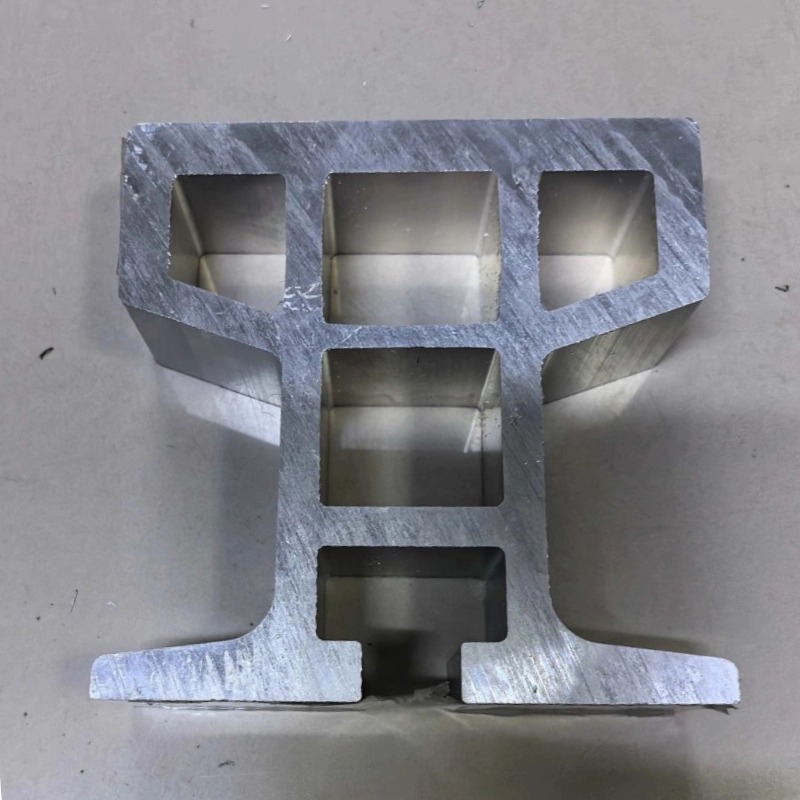
Automated Warehouse RGV Heavy-Load Floor-Rail Aluminum Profiles
Heavy load RGV rails in 6061-T6 at 240 MPa yield, straightness 1.5 mm over 10 m, parallelism 0.8 mm over 10 m, HV300 running face. Per drawing.
Product Details
Short answer: a heavy-load RGV floor rail is a thick-section aluminum track for vehicles in the 500–1000 kg class that run fast and stop often. Working reference: 6061-T6 with yield at 240 MPa or better against about 170 MPa for 6063-T5, straightness within 1.5 mm over 10 m, dual-rail parallelism within ±0.8 mm over 10 m, repeat positioning within ±3 mm, hard anodized running face for 2.5 m/s duty. Section and tolerance are set by your drawing.
What it is used for
It carries heavy RGV and AGV vehicles in automated warehouses, transfer cars between production bays, stacker crane floor tracks, and heavy shuttle systems in pallet handling.
The sections are thick: a 200 × 100 mm envelope is typical, with guide slots and fixing positions formed into the profile rather than added as separate parts. At that size the rail is a structural element, and its anchors are part of the civil design rather than an accessory.
The duty is what defines it. A light rail runs occasionally. A heavy RGV runs at 2.5 m/s with a full load, decelerates hard at a station, dwells, and accelerates again, thousands of times a shift. Every one of those cycles loads the rail vertically, laterally and longitudinally, and the longitudinal load lands on the anchors.
Specifications
| Item | Working reference | How it is set |
|---|---|---|
| Alloy | 6061-T6, yield ≥240 MPa | Chosen against your load class |
| Comparison | 6063-T5, yield about 170 MPa | Material property |
| Section | Thick-wall, e.g. 200 × 100 mm, with guide slots formed in | Set by your drawing |
| Straightness | ≤1.5 mm over 10 m | Set by your drawing |
| Dual-rail parallelism | ≤ ±0.8 mm over 10 m | Set by your drawing |
| Machined tolerance | ±0.02–0.04 mm | Set by your drawing |
| Repeat positioning | ≤ ±3 mm | Set by your station requirement |
| Running face | Hard anodized, for 2.5 m/s and high cycle | Set by your duty |
| Service life reference | Over 10 years at ≤1000 kg, ≤2.5 m/s, with maintenance | Conditional on the duty stated |
How it is made
- The section is extruded in 6061 and heat treated to T6, since the yield strength is the reason for the alloy.
- The running face is machined and the rail straightened, then checked over the full length rather than at sample points.
- Guide slots, anchor holes and end features are machined on one datum, so the geometry that the vehicle follows and the geometry that fixes the rail agree.
- The running face is hard anodized, with anchor and electrical contact areas masked.
- Rails are paired and matched before shipment, because parallelism is a property of the pair.
Where this fits
It fits when vehicles are in the 500–1000 kg class, when the duty cycle is high, when the floor load has to be kept down, and when the aisle is long enough that alignment accumulates.
Where it does not fit: if the vehicle is well beyond 1000 kg, steel gives the stiffness needed and aluminum becomes a weight saving that costs deflection. If the duty is light and intermittent, 6063-T5 is sufficient and the extra cost of 6061 is wasted. And if the floor cannot take the anchor loads, the rail choice is not the problem to solve first.
What actually fails on a heavy rail
The failure is local, not global. A heavy RGV does not break a rail in half. What happens is that the wheel pressure at the flange exceeds what the material can take locally, the surface yields, and a shallow depression forms. That depression is a bump that the next pass hits, so the load concentrates there again, and the dent grows. The vehicle then rides on a series of depressions, the guide wheels work harder, and the positioning drifts. This is why the section thickness at the running flange and the hardness of the running face matter more than the moment of inertia, and why a rail that passes a bending calculation can still fail in service.
The difference between 6061-T6 and 6063-T5 is margin against that yielding. At 240 MPa against about 170 MPa, the T6 alloy has roughly forty percent more yield strength. On a light rail that margin is never used. On a 1000 kg vehicle with hard braking and a high cycle count, it is the difference between a surface that stays flat for a decade and one that dents in the first year. The alloy is not a preference here; it is the mechanism that prevents the failure mode.
Braking loads the anchors, not the rail. When a loaded vehicle decelerates, the horizontal force has to go somewhere, and it goes into the fixings as shear. On a rail carrying a tonne at 2.5 m/s with a short stop, that force is not small, and it is repeated every cycle. The anchor spacing, the bolt grade and the floor condition are part of the rail specification whether or not they appear on the profile drawing, and a rail that is straight and level can still walk if the fixings are under-designed.
Hard anodizing buys the speed. A bare or lightly anodized aluminum face at 2.5 m/s with high cycle wears into the wheel path quickly, and once the oxide is gone the soft metal underneath goes faster. Hard anodizing at HV 300 or above is what makes the 2.5 m/s and ten-year figures achievable together rather than as a trade-off.
And parallelism still governs the running. Two rails, each straight, can still be a bad pair. The vehicle crabs, the guide wheels load on one side, and the position at the far end differs from the near end. At heavy load that error is amplified, so the pair has to be matched rather than each rail being judged alone.
What to send for a quote
- The section drawing with the guide slots, anchor positions and wall thicknesses
- Vehicle weight, wheel load, wheelbase and the number of wheels
- Speed, acceleration and the stopping distance at the stations
- Floor type and the anchor method you intend to use
- Required service life and the shift pattern, since they set the surface treatment
FAQ
What tolerance and life can you state?
Straightness within 1.5 mm over 10 m, parallelism within ±0.8 mm over 10 m, machined features at ±0.02–0.04 mm, and repeat positioning within ±3 mm are our reference values. The life figure of over ten years applies at 1000 kg or less and 2.5 m/s or less with normal maintenance. The value on your order is set by your drawing, and the life claim is conditional on the duty you state.
Why 6061-T6 instead of 6063-T5?
Because heavy vehicles do not break rails, they dent them. At 240 MPa yield against about 170 MPa, the T6 alloy resists local yielding at the wheel contact, which is the actual failure mechanism. 6063-T5 is fine up to about 300 kg; above that the margin disappears.
What does hard anodizing add over ordinary anodizing?
Hardness and wear life at the running face, which is what allows 2.5 m/s with a high cycle count. Ordinary anodizing protects against corrosion and wears through where the wheel runs, after which the soft metal under it wears much faster.
Why does the rail weigh a third of steel if the section is thick?
Because aluminum is about a third of the density of steel. The section can be thicker in the walls and still be lighter overall, which reduces the drive force needed and the load on the floor slab. On a large installation the floor and the motor sizing are the bigger numbers.
How is repeat positioning achieved?
By the combination of a straight, parallel pair and a consistent stopping reference. The rail provides the repeatability; the vehicle's encoder and control provide the position. A ±3 mm figure assumes the pair is installed to datum, so installation is part of the accuracy chain.
Can the rail be supplied with the guide slots already formed?
Yes, and on a thick section it should be, because machining a deep slot out of a heavy profile removes material and releases stress. Forming it in the die and machining only what needs tolerance is both cheaper and more stable.
Next step
Send the section drawing with the vehicle data, the speed profile and the floor anchor arrangement. We will come back with a section, a pairing plan and a tolerance and surface statement against your drawing.
Email: linjunbing@truetrustlv.com | Call or WhatsApp: +86 136 6644 0600
GET A QUOTE
Once you have submitted your requirements, we will contact you as soon as possible regarding your product inquiry.:Automated Warehouse RGV Heavy-Load Floor-Rail Aluminum Profiles