
Automated logistics
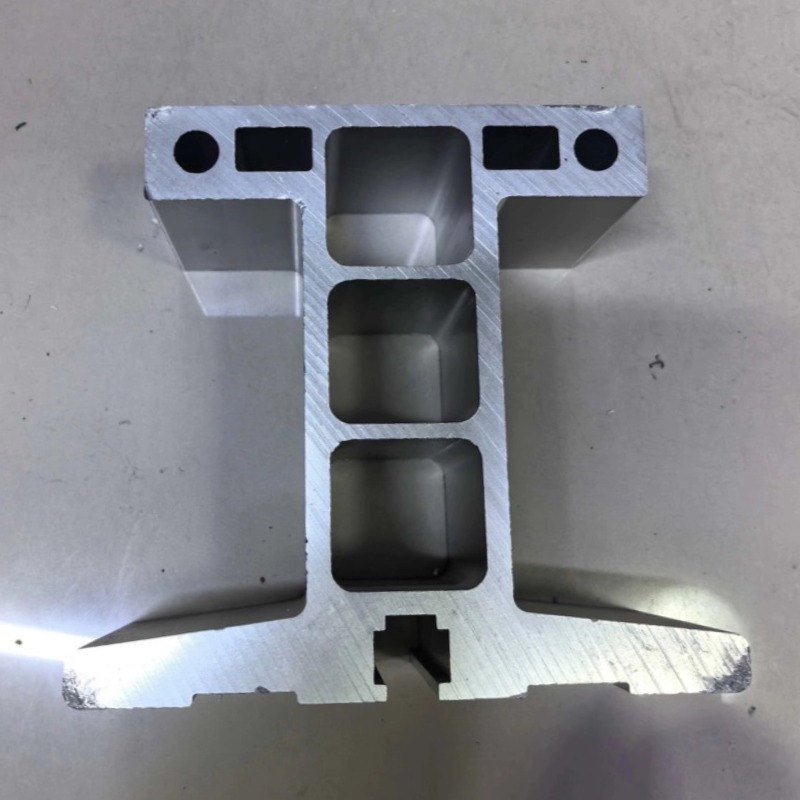
Automotive Final-Assembly EMS Hanging-Rail Aluminum Profiles
EMS hanging rails in 6061-T6, 500-2000 kg per carrier, 10-100 m/min, ring error +/-0.4 mm, arc accuracy 0.5 deg. Section and finish per drawing.
Product Details
Short answer: an EMS hanging rail is the overhead track of an electrical monorail system, mounted above the assembly floor with the trolleys suspended beneath it, carrying car bodies or assemblies through the line. Working reference: 500–2000 kg per carrier, 10–100 m/min, ring-bending error within ±0.4 mm, arc accuracy within 0.5 degrees. The rail is judged on two things a logistics track is not: whether it can run without stopping the line, and whether it sheds anything onto the product. Section and tolerance are set by your drawing.
What it is used for
It carries the final assembly conveyor in automotive plants: body-in-white transfer, paint shop carriers, trim and final lines, door-off and door-on loops, and engine and battery marriage stations. It also serves heavy assembly in truck, bus and off-highway plants, and large-component lines where the workpiece is too big to sit on a floor conveyor.
Suspending the load from above is the point of the system. The floor stays clear for people, robots and material, and the upper volume of the building, which is otherwise empty, does the work. In a plant where every square metre of floor is contested, that is the reason the system exists.
The duty is different from a warehouse track. A warehouse crane runs when there is work. An assembly line runs at takt, and at 60 jobs per hour that is one body every 60 seconds, all shift, every shift. A stop is not a delay on one item, it is the whole line.
Specifications
| Item | Working reference | How it is set |
|---|---|---|
| Alloy | 6063-T5, or 6061-T6 for heavy carriers and final assembly | Chosen against your load case |
| Load per carrier | 500–2000 kg | Set by your drawing |
| Running speed | 10–100 m/min | Set by your takt |
| Ring-bending error | ≤ ±0.4 mm | Set by your drawing |
| Arc accuracy | ≤0.5 degrees | Set by your drawing |
| Joint to straight rail | Tangent continuous, step-free, closed gap | Set by your acceptance method |
| Section range | Weight from 0.05 to 100 kg/m, circumscribed circle 5 to 700 mm | Chosen against your load and hanger |
| Conductor rail | Integrated into the section | Set by your power supply design |
How it is made
- The section is extruded to the customer's drawing, with the trolley running geometry and the hanger interface formed in the die.
- Straight lengths are cut and the ends machined; curved lengths are CNC roll bent and checked against a template.
- Joint faces are machined after bending so the transition is tangent continuous and closed, with no gap for a wheel to drop into.
- Hanger points and the conductor rail mounting are machined on a single datum along the length.
- Surface treatment follows, with attention to the running face and to any edge that could shed material onto the product below.
Where this fits
It fits when the floor has to stay clear, when the building has usable height, when the load is in the 500–2000 kg range, and when the line runs at takt with little tolerance for a stop.
Where it does not fit: if the building has no structure able to carry the hanger loads, a floor conveyor is the right answer. If the product is small and light, the overhead system is over-engineered. And if the process needs the carrier to stop at a robot with sub-millimeter repeatability, that requirement belongs on a fixed station rather than on a moving carrier.
What makes this different from a logistics track
Takt time turns every defect into a line stop. On a warehouse rail, a rough joint is a maintenance item. On a final assembly line running 60 jobs per hour, a rough joint is a vibration that eventually cracks a trolley bracket, and a cracked bracket stops the line while it is found and replaced. The economics push every tolerance tighter than a logistics customer would ask for, and they push the joint quality to the top of the list. It is also why the conductor rail is integrated rather than hung separately: fewer parts above a moving line means fewer things that can fail.
The body swings, and the curve is where it swings most. A car body on a hanger is a large mass on a pendulum. On a straight run the motion is small. In a curve the lateral acceleration sets the body swinging, and if the arc has a discontinuity the swing is excited rather than damped. The body then moves relative to the station, which means a robot or an operator has to work on a moving target, and in the worst case the body contacts the fixture or the equipment. Arc accuracy at 0.5 degrees and ring error at ±0.4 mm are not cosmetic numbers on this product; they are what keeps the body still enough to work on.
Anything that falls off the rail lands on a painted body. In a paint shop or a final line, a particle of aluminum oxide on a panel is a defect that requires rework. That changes what is acceptable at the running face. A surface treatment that wears, chalks or flakes is a defect source even if it never fails mechanically, and a bare aluminum running face that smears against a wheel produces exactly the debris that must not fall. The finish specification on an automotive EMS rail is therefore a quality document, not a corrosion document, and it is worth writing it that way.
And the hanger is a fatigue detail. Every hanger point sees the full carrier load plus the dynamic factor of the moving body, reversed as the trolley passes. On a line that runs for years, that is a very large number of cycles at each point. The hanger geometry, the local section thickness and the hole preparation all matter more than they look on a drawing, and they are the reason a rail can be perfectly straight and still fail at a bracket.
What to send for a quote
- The line layout with straights, curves, elevations and hanger positions
- Carrier and body weight, and the trolley wheel arrangement
- Takt time and running speed
- Where the rail passes over the product, and the cleanliness expectation there
- The conductor rail design and the power supply requirement
FAQ
What bend accuracy can you hold?
Ring-bending error within ±0.4 mm and arc accuracy within 0.5 degrees are our reference values, with the joint to a straight rail machined tangent continuous and closed. The value on your order is set by your drawing, and on a body-carrying line we state the joint condition explicitly because that is what the body feels.
6063-T5 or 6061-T6 for an EMS rail?
6061-T6 for final assembly and heavy carriers, because the load, the dynamic factor and the fatigue duty all point the same way. 6063-T5 is adequate for lighter carriers and lower speeds, and it forms and finishes more easily, but on a high-takt line the higher yield strength is what buys the service life.
How is the conductor rail installed?
It is carried in the section, so the power supply runs with the track instead of being hung separately. That reduces the parts above the line and keeps the conductor out of reach of the process. The conductor specification itself is a separate design and is quoted as such.
Why is the surface finish so critical here?
Because the rail is above a painted body. A coating that wears or flakes drops particles onto the product, and a bare running face generates debris at the wheel contact. In a paint or final line that is a quality defect, so the finish has to be chosen for what it does not shed, not only for corrosion.
Can the rail follow a change of elevation?
Yes, within limits, using inclined sections and transitions, but the transitions have to be planned as part of the layout. A sudden change of slope at a joint is a step in the running direction even if the parts are individually correct.
What does the customer need to provide?
The section drawing if it exists, otherwise the trolley interface and the hanger geometry; the load per carrier; the takt and speed; and the layout with elevations. From those we can propose a section, a bend plan and a joint specification.
Next step
Send the line layout with the carrier data and the takt. We will come back with a section, a bend and joint plan, and a statement of the accuracy we can hold against your drawing.
Email: linjunbing@truetrustlv.com | Call or WhatsApp: +86 136 6644 0600
GET A QUOTE
Once you have submitted your requirements, we will contact you as soon as possible regarding your product inquiry.:Automotive Final-Assembly EMS Hanging-Rail Aluminum Profiles