
Automated logistics
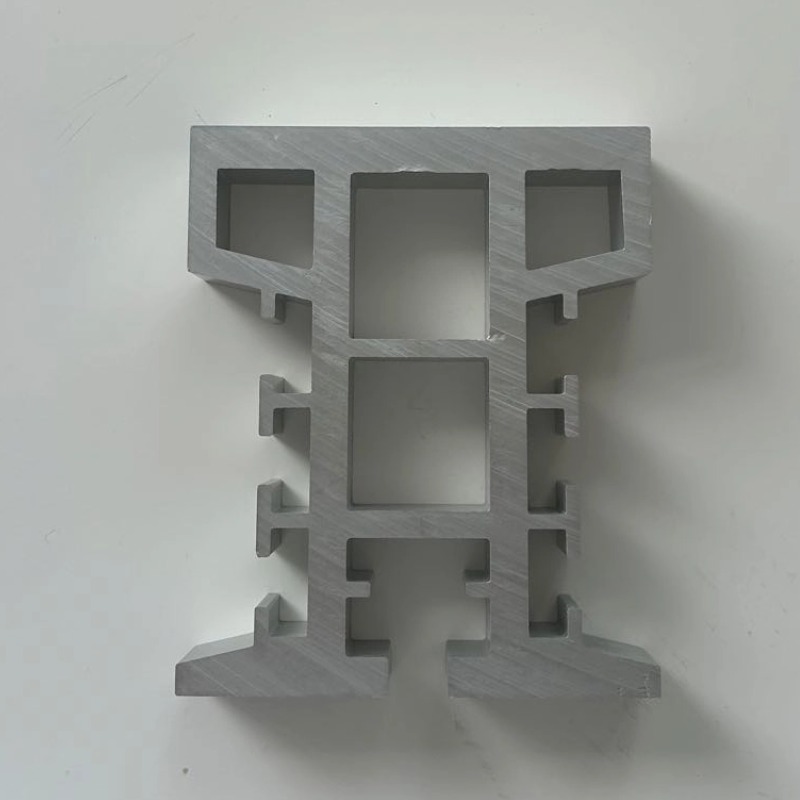
Stereoscopic Warehouse Stacker Floor Rail Aluminum Profiles
Stacker floor rails in 6061-T6 at 240 MPa yield, straightness 1.5 mm over 10 m, dual rail parallelism 0.8 mm over 10 m. Pair and tolerance per drawing.
Product Details
Short answer: a stacker floor rail is the bottom track a stacker crane runs on inside an automated warehouse, and the top rail only guides it. That division of labour is why the floor rail carries the accuracy: straightness within 1.5 mm over 10 m, parallelism between the two rails within ±0.8 mm over 10 m, machined features at ±0.02–0.04 mm, running position within ±2 mm. Working reference: 6061-T6 at 240 MPa yield or better, 500–1000 kg class cranes, speed up to 2.5 m/s. Section and tolerance are set by your drawing.
What it is used for
It goes into automated storage and retrieval systems: stacker cranes in pallet and tote warehouses, heavy-duty RGV installations, and any tall aisle machine that runs on a floor rail with a top guide.
The load range is 500 to 1000 kg for the crane class this rail serves, at running speeds from 0 to 210 m/min, which is up to about 2.5 m/s. The crane may be 20 m or more tall, and the mast is a tall cantilever, so the floor rail is not only carrying weight, it is resisting the overturning moment that the mast applies to it.
In most warehouses the floor is a costly item: it has to be flat, it has to carry the racking and the crane, and it is poured once. That is where an aluminum rail changes the economics, because the rail weight is roughly a third of the steel equivalent and the floor is designed around it.
Specifications
| Item | Working reference | How it is set |
|---|---|---|
| Alloy | 6061-T6, yield ≥240 MPa | Chosen against your crane class |
| Straightness | ≤1.5 mm over 10 m | Set by your drawing |
| Dual-rail parallelism | ≤ ±0.8 mm over 10 m | Set by your drawing and the crane wheelbase |
| Machined tolerance | ±0.02–0.04 mm | Set by your drawing |
| Running position | ≤ ±2 mm | Set by your fork and rack tolerance |
| Load class | 500–1000 kg crane | Set by your vehicle |
| Speed | 0–210 m/min, up to about 2.5 m/s | Set by your system |
| Rail weight | About one third of steel | Material property |
How it is made
- The section is extruded in 6061 and heat treated to T6, because the mast moment and the wheel loads need the yield strength.
- Lengths are cut and the running face machined, then the rail is straightened to the call and checked over the full length rather than at points.
- Holes and anchor positions are machined from the running face datum, so that fixing the rail to the floor does not bend it.
- Rails are paired and matched before shipment, since parallelism is a property of the pair rather than of one rail.
- Finished parts are checked for straightness, running-face condition and anchor geometry.
Where this fits
It fits when the aisle is long, the floor load is a constraint, the crane class is in the 500–1000 kg range, and the building has to go up without a heavy steel foundation.
Where it does not fit: if the crane class is well above 1000 kg, steel is the right answer for stiffness. If the floor is already poured and the steel rails are installed, replacing them is not an upgrade. And if the warehouse is small with a short aisle, the accuracy gain from a matched pair may not pay for itself.
Where the real difficulty sits
Parallelism between the two rails decides whether the crane runs, not straightness. A single rail held to 1.5 mm over 10 m is a good part. Two rails each individually good, but not parallel to each other, produce a crane that crabs: the guide wheels on one side take the load, the mast is forced into a slight skew, and the position at the top differs from the position at the bottom. The operator sees it as uneven wheel wear, then as positioning drift, then as a fork that does not enter the pallet opening. Parallelism at ±0.8 mm over 10 m is the number that prevents this, and it is the one most often quoted without being measured as a pair.
Positioning accuracy is a safety figure, not a convenience figure. At ±2 mm the fork enters the pallet opening reliably. Miss by more and the fork strikes the rack or the load, and at 20 m up that is a dropped pallet, a damaged rack and a stopped warehouse. The accuracy chain runs from the rail through the wheels to the encoder, so a rail that is straight but mounted from a poor datum puts a bias into every position on the aisle, and the control system cannot correct a bias it did not create.
Speed is limited by the joints. At 2.5 m/s the crane crosses a joint every few seconds, and each crossing is an impact if there is a step. The rail can be straight and the drive can be capable, and the practical limit still comes down to how well the joints are made. This is why we machine joint faces and match them, rather than cutting to length and relying on the splice plate.
The weight saving is a floor saving. Aluminum at a third of the steel weight reduces the load the slab has to carry and the point loads at the anchors, which can change the floor specification. It also reduces the drive force needed to accelerate the crane, which shows up in motor sizing and in energy over a life of continuous shifts. Comparing the rail on price per meter misses both of these, and on a large warehouse the floor is the bigger number.
What to send for a quote
- The warehouse layout with the aisle length, the rail spacing and the anchor positions
- Crane weight, mast height and the wheel arrangement
- Running speed and the pallet or tote tolerance at the fork
- The straightness and parallelism you need, and how they will be measured
- Floor condition and the anchor type you intend to use
FAQ
What straightness, parallelism and tolerance can you hold?
Straightness within 1.5 mm over 10 m, dual-rail parallelism within ±0.8 mm over 10 m, and machined features at ±0.02–0.04 mm are our reference values on this family, with running position within ±2 mm. The value on your order is set by your drawing, and we state how each figure is measured because parallelism only means something when the pair is measured together.
Why does parallelism matter more than the straightness of one rail?
Because the crane spans both rails. If they converge or diverge, the guide wheels load unevenly, the mast skews, and the position at the top of the mast differs from the bottom. The visible result is uneven wheel wear and then a fork that misses the pallet opening. Two individually good rails can still make a bad pair.
Why aluminum instead of steel for a stacker rail?
Weight. At about a third of steel, the rail reduces the floor load, the anchor point loads and the drive force, which affects the slab specification and the motor sizing. On a large warehouse those are bigger numbers than the rail price, and the installation is easier as well.
What accuracy does the fork need from the rail?
Around ±2 mm at the running position is the working figure, because that is what lets the fork enter the pallet opening without contact. The requirement is really set by the pallet tolerance and the rack installation tolerance, so the rail figure should be derived from those rather than chosen independently.
What speed can the rail support?
Up to about 2.5 m/s, or 210 m/min, with the practical limit set by joint quality and by the crane's own dynamics. A faster drive does not help if the joints produce an impact at every crossing.
Can you supply the pair matched?
Yes, and for a long aisle we recommend it. Parallelism is a pair property, so matching the two rails before shipment removes a variable that the site team would otherwise have to solve with shims under a rail that is already anchored.
Next step
Send the layout with the rail spacing, the crane data and the pallet tolerance. We will come back with a section, a paired-rail plan and a statement of the straightness and parallelism we can hold against your drawing.
Email: linjunbing@truetrustlv.com | Call or WhatsApp: +86 136 6644 0600
GET A QUOTE
Once you have submitted your requirements, we will contact you as soon as possible regarding your product inquiry.:Stereoscopic Warehouse Stacker Floor Rail Aluminum Profiles