
Automated logistics
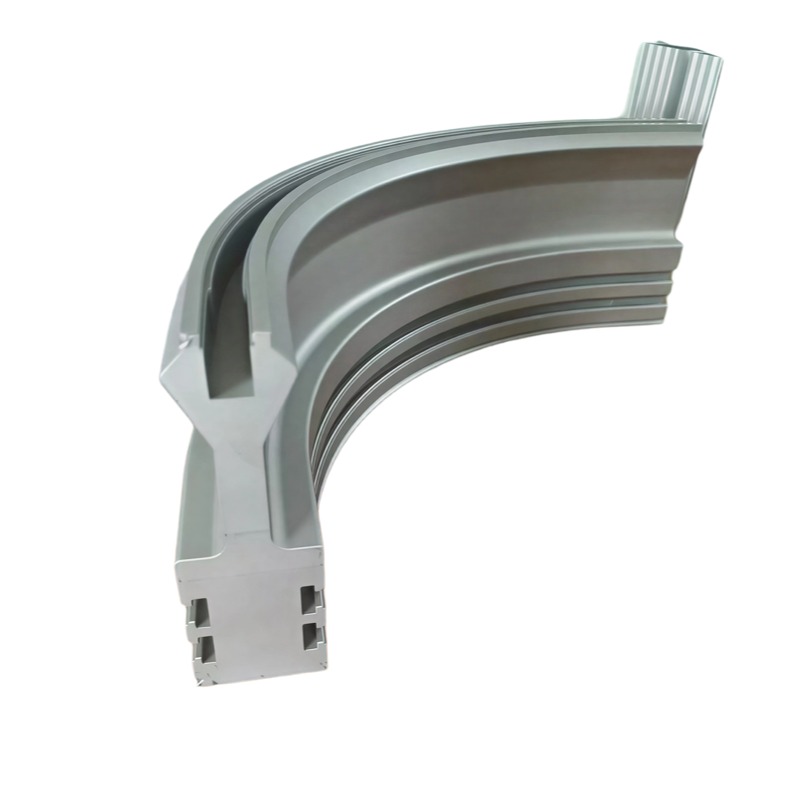
Ring-Shaped RGV Curved-Rail Aluminum Profiles
RGV curved rails in 6063-T5 or 6061-T6, arc accuracy within 0.5 deg, ring error +/-0.4 mm, radius from 1000 mm. Alloy and speed per drawing.
Product Details
Short answer: an RGV curved rail is a roll-bent aluminum profile that turns a track through an arc so a rail-guided vehicle can change direction instead of stopping and reversing. Working reference: arc accuracy within 0.5 degrees, ring-bending error within ±0.4 mm, minimum turning radius down to 1000 mm. Alloy choice follows the turn: 6063-T5 for cars up to about 300 kg at low speed, 6061-T6 above that. Radius, alloy and tolerance are set by your drawing.
What it is used for
It goes into RGV loop tracks in automated warehouses, transfer curves between aisles, corner turns in shuttle systems, U-shaped returns at the end of a run, and S-shaped crossovers that shift a track sideways between two parallel aisles.
The three layouts ask different things of the same part. A U-turn is two arcs of the same hand joined by a tangent. An S-curve is two arcs of opposite hand, and the middle has an inflection where the curvature reverses. A ring is a continuous closed circuit, which adds the closure problem on top of the arc accuracy. The bending process is the same; the tolerance allocation is not.
What every one of them shares is that the vehicle is turning, and a turning vehicle is not a straight-line vehicle. That single fact drives the alloy choice, the speed limit and the wear pattern.
Specifications
| Item | Working reference | How it is set |
|---|---|---|
| Alloy | 6063-T5 to about 300 kg, 6061-T6 for 300–500 kg or higher speed | Chosen against your load and speed |
| Yield strength, 6061-T6 | ≥240 MPa | Material property |
| Arc accuracy | ≤0.5 degrees | Set by your drawing |
| Ring-bending error | ≤ ±0.4 mm | Set by your drawing |
| Minimum turning radius | 1000 mm | Set by your layout and section |
| Joint to straight track | Tangent continuous, step-free in the running direction | Set by your acceptance method |
| Forming | CNC roll bending, one piece per arc where possible | Result of the layout |
| Surface | Anodized, hard anodized on the running face where wear matters | Set by your duty cycle |
How it is made
- The arc is defined from the layout: radius, included angle and the tangent points where it meets the straight run.
- The profile is roll bent on CNC equipment, with the radius checked against a template as it forms rather than only at the end.
- The ends are cut so the tangency to the adjoining straight rail is correct, which is a different cut from one that simply shortens the piece.
- Holes and mounting features are machined after bending, because the bend moves positions along the length.
- The arc is trial fitted against its neighbours before finishing, so a tangency error is found at our works rather than on site.
Where this fits
It fits when the vehicle has to change direction within a fixed route, when the radius is inside what the section can bend, and when the car's speed through the turn is known.
Where it does not fit: if the car reverses at the end of a run rather than turning, a straight rail with end stops is cheaper and has no arc error to manage. If the radius needed is below the section's bending limit, the answer is a different section or a fabricated corner, not a tighter bend. And if the layout is still moving, bending is premature by definition.
The physics of a turn, and what it costs
Centrifugal force is the load case a straight rail never sees. A car moving at speed v around a radius R experiences a lateral acceleration of v²/R. At 1 m/s around a 1 m radius that is about 1 m/s², or a tenth of gravity, which is mild. At 2 m/s around the same radius it is about 4 m/s², close to half gravity, so a 500 kg car pushes roughly 250 kg sideways into the rail. That lateral force bends the rail in its weak axis and loads the guide wheels far harder than the vertical load does. It is the reason 6061-T6 with a yield of 240 MPa or better earns its place on a heavy or fast turn, and the reason the quoted load range for a curved rail is lower than for the same section running straight.
Tangency at the joint matters more than the arc itself. If a curved segment meets a straight one at a slight angle, even a fraction of a degree, the wheel hits the discontinuity as an impact on every pass. The symptom is a click or a knock at the same place on each lap, and over months it becomes a worn spot, a flat on the wheel and a loosened joint. Arc accuracy tells you how well the curve was formed; tangency tells you whether the car can enter it. We check both, and the joint is machined to the mating rail rather than to a nominal length.
Bending changes the section, so there is a radius limit. On the outside of the bend the material stretches and the wall thins; on the inside it compresses and can wrinkle. On an open profile the flanges are the vulnerable part: they can buckle outward or the web can go wavy. The practical minimum radius is therefore a property of the section, not of the machine, and quoting an aggressive radius without checking the section is how a rail arrives looking acceptable and running badly.
Speed through the turn is usually set by the payload, not the vehicle. On a loaded car with a high center of gravity, lateral acceleration shifts the load onto the outer wheels and can unload the inner ones, which is where derailment begins. If your car carries a tall load, the turn speed has to come down even though the rail and the drive could go faster. It is worth deciding that limit before the layout is fixed, because a larger radius is cheap at the drawing stage and expensive afterwards.
What to send for a quote
- The layout drawing with radius, angle, tangent points and joint positions
- Car weight, center of gravity height, wheelbase and wheel material
- Speed through the straight and through the turn
- Whether the layout is U, S or a closed ring, since the tolerance allocation differs
- The wear life expected, which decides the running-face treatment
FAQ
What arc accuracy and tolerance can you hold?
Arc accuracy within 0.5 degrees and ring-bending error within ±0.4 mm are our reference values on this family, measured against a template after forming. The value on your order is set by your drawing and by the radius, since the same angular error becomes a larger linear error on a bigger arc. We state the achievable band for your geometry before production.
What is the smallest radius you can bend?
1000 mm is our standard minimum for this rail family, and it depends on the section. A deeper, heavier section needs a larger radius because the flanges are more prone to buckling on the inside of the bend. If your layout needs tighter, we would rather discuss a fabricated corner than promise a bend that will distort.
6063-T5 or 6061-T6 for a curved rail?
6063-T5 up to about 300 kg at low turn speed, because it forms cleanly and takes a better finish. 6061-T6 for 300 to 500 kg or where the turn speed is high, because the lateral load from the turn is what the rail has to resist. The curved case is where the higher strength actually pays, unlike a straight run where it is often unnecessary.
How are curved and straight rails joined?
With a machined joint that is tangent continuous and step-free in the running direction, using a splice that keeps the joint from opening under load. The joint is the weakest point in any layout, so it is defined on the drawing rather than left to the installer.
What is the difference between S, U and ring layouts?
A U-turn is two arcs of the same hand, an S-curve is two arcs of opposite hand with an inflection in the middle, and a ring closes on itself. The S-curve is the hardest to hold because the inflection has to be smooth, and the ring adds a closure tolerance on top of the arc accuracy.
Can the running surface be hardened?
Yes, with hard anodizing where the duty is high. On a curve the outer rail carries more load, so the wear is not symmetrical and the treatment can be applied where it is needed rather than uniformly.
Next step
Send the layout with the radius, the car data and the turn speed. We will come back with a segment plan, an alloy recommendation and a tangency and arc tolerance we can commit to against your drawing.
Email: linjunbing@truetrustlv.com | Call or WhatsApp: +86 136 6644 0600
GET A QUOTE
Once you have submitted your requirements, we will contact you as soon as possible regarding your product inquiry.:Ring-Shaped RGV Curved-Rail Aluminum Profiles