
Automated logistics
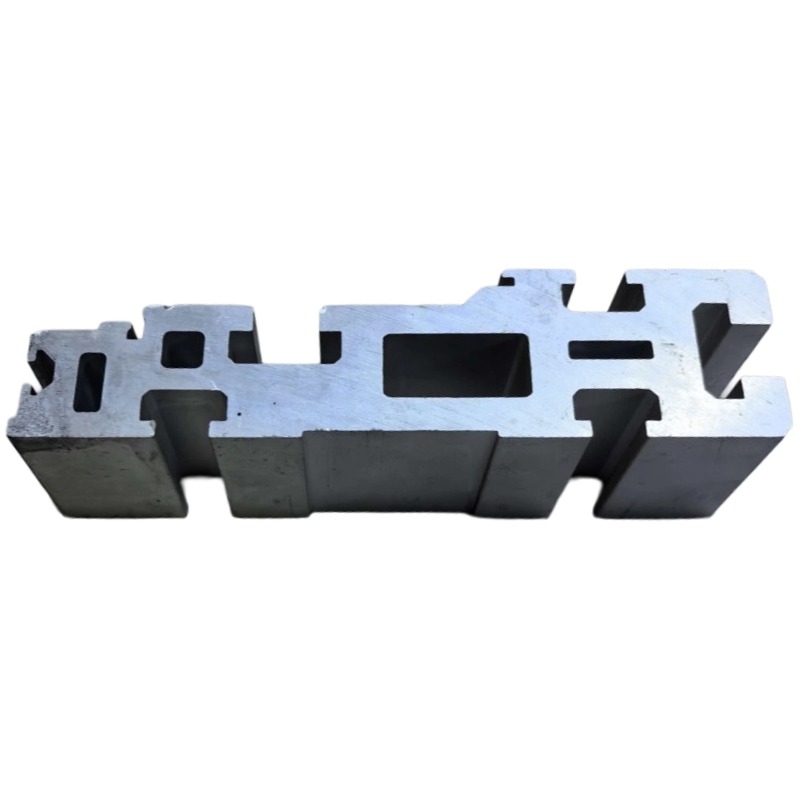
Crane Conductor-Rail Aluminum Profiles
Crane conductor rails in conductive 6063-T5 at 45-50% IACS, machined to +/-0.02-0.04 mm, 3 to 6 poles, brush track masked bare. Rating per drawing.
Product Details
Short answer: a crane conductor rail is an extruded aluminum profile that carries current to a moving hoist or trolley through a sliding collector, instead of a festooned cable. The material is a conductive 6063-T5 grade reaching about 45–50 percent IACS against 35–40 percent for ordinary 6063-T5, machined to ±0.02–0.04 mm so the collector brush runs true. Section, pole count and current rating are set by your power supply design.
What it is used for
It supplies power to overhead cranes, KBK and light crane systems, monorails, transfer cars, automated storage shuttles, and any machine that travels along a fixed path and needs continuous power rather than a trailing cable.
Typical systems use three to six poles on one track: three for the phases, one for neutral, one for protective earth, and sometimes an extra pair for control or a signal. The collector is a carbon brush or a copper-graphite block that rides the rail under spring pressure and takes current off as the crane moves.
The alternative is a cable festoon or a cable chain. Conductor rails win where the travel is long, the environment is dirty, the crane runs at high duty, or the cable would sag into the working area.
Specifications
| Item | Working reference | How it is set |
|---|---|---|
| Alloy | Conductive 6063-T5, 45–50 percent IACS | Chosen against your current and length |
| Ordinary 6063-T5 for comparison | 35–40 percent IACS | Material property |
| Machining tolerance | ±0.02–0.04 mm | Set by your drawing |
| Pole count | 3, 4, 5 or 6 poles on one track | Set by your supply and control design |
| Contact surface | Bare metal at the brush track, anodized elsewhere | Set by the design, not optional |
| Joint | Machined splice with a conductive joint, no step at the brush track | Set by your drawing |
| Straightness | Controlled over the full length, since the brush follows it | Set by your drawing |
| Machining | Cut, milled, drilled, joint faces machined | Per your drawing |
How it is made
- The section is extruded in a conductive grade, then aged so the conductivity and the mechanical properties are both stable before machining.
- The brush track is machined to tolerance and to a surface condition the collector can run on, because roughness here decides brush wear and contact resistance.
- Joint faces are machined square and the splice is designed so the brush crosses without a step, since a step at a joint chips the brush and arcs.
- Anodizing is applied to the external faces only, with the brush track masked bare.
- Conductivity and dimensional checks are made on the finished length, and the poles are assembled into the track.
Where this fits
It fits when the travel is long, the crane runs frequently, the environment is dusty or wet, and the route would otherwise need a long festoon that sags or snags.
Where it does not fit: if the travel is short and the duty is low, a cable festoon is cheaper and needs no brush maintenance. If the route has tight curves in both planes, a rigid conductor rail is the wrong geometry. And if the environment is explosive or highly conductive dust, the arcing risk has to be engineered out, which is a different product.
The detail that decides whether the system works
An anodized surface is an insulator, so the brush track cannot be anodized. This is worth stating plainly because it is routinely got wrong. Anodizing builds an aluminum oxide layer that is hard, corrosion resistant and electrically insulating, which is exactly what you want on the outside of a rail and exactly what you must not have where the collector runs. If a whole profile is anodized, the contact resistance at the brush goes up by orders of magnitude and the rail is scrap. The process is therefore a masked one: anodize the visible and weather-exposed faces, keep the brush track bare, and define which is which on the drawing. Any quotation that does not mention masking has not understood the part.
Conductivity is bought in the alloy, not in the section size. Going from ordinary 6063-T5 at 35–40 percent IACS to a conductive grade at 45–50 percent is roughly a quarter more current for the same section. That can mean a smaller rail in a tight track, or the same rail with margin. Since the rail is usually the part that is hard to change late, spending the conductivity at the design stage is cheaper than adding a second feed point later.
The rating depends on how the poles are packed. A single rail in free air sheds heat easily. Six poles in one housing, enclosed and running continuously, do not, and the current has to be derated accordingly. A current figure quoted without the pole arrangement and the duty cycle is not a rating, it is a hope.
Voltage drop, not ampacity, limits the length. Over a long run the resistance of the rail adds up and the voltage at the far end falls. The practical limit is usually the voltage the load will accept, not the current the rail can carry. On a long crane runway this decides where the feed points go, and it is worth calculating before the layout is frozen rather than discovering the drop at commissioning.
And the brush is the maintenance item. A rough or stepped track wears the brush fast, brush dust accumulates on insulators, and the contact resistance creeps up until it arcs. A smooth, straight, step-free track with correct spring pressure turns that into a routine inspection instead of a failure.
What to send for a quote
- The power supply design: voltage, current, number of poles and the control signals
- Travel length and the number of feed points, or the voltage drop you will accept
- The collector you intend to use, with its brush material and contact pressure
- Environment: indoor, outdoor, dusty, humid or washdown
- Whether the profile has to fit an existing track or a known brand
FAQ
What tolerance and conductivity can you hold?
Machining tolerance of ±0.02–0.04 mm and 45–50 percent IACS are our reference values for the conductive grade, with the brush track machined to the surface condition your collector needs. The value on your order is set by your drawing, and the current rating we quote is for your pole arrangement and duty, not a generic figure.
Why are the rails anodized at all if the oxide insulates?
Because only the external faces are anodized. The rail sits in a workshop or outdoors for years, so the outside needs corrosion and wear protection. The brush track is masked and stays bare metal. Treating the whole profile would destroy the electrical function, which is why masking is specified on the drawing rather than left to the finisher.
How is the current rating determined?
From the section area, the conductivity grade, the pole packing and the duty cycle. Poles enclosed in one housing run hotter than a single rail in free air, so the usable current is lower. We quote a rating against your arrangement, and if the load is near the limit we say so and suggest a second feed point instead of a larger rail.
Can several poles run on one track?
Yes, three to six is normal, with separate insulated conductors in one housing. The insulation between poles and the creepage distance are part of the design, and adding poles changes both the thermal rating and the housing width.
Will your rail work with another brand's collector?
In most cases yes, if the brush track height and the contact geometry match. We need the collector drawing or the existing rail specification, because the brush pressure and the track position are what decide whether it runs correctly. A mismatch shows up as uneven brush wear, not as an obvious fault.
How are the joints made conductive?
By machining the joint faces flat and using a splice that carries current across the joint with a defined contact, plus a step-free transition at the brush track. A joint that is mechanically tight but electrically poor heats up under load, and heat at a joint is the beginning of a failure.
Next step
Send the supply design, the travel length and the collector details. We will come back with a section, a pole arrangement and a current rating stated against your duty.
Email: linjunbing@truetrustlv.com | Call or WhatsApp: +86 136 6644 0600
GET A QUOTE
Once you have submitted your requirements, we will contact you as soon as possible regarding your product inquiry.:Crane Conductor-Rail Aluminum Profiles