
Automated logistics
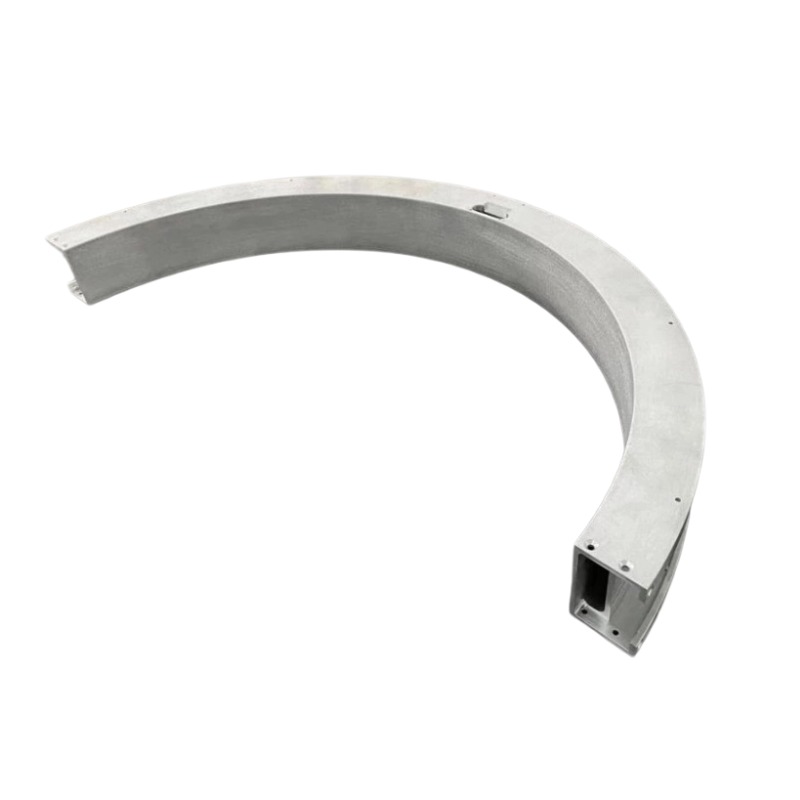
Closed-Loop Circulating Ring Guide Rail Aluminum Profile
Closed-loop ring rails in 6063-T5 or 6061-T6, closed-loop error within +/-0.4 mm and curvature within 0.5 deg, step-free joints. Closure per drawing.
Product Details
Short answer: a closed-loop ring rail is an aluminum guide track bent into a continuous circuit, usually for RGV cars that circulate instead of reversing. The number that decides whether it works is not the bend radius but the closed-loop error after assembly: the finished ring has to close on the theoretical circle within about ±0.4 mm, with curvature held to 0.5 degrees and joints flat enough that a wheel crossing them feels nothing. Alloy, load and tolerance are set by your drawing.
What it is used for
It carries vehicles that run in one direction around a fixed circuit: RGV cars in automated warehouses, transfer loops between production bays, circulating conveyors in assembly shops, test loops, and clean-room transport circuits.
The layout decides the section. A single ring is one closed circuit at one level. A multi-ring layout stacks or nests several circuits that share a route for part of the lap. An S-shaped compound ring joins two loops through a crossover, which is the hardest of the three because the crossover has to satisfy both circles at once.
What separates this from a straight rail is duty. A car on a ring passes the same point thousands of times in a shift, and it passes it under the same load every time. The rail is not just carrying weight, it is being fatigue-loaded at every joint on every lap.
Specifications
| Item | Working reference | How it is set |
|---|---|---|
| Alloy | 6063-T5 for light duty, 6061-T6 for heavy or high cycle | Chosen against your load and cycle count |
| Closed-loop error | ≤ ±0.4 mm on the assembled ring | Set by your drawing, verified after installation |
| Curvature accuracy | ≤ 0.5 degrees | Set by your drawing |
| Joint condition | Flat, step-free, no measurable lip in the running direction | Set by your acceptance method |
| Forming | CNC roll bending, one piece per segment where the layout allows | Result of the layout |
| Load reference | Up to about 300 kg per car on 6063-T5, 300–500 kg on 6061-T6 | Set by your load case |
| Verification | 50 or more continuous laps with the actual car after installation | Agreed at quotation |
| Surface | Anodized or as-machined running surface | Set by your wear requirement |
How it is made
- The layout is converted into segments, and each segment is assigned a share of the total closed-loop tolerance rather than a standalone bend tolerance.
- Segments are roll bent on CNC equipment, then checked against a template before any machining.
- Ends are cut and machined so the joint faces meet without a step in the running direction, which is a different requirement from meeting at the right angle.
- Holes and mounting features are machined after bending, because bending moves hole positions and drilling before bending guarantees misalignment on assembly.
- The ring is trial assembled, measured for closure and curvature, and adjusted or re-cut before shipment.
Where this fits
It fits when the process is genuinely circulatory, when the layout is fixed before tooling, and when the vehicle's wheel geometry is known, because the wheel is what feels every joint.
Where it does not fit: if the route is still being changed, bending is the wrong thing to commit to, because a bent segment cannot be unbent. If the car reverses at the ends of a run, a straight rail with end stops is cheaper and better. And if the ring needs a switch or a junction, that is a layout with a switch in it rather than a plain ring, and it should be quoted as such.
Why closure, not bend radius, is the real problem
Errors accumulate around a circuit. A single curved segment held to ±0.2 mm is a good part. Eight of them assembled into a ring can be out by well over a millimeter in closure, because the errors add up as you go round rather than averaging out. A supplier who quotes a per-segment tolerance and leaves closure to the assembly is transferring the risk to the customer's installation team, who cannot fix it on site. The tolerance has to be allocated backwards from the closure requirement, and one segment has to be made as the closing piece, cut to what the ring actually measures.
A joint is a wear point before it is an alignment problem. If there is a lip at a joint, every wheel passage is a small impact. The impact makes noise, loads the wheel bearing, and locally compresses the running surface. The compressed spot becomes a bigger lip, and the next lap is worse. This is why the requirement is step-free rather than merely aligned: a joint that is straight but stepped wears out the car, and the symptom appears as wheel failure a long way from the rail.
Cyclic duty changes the alloy. On a straight rail the load case is mostly static. On a ring the same section is bent, straightened by the wheel, and bent again on every lap, at the same point. That is fatigue, and it is why 6061-T6 earns its place on heavy or high-frequency rings even though it is harder to bend than 6063-T5. Saving on the alloy and then replacing wheels and rails in year two is not a saving.
And the verification is a running test, not a measurement. A ring can measure correctly while standing and still run badly, because the car's wheelbase, the joint positions and the drive all interact. Fifty continuous laps with the real car finds what a tape measure cannot.
What to send for a quote
- The ring layout drawing with the theoretical circle, the levels and the joint positions marked
- Car weight, wheelbase, number of wheels, and wheel material
- Laps per shift, because cycle count selects the alloy
- Whether there is a switch, a crossover or a multi-level route
- The closure tolerance you need, so the segments can be allocated against it
FAQ
What closed-loop error can you hold?
About ±0.4 mm closure on an assembled ring, with curvature within 0.5 degrees, are our reference values for this product family. The value on your order is set by your drawing and by the ring diameter, since a larger circle makes the same angular error a bigger linear one. We state the achievable figure for your layout before production rather than after the trial assembly.
Why does a ring rail need a different alloy from a straight rail?
Because of fatigue. A straight rail sees a mostly static load, while a ring is loaded at the same points on every lap, thousands of times. 6063-T5 is fine for light cars on low cycles; 6061-T6 is the safer choice for heavy cars or high-frequency circulation, where the track itself is a fatigue component.
How do you make the joints flat?
By machining the joint faces after bending rather than cutting them before, and by checking the joint with the wheel's contact line as the reference. Alignment in plan view is not enough; the requirement is that nothing protrudes into the running direction.
Can the ring be supplied in segments and assembled on site?
Yes, and for large rings it usually is, because a complete ring does not fit in a truck. In that case we trial assemble and measure at our works, mark the segments, and supply a closing segment sized to the measured ring, so the site team is not fighting an accumulated error they did not create.
What if the layout changes after the rails are bent?
Then the affected segments have to be re-made. A bent profile cannot be straightened and re-bent to a new radius without losing the accuracy that made it usable. This is the reason we ask for a frozen layout before bending starts, and it is a schedule issue rather than a commercial one.
Do you supply the mounting brackets and the car interface?
We machine the rail and its mounting features. Brackets and the car's wheel assembly interface can be included where the drawing defines them, and where they are bought-in items we will state that they sit outside our scope rather than leaving it ambiguous.
Next step
Send the ring layout with the theoretical circle, the car data and the cycle count. We will come back with a segment plan, an alloy recommendation and a closure tolerance we can commit to against your drawing.
Email: linjunbing@truetrustlv.com | Call or WhatsApp: +86 136 6644 0600
GET A QUOTE
Once you have submitted your requirements, we will contact you as soon as possible regarding your product inquiry.:Closed-Loop Circulating Ring Guide Rail Aluminum Profile