
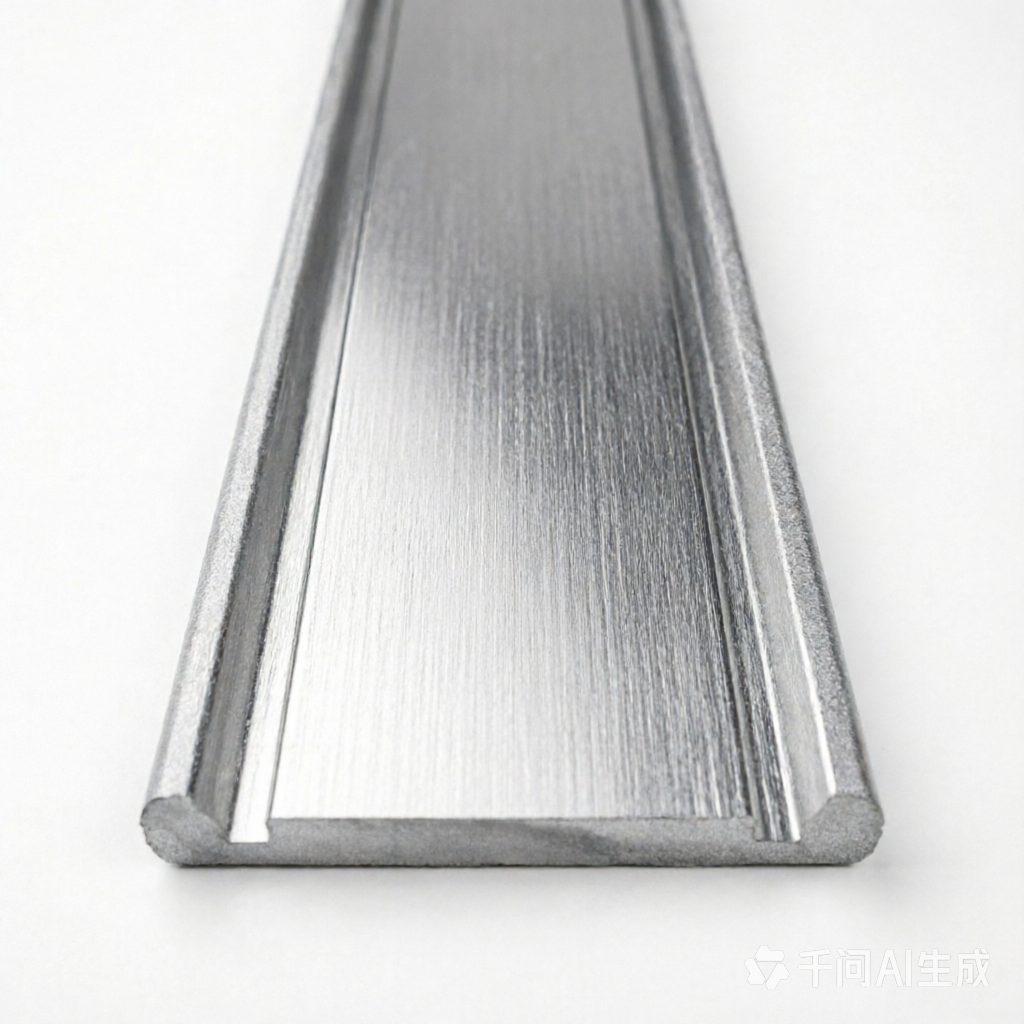
Aluminum product surface
Wire Drawing and Sandblasting Aluminum Profile
Wire drawn and sandblasted aluminum profiles in 80#-600# grain or Ra 0.8-1.5 um matte. Texture hides die lines and tool marks. Grit agreed per drawing.
Product Details
Short answer: wire drawing cuts a directional satin grain into the profile with abrasive belts, and sandblasting bombards it with fine media to leave a uniform matte at Ra 0.8–1.5 µm. Both are mechanical, both remove material rather than adding it, and both exist for the same two reasons: they hide the marks an extrusion and a machining pass leave behind, and they give the metal a texture. The choice between them, and the grit behind it, is decided by how much needs hiding and whether the part will be seen from more than one angle.
What these finishes actually do
It is worth being direct about the commercial value, because the marketing language around these finishes tends to bury it. The primary job of drawing and blasting is to make an imperfect surface look intentional. An extruded profile carries die lines along its length and a certain waviness across it; a machined part carries tool marks and the occasional handling scratch. Polishing removes these by making the surface flawless, which is expensive and unforgiving. Drawing and blasting remove them by replacing the original surface with a controlled texture, so the defects are no longer distinguishable from the finish.
The second job is appearance, and it is real. A drawn grain reads as machined metal and catches light in a way a painted surface cannot. A blasted matte reads as solid and industrial and does not glare under work lighting. Neither of these is decoration in the trivial sense; on equipment that people stand next to all day, glare and perceived solidity matter.
Both processes remove material, typically a few microns. That is small enough to ignore on most parts and not small enough to ignore on a precision fit, which is a point worth marking on the drawing.
Specifications
| Item | Range |
|---|---|
| Processes | Straight-grain wire drawing, random-grain wire drawing, sandblasting |
| Grit range for drawing | 80# to 600#, coarse to fine |
| Sandblasted roughness | Reference Ra 0.8–1.5 µm, set by media size and blasting pressure |
| Typical use of the texture | Concealing die lines, tool marks and handling scratches; decorative satin or matte appearance |
| Compatibility | Can be followed by anodizing or powder coating; blasting improves coating adhesion |
| Alloys | 6063-T5, 6061-T6 |
| Maximum part length | 6,500 mm |
| Inspection | Surface roughness reported per batch; visual check for consistency of grain |
The grit number decides almost everything
If a drawing says "brushed finish" and nothing else, two suppliers will deliver two different products, because the grit is what determines both the look and the hiding power.
| Grit | Result | What it hides | Typical use |
|---|---|---|---|
| 80#–120# | Bold, tactile grain, strong directionality | Deep die lines and visible scratches | Heavy equipment, industrial housings |
| 150#–240# | Balanced satin, clearly readable grain | Normal extrusion and machining marks | General equipment, appliance fascias |
| 320#–400# | Fine, soft grain, low contrast | Light marks only | Consumer product panels |
| 500#–600# | Very fine, close to a dull polish | Almost nothing; surface must be sound | Appearance parts with a good substrate |
The trade-off runs both ways. Coarse grit hides more but holds dirt, shows fingerprints, and is harder to clean. Fine grit looks better on a good substrate and exposes any defect that is there. If a batch has a surface problem, going coarser is a legitimate way to recover it, but it changes the product, so it should be agreed rather than decided in the finishing shop.
Straight grain against random grain
This choice causes more assembly problems than any other in brushed aluminum, and it is invisible on a single sample.
Straight-grain drawing runs the abrasive in one direction along the profile, leaving parallel lines. The grain has a direction, and light reflects differently depending on the angle between the grain and the viewer. Two parts from the same batch, one rotated 90° relative to the other, will read as two different shades when assembled side by side. On a long run of panels or a frame made from several lengths, all the grain has to run the same way, which is a drawing note, not something the shop can infer.
Random-grain drawing uses an oscillating or non-directional abrasive, so there is no preferred axis and no orientation problem. It is the safer choice for parts that will be assembled in mixed orientations, for complex shapes, and for anything where the drawing cannot guarantee how the pieces will be laid out. It gives up some of the crisp linear look of straight grain.
Sandblasting has no grain direction at all, so it sidesteps the problem entirely. That, along with its uniformity on complex shapes, is why it is often chosen for parts whose assembly orientation is unpredictable.
Sandblasting does a second job most buyers do not ask for
Beyond appearance, blasting roughens the surface at a microscopic scale, and that roughness is what an applied coating grips. A profile that is blasted before anodizing or powder coating holds its coating better than one that is only cleaned, particularly at edges and in areas that will see impact. If a part is going to be coated anyway and has surface marks to hide, blasting before coating does both jobs in one pass.
The limit is that blasting cannot fix a dimensional problem or a bent profile. It removes a few microns evenly; it does not straighten anything.
Where this fits
- Equipment housings and machine guards where die lines and handling marks should not be visible
- Electronic enclosures and control panels where a satin metal surface replaces paint
- Architectural trim and interior fittings where a brushed look is the design intent
- Parts that will be anodized or coated and need both a texture and better adhesion
- Recovering a batch whose extrusion surface is cosmetically marginal but structurally sound
Where it does not fit
- A part that has to be reflective. Drawing and blasting both scatter light by design; a mirror finish is the opposite process.
- Deep scratches or gouges. The texture hides shallow marks; it cannot fill a defect that is deeper than the material removed.
- Precision fits and sealing faces, which should be masked or left unprocessed.
- Parts where a consistent appearance across separate batches is critical and the grit is not specified on the drawing.
What to send for a quote
- The drawing, with the faces to be processed marked
- The finish you want: straight grain, random grain, or blasted matte
- The grit, or a sample of the texture you want to match
- For straight grain, the direction it should run, stated relative to the profile
- Whether the part will be anodized or coated afterwards, so blasting is sequenced for adhesion
- Quantity and the longest single length, checked against the 6,500 mm limit
A photograph is a poor reference for texture because grit does not survive a camera and a screen. A sample piece, even a small offcut, removes the guesswork.
FAQ
What roughness will the surface have?
For sandblasting, a reference Ra 0.8–1.5 µm depending on media size and pressure. For wire drawing, the roughness follows the grit rather than a single number, which is why the grit is the specification that matters. As a reference we work to the texture agreed on the drawing or the sample, and we confirm what the chosen process produces before the batch runs.
Can you match the brushed finish on a part I already have?
Usually, and a sample is the only reliable way to do it. Send the existing part or an offcut and we will identify the grain and grit that reproduces it. A photograph will not work: the grain direction, the grit and the base alloy all affect what the finish looks like, and none of them survive being photographed.
Will the grain direction be visible when parts are assembled?
Yes, with straight grain. Two identically finished parts rotated 90° to each other reflect light differently and read as different shades. If the assembly orientation is not fixed, specify random grain or sandblasting instead. If straight grain is required, mark the direction on the drawing and mark it on the parts so assembly can follow it.
Does drawing or blasting remove much material?
A few microns, which is negligible on a decorative face and not negligible on a precision fit. Masking or leaving critical faces unprocessed handles it. Tell us which dimensions are functional and they are kept out of the process.
Can the surface be anodized afterwards?
Yes, and it is the usual sequence: draw or blast first, then anodize, so the color sits on top of the texture and the grain stays visible through the film. Anodizing a drawn surface deepens the grain slightly. Blasting before coating also improves adhesion, which is a useful side effect if the part is going to be painted or powder coated.
What is the difference between brushed and blasted, in one line?
Brushed has a direction and reads as machined metal; blasted has no direction and reads as solid matte. Brushed is chosen when the linear look is wanted, blasted when uniformity matters more than texture and the part has complex geometry.
Send your drawing
Email linjunbing@truetrustlv.com with the drawing and either the grit or a sample of the texture you want. If the grain direction matters for assembly, mark it. You will get a process proposal, a quotation and the texture we can hold — reviewed by an engineer, not an auto-reply.
WhatsApp: +86 136 6644 0600
GET A QUOTE
Once you have submitted your requirements, we will contact you as soon as possible regarding your product inquiry.:Wire Drawing and Sandblasting Aluminum Profile