
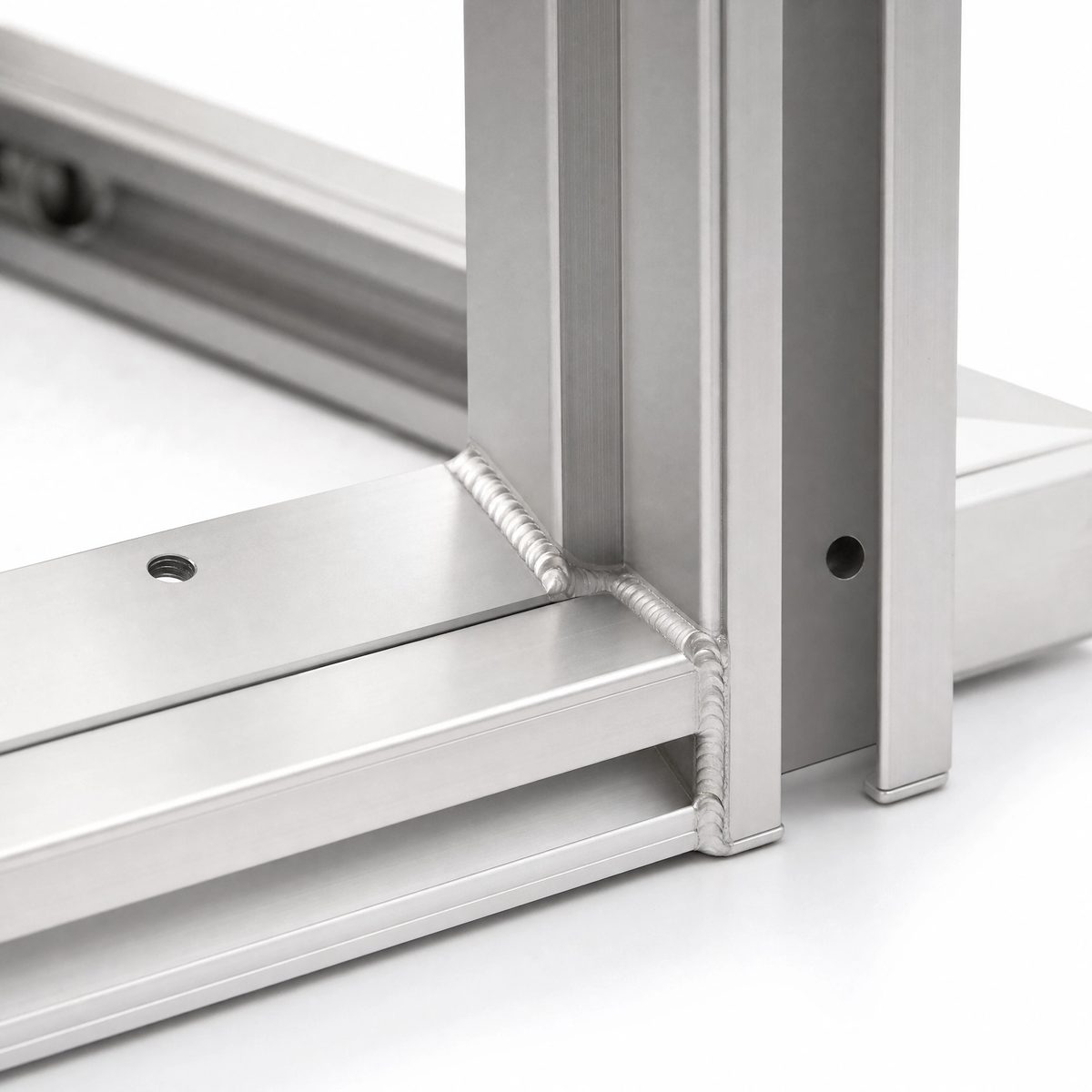
Aluminum Product Processing
Aluminum Profile Frame Welding - Rigid Machine Frames
Welded aluminium frames vs bolted: joint stiffness, HAZ strength at 50-65%, and why a precision frame must be machined after welding.
Product Details
An aluminium frame can be assembled two ways: bolted with connectors, or welded. Most equipment builders default to bolted because it is familiar, adjustable and needs no finishing. Welding is chosen when the frame has to be rigid, and it is chosen for the wrong reason surprisingly often — because a welded frame is stiffer only if the joints are designed for it, and much of that advantage is given back by the heat-affected zone.
We weld aluminium frames in 6061-T6, 6063-T5, 5052 and 5083, from 1 to 40 mm, using MIG, TIG, gas-shielded and spot welding, for automation frames, machine bases, conveyor supports, workbenches and safety guards.
Bolted or welded: the actual trade
| Bolted with connectors | Welded | |
|---|---|---|
| Joint stiffness | Low; the joint slips under load | High; the joint is continuous material |
| Dimensional accuracy | Good, adjustable on assembly | Drops after welding; needs machining for precision |
| Disassembly | Yes | No |
| Material strength at the joint | Parent metal, minus the bolt holes | 50–65% in the HAZ on heat-treatable alloys |
| Cost of fittings | High; connectors are expensive | Low; filler and labour instead |
| Finishing | Can be finished before assembly | Must be finished after welding |
| Lead time | Short; cut and assemble | Longer; fixture, weld, cool, machine |
The first and fourth rows are the real trade, and they pull in opposite directions. A welded joint is much stiffer because it is continuous — a bolted T-joint in a thin-wall profile has very little rotational restraint, so the frame racks. But the weld softens the material around it, so the joint is stiff and weaker at the same time.
What that means in practice: a welded frame is the right answer where the load is a stiffness requirement rather than a strength requirement. A machine base that must not deflect under a moving axis is a good case for welding. A frame that carries a heavy static load through its joints is not, unless the joints are thickened or the alloy is changed.
The thing most buyers do not know: it has to be machined after welding
This is the single most important practical point about a welded frame, and it is routinely missed in the enquiry.
A frame welded from six members will not have coplanar mounting faces. The shrinkage at each joint pulls the members by a fraction of a millimetre to a couple of millimetres, and the accumulated result is that the frame is out of square and its faces are not in one plane.
Every precision welded frame is therefore welded with machining stock on the critical faces, then set up once on a machine and all the critical faces machined in one setup. That is what produces a frame whose mounting faces are coplanar and whose holes line up.
Two consequences for the drawing:
- Allow stock. If a member is specified at its final dimension and welded, there is nothing left to machine. The face that has to be true needs 1–3 mm of stock, depending on the frame size.
- Say which faces are critical. Machining every face is expensive. Usually it is the mounting faces and the faces that carry linear rails, and nothing else.
A frame quoted without machining will be cheaper and will not be square. That is not a supplier problem; it is a specification problem.
Sequencing the welds
Distortion in a welded frame comes from shrinkage, and shrinkage is managed by sequence.
Balance about the neutral axis. A member welded on one side only shrinks that side and bows. Where the design allows a double-sided weld, the bow largely cancels.
Alternate opposite joints. Weld the two diagonally opposite corners, let them cool, then the other two. The shrinkage from one partially balances the other.
Work from the centre outward on long seams. Starting at one end and running to the other pushes the accumulated shrinkage to the far end; starting in the middle and running outward splits it.
Tack in a pattern before welding. A frame tacked only at the corners will move when the full welds are run. Tacks along the seam length hold the fit-up while the weld shrinks.
Let it cool in the fixture. Removing the clamps while the frame is still hot lets it distort freely. Cooling clamped controls the shape and leaves residual stress, which the machining step then relieves.
Specifications
| Item | Reference value |
|---|---|
| Applications | Automation frames, machine bases, conveyor supports, workbenches, safety guards |
| Alloys | 6061-T6, 6063-T5, 5052, 5083 |
| Processes | MIG, TIG, gas-shielded welding, spot welding |
| Thickness range | 1–40 mm |
| Weld metal strength | ≥85% of base metal |
| Joint efficiency in the HAZ | Reference 50–65% for heat-treatable alloys |
| Post-weld dimensional accuracy | Reference ±0.5 mm without machining; ±0.05 mm on machined faces |
| Machining stock on critical faces | 1–3 mm, depending on frame size |
| In-house support | Extrusion, die design, CNC machining, surface treatment |
| Downstream | CNC milling, drilling, tapping |
| Surface treatment | Anodising, powder coating, sandblasting, brushing |
| Standard | ISO 9001 quality management system |
Alloy choice for a welded frame
6061-T6 is the default for a welded machine frame: good strength, good machining, widely available. The caveat is the HAZ. If the frame's joints are the critical load path, thicken the members locally or accept a lower allowable at the joint.
6063-T5 is used where the frame is more about shape than strength: it extrudes into useful profiles with integral flanges and slots, and it welds easily. Lower strength, better finish.
5052 and 5083 are the under-used answer for welded frames. They are not heat-treatable, so the welded joint retains a much higher fraction of parent strength, and they are far more forgiving on cleaning and fit-up. If a frame is welded and then loaded, and the loads are moderate, 5083 will often outperform 6061 at the joint even though its parent strength is lower. The trade is that it does not extrude into complex profiles, so the frame is built from sheet, plate and simple sections rather than from a purpose-designed profile.
Where it does not fit
- The frame has to come apart for transport or for access. A welded frame does not. Use bolted connections at the split points and weld only the sub-frames.
- The tolerance on mounting faces is tight and there is no machining allowance. The frame will not be square. Either add stock or change the design to a bolted frame with adjustable connections.
- The frame is thin-wall and visible. Welding distorts thin wall, and the HAZ shows as a colour band after anodising. Powder coating hides the colour; it does not hide the distortion.
- The frame will be reworked regularly. Welded frames are not reworkable. If the machine layout will change, bolted is the right choice regardless of stiffness.
- The design assumes parent-metal strength at the welds. The HAZ is at 50–65 percent on 6xxx. Re-check the load case or change the alloy.
- The frame is very large. A large welded frame needs a large fixture and a large machine to finish it, and both have limits. Beyond a certain size, bolted construction with machined pads is the practical answer.
What to send for a quote
Send the frame assembly drawing with the weld locations, the member sections, the alloy, the critical faces marked, and the load the frame carries. Tell us the stiffness requirement if there is one — a frame specified by deflection rather than by strength is a different design conversation. And tell us whether the frame will be machined after welding, or whether it has to be accurate as welded; those two are priced very differently.
We will reply with the weld sequence, the fixture, the machining allowance we need, the tolerance we can confirm after welding and after machining, and the alloy recommendation. If the design has no allowance for machining and needs a tight tolerance, that goes in the reply.
FAQ
What tolerance can you hold on a welded frame?
Reference ±0.5 mm as welded and ±0.05 mm on faces machined after welding. That is the honest split: welding alone does not produce a precision frame, and any supplier who quotes a tight tolerance on an as-welded frame is either machining it or will not meet it. The value on your order is set by your drawing, and we confirm which faces we would machine and what stock they need before you order.
Is a welded frame stronger than a bolted one?
Stiffer, not necessarily stronger. A welded joint is continuous, so it resists rotation far better than a bolted connector in a thin-wall profile — that is where the stiffness comes from. But the weld softens the material around it to 50–65 percent of parent strength on a heat-treatable alloy, so the joint can be the weakest point. Stiffness and strength are two different questions and welding answers only the first by itself.
How is distortion controlled?
By sequence — alternate opposite corners, work from the centre outward on long seams, tack along the seam before welding — by balancing the weld about the neutral axis where the design allows, and by cooling the frame clamped in its fixture. For precision, the decisive control is machining the critical faces after welding.
Why does the frame need machining after welding?
Because shrinkage at each joint pulls the members out of square and out of plane. The accumulated error is typically a millimetre or more, which is far beyond a mounting-face tolerance. Welding with 1–3 mm of stock and machining all critical faces in one setup is what makes the faces coplanar and the holes line up.
Which alloy should I use?
6061-T6 for general machine frames, accepting the HAZ effect at the joints. 6063-T5 where the shape and finish matter more than strength. 5052 or 5083 where the frame is welded and loaded: their welded joints retain far more strength, at the cost of not being extrudable into complex profiles.
Can the frame be anodised?
Yes, after welding and machining. The weld and the HAZ anodise differently from the parent metal, so a visible weld will show as a band. Powder coating covers it; anodising does not. If the appearance matters, plan the weld onto a hidden face or change the finish.
How is it priced?
On the frame complexity, the total weld length, the fixture, the machining and the finishing. Machining after welding is a significant part of the cost on a precision frame, and a quote that omits it is quoting a frame that will not be square.
Send your drawing
Email the frame drawing with the weld locations, the critical faces and the load case to linjunbing@truetrustlv.com, or send it on WhatsApp at +86 136 6644 0600. You will get a weld sequence, a machining allowance and a written tolerance statement.
GET A QUOTE
Once you have submitted your requirements, we will contact you as soon as possible regarding your product inquiry.:Aluminum Profile Frame Welding - Rigid Machine Frames