
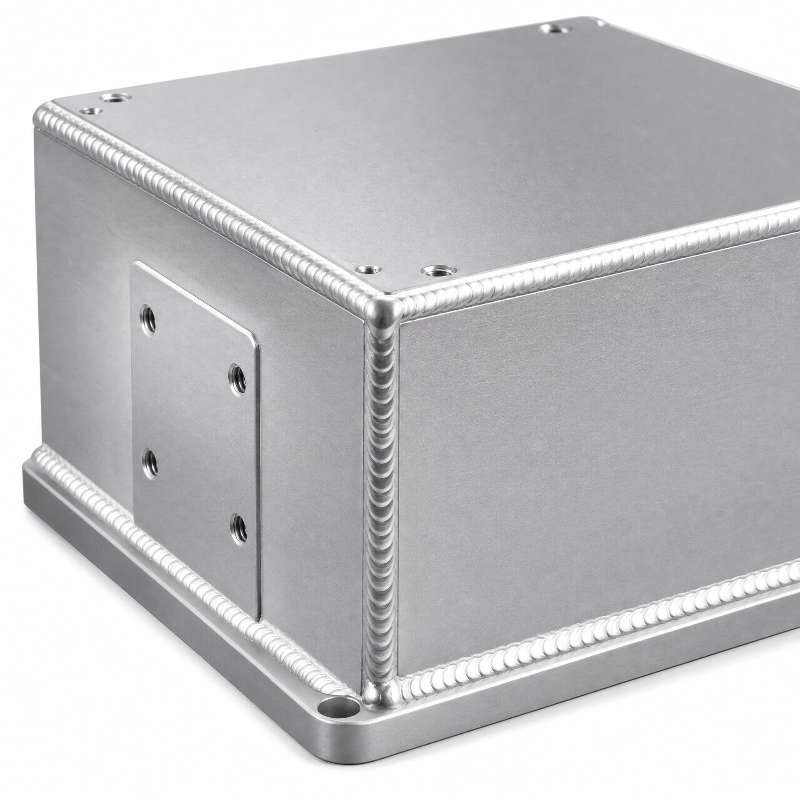
Aluminum Product Processing
Aluminum Enclosure Welding - Sealed Cabinets and Chassis
Welding aluminium control cabinets, chassis and battery boxes: hydrogen porosity control, leak testing, distortion sequence, 0.5-40 mm.
Product Details
An aluminium enclosure is usually specified by its dimensions and its appearance. It is judged by whether it keeps water out. That is a welding question, and on aluminium the answer is decided by hydrogen, not by the operator's skill.
We weld aluminium alloy enclosures — control cabinets, electronic chassis, communication boxes, distribution boxes, instrument housings and battery boxes — in 6063-T5, 6061-T6, 5052 and 5083, from 0.5 to 40 mm, using MIG, TIG, gas-shielded and robotic welding, with an ISO 9001 quality system.
Where porosity comes from, and why it is a hydrogen problem
Aluminium in the molten state dissolves a large amount of hydrogen, and on solidification it can hold almost none. Whatever is dissolved when the pool freezes has to come out, and it comes out as bubbles trapped in the weld. That is porosity, and it is the main reason an aluminium weld leaks.
The hydrogen does not come from the filler. It comes from the surfaces:
| Source | What it is | Control |
|---|---|---|
| Adsorbed moisture on the oxide layer | Aluminium oxide is hygroscopic; it holds water from the air | Clean and dry immediately before welding; limit the open time |
| Cutting fluid and oil residue | Hydrocarbons break down in the arc and release hydrogen | Degrease, then mechanical clean; not the other way round |
| Hydrated oxide from storage | Thick oxide on stock that has been stored damp | Stainless brush or machine to bright metal within the joint area |
| Shielding gas contamination | Moisture in the gas line or a leaking torch | Gas quality check, regular line purge, leak check |
| Filler wire surface | Moisture and drawing residue on the wire | Dry storage; do not leave spools open |
The order of cleaning matters and it is counter-intuitive. Degreasing first, then mechanical cleaning. If you brush first and degrease afterwards, you push contamination into the fresh surface you just created. And the mechanical clean has to happen close to the weld — an oxide layer regrows within hours in humid air, which is why "cleaned yesterday" is not the same as "cleaned".
Sealing is not the same as welding
A weld that looks continuous can still leak along a path that is not visible from outside. Three specific mechanisms:
Lack of fusion at the root. The weld sits on top of the joint but does not penetrate to the root, leaving a capillary gap. It looks sound and passes a visual check. It fails a leak test immediately.
Porosity connected through the section. Individual pores are harmless; a chain of them that connects the inside to the outside is a leak path. This is why a leak test is done after welding and not inferred from appearance.
Cracking at a corner. A corner is where three shrinkage directions meet, and it is the highest-stress point in a welded box. A small crater crack at a corner is a leak.
The practical answer is to test, not to inspect. A pressure decay test or a bubble test on the assembled enclosure tells you what a visual inspection cannot. For an IP-rated enclosure, the leak test is the acceptance criterion, and everything else is preparation for it.
Distortion: higher coefficient, faster heat
Aluminium expands about 23.6 µm per metre per degree, roughly twice steel, and it conducts heat about four times as fast. Those two facts produce a specific distortion behaviour: the heat spreads quickly, so the heated zone is wider and the shrinkage is distributed over a larger area, but the total contraction is larger.
For an enclosure, the consequence is that a box welded on the outside of the corners pulls out of square, and the flat panels between the welds bow.
The controls, in order of effectiveness for an enclosure:
- Weld sequence. Weld opposite corners in alternation, not one corner then the next. The shrinkage from one corner partially balances the other.
- Balanced joints. Where the design allows, weld from both sides or use a double-fillet instead of a single deep fillet. A symmetric weld shrinks symmetrically.
- Fixture. Clamp the box to a rigid frame and let it cool in the fixture. This controls the shape and locks in some stress, which then has to be considered if the box is machined afterwards.
- Heat input. Lower current and faster travel reduce the shrinkage per unit length. TIG at controlled heat input is better for thin enclosures than MIG at high current.
- Machining after welding. For a box with critical mounting faces, weld with stock and machine the faces after welding. This is the only method that reliably holds a tight tolerance on a welded enclosure.
Material choice: heat-treatable or not
This is a decision worth making deliberately, because it is often made by default.
5052 and 5083 are non-heat-treatable alloys. They have excellent weldability, their welded joints retain a high fraction of parent strength, they are highly corrosion resistant, and they form well. For an enclosure that has to be sealed and may see moisture, they are the natural choice.
6063-T5 and 6061-T6 are heat-treatable. They extrude into the profile shapes that make an enclosure easy to build — integral flanges, slots, screw channels — and they are stronger. But their welded joints lose strength in the heat-affected zone, as described elsewhere, and they are less forgiving of poor cleaning.
The usual arrangement is a hybrid: extruded 6061 or 6063 profiles for the frame, where the shape and the screw channels matter, and 5052 sheet for the panels, where sealability and formability matter. That combination is common for a reason.
Specifications
| Item | Reference value |
|---|---|
| Applications | Control cabinets, electronic chassis, communication boxes, distribution boxes, instrument housings, battery boxes |
| Alloys | 6063-T5, 6061-T6, 5052, 5083 |
| Processes | MIG, TIG, gas-shielded welding, robotic welding |
| Thickness range | 0.5–40 mm |
| Weld metal strength | ≥85% of base metal |
| Joint efficiency in the HAZ | Reference 50–65% for heat-treatable alloys |
| Leak test | Pressure decay or bubble test, on request |
| Downstream | Extrusion, die design, CNC finishing, surface treatment |
| Surface treatment | Anodising, powder coating, sandblasting, brushing |
| Quantity | Small batches supported |
| Standard | ISO 9001 quality management system |
What each enclosure type actually demands
| Enclosure | The requirement that decides the design | Typical product |
|---|---|---|
| Electrical control cabinet | Sealing plus structural stability | Distribution cabinets, control cabinets, outdoor boxes |
| Electronic chassis | Dimensional accuracy and a clean appearance | Industrial control chassis, server chassis, instrument housings |
| Communication box | EMC behaviour and heat dissipation | Telecom cabinets, base-station enclosures |
| Battery box | Sealing plus load capacity | Battery pack enclosures, energy storage boxes |
| Medical housing | Appearance and a smooth cleanable surface | Imaging equipment housings, instrument enclosures |
Note the second column. A control cabinet is judged on sealing; a chassis is judged on dimensional accuracy and appearance; a communication box is judged on EMC, which is a joint-continuity requirement as much as a welding one. These lead to different weld designs, and a single "weld it all round" approach serves none of them well.
On EMC specifically: the shielding effectiveness depends on the continuity of the conductive path, which means the joints need to be bonded, not just structurally welded. A spot-welded or riveted panel with an anodised surface is a poor shield, because the anodic layer is an insulator. If the enclosure is for EMC, the bonding points have to be bare metal, and that has to be planned before anodising.
Where it does not fit
- The enclosure has to be pressure-tight to a high standard and there is no leak test in the specification. Then the acceptance is appearance, and appearance does not predict sealing. Add the test, or accept the risk knowingly.
- The design has thin panels welded to thick frames with a single deep fillet. The heat imbalance distorts the thin panel. Use a thinner fillet, a balanced joint, or a mechanical fastening for the panel.
- The tolerance on mounting faces is tighter than ±0.5 mm on a welded box. Weld shrinkage will exceed it. Weld with stock and machine after welding.
- The enclosure must be anodised and the welds are visible. The weld and the heat-affected zone anodise differently from the parent metal, producing a visible band. This is a materials fact. Paint it, or design the weld onto a hidden face.
- The alloy is 6061-T6 and the design assumes parent strength at the joint. The HAZ is at 50–65 percent. Re-check the load case, or use 5052/5083 where the joint efficiency is much higher.
- The box is large and thin and has to hold a flat panel. Welding will bow the panel. A framed construction with a mechanically fixed panel, or a stress-relieved weld sequence, is the honest route.
What to send for a quote
Send the assembly drawing with the weld locations, the alloy and thickness of each part, the sealing requirement (IP rating or a leak rate), the surface finish, the quantity, and which faces are critical after welding. Tell us whether the enclosure has to provide EMC shielding — it changes the joint design and the finishing sequence.
We will reply with the weld process and sequence, the cleaning and preparation we require, the leak test we would perform, the distortion control, the alloy recommendation if the current one is fighting you, and the tolerance we can confirm after welding. Where a sealing or tolerance requirement cannot be met by welding alone, that goes in the reply.
FAQ
What tolerance and sealing can you hold on a welded enclosure?
Reference ±0.5 mm on overall dimensions after welding, with tighter tolerances achieved by welding with stock and machining the critical faces. Sealing is verified by a pressure decay or bubble test rather than by tolerance. These are capability references: the value on your order is set by your drawing, and we agree the leak test method and the dimensional acceptance in writing before you order.
How is aluminium enclosure welding different from steel welding?
Four ways that matter. Aluminium needs far higher heat input per unit thickness because it conducts heat away quickly, and it distorts more because its expansion coefficient is about twice steel's. Its oxide layer melts at a much higher temperature than the metal, so it has to be removed mechanically rather than burned through. And it absorbs hydrogen in the melt, which is why porosity and leaks are the dominant defect rather than a rare one.
How is distortion controlled?
By welding alternate corners rather than sequentially, by balancing the weld about the joint where possible, by fixturing the box and letting it cool clamped, by keeping heat input low, and by machining critical faces after welding when the tolerance demands it. The last is the only method that reliably holds a tight tolerance.
How is weld sealing ensured?
By preparation and by testing. Preparation means degreasing then mechanical cleaning close to the weld time, dry filler and clean gas. Testing means a pressure decay or bubble test on the finished enclosure, because a sound-looking weld can still have a root gap or a connected pore chain.
What materials and thicknesses can be welded?
6063-T5, 6061-T6, 5052 and 5083, from 0.5 mm up to about 40 mm depending on the process and the joint. Thin gauge needs TIG at controlled heat input; thick sections are more efficient with MIG. 5052 and 5083 are the better choice for a sealed enclosure because their welded joints retain more strength.
What surface treatments can follow welding?
Anodising (natural or black), powder coating, sandblasting and brushing. One caution: anodising a welded enclosure shows the heat-affected zone as a colour band, and welding after anodising is not possible without destroying the coating locally. Sequence it as weld, machine, then finish.
How is it priced?
On the enclosure complexity, the total weld length, the number of parts, the fixture, the leak test and the finishing. Distortion control and testing are real labour. A price that omits them is a price that will be renegotiated after the first lot fails a leak test.
Send your drawing
Email the assembly drawing with the weld locations, the alloys, the sealing requirement and the critical faces to linjunbing@truetrustlv.com, or send it on WhatsApp at +86 136 6644 0600. You will get a weld sequence, a leak test proposal and a written tolerance statement.
GET A QUOTE
Once you have submitted your requirements, we will contact you as soon as possible regarding your product inquiry.:Aluminum Enclosure Welding - Sealed Cabinets and Chassis