
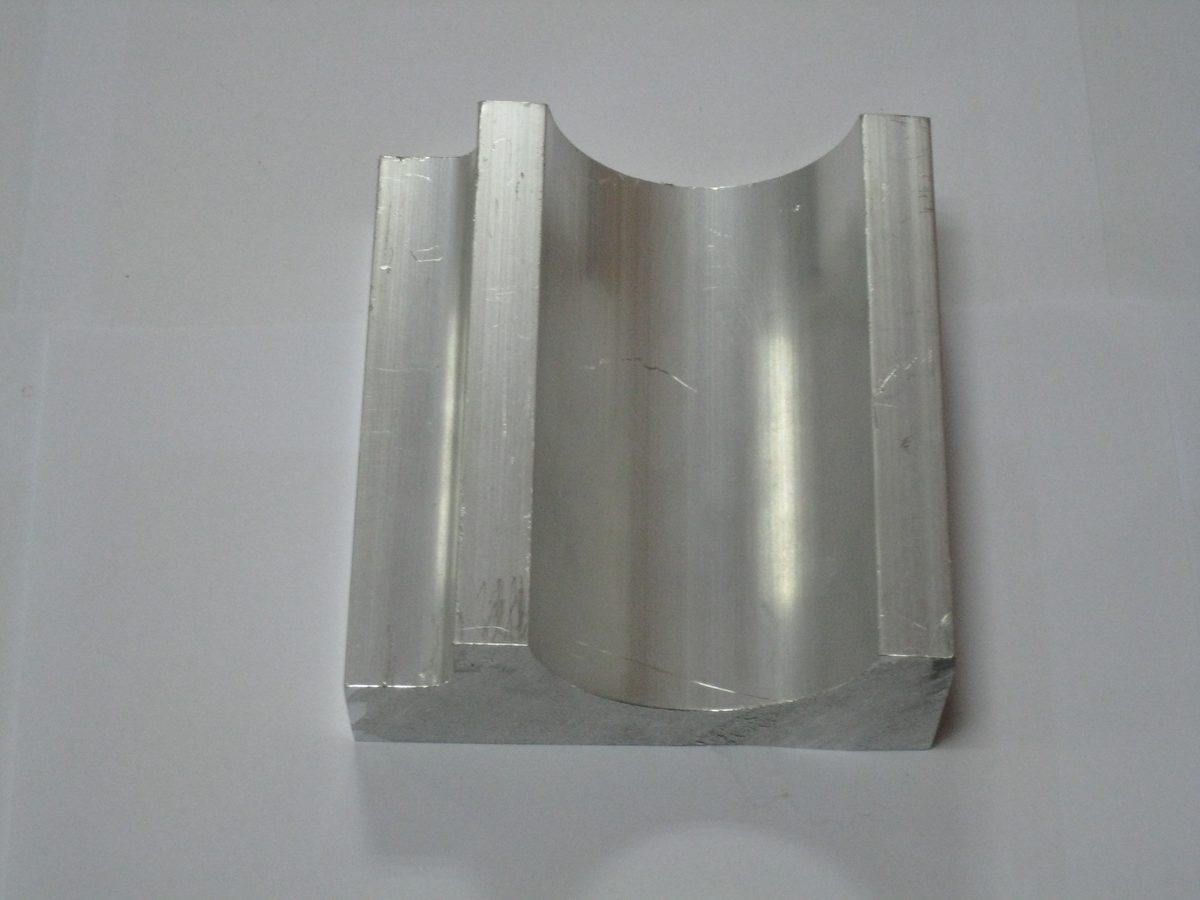
Aluminum Product Processing
Special-Alloy Aluminum Profiles - 6082 or 7075?
Most "7075 aerospace" enquiries are actually 6082-T6 jobs. What extrudes, what welds, what survives corrosion, and when T6 becomes T73.
Product Details
"We need 7075, aerospace grade." It is one of the most common opening lines in a special-alloy enquiry, and roughly four times out of five the honest answer is that the part does not need it. 7075 is the strongest aluminium in common commercial use — 524 MPa tensile in T6 — and it is also unweldable, poor in corrosion, prone to stress-corrosion cracking in the T6 temper, and effectively unextrudable as a complex section. A part that needs 340 MPa and a weldable joint is a 6082-T6 part, and specifying 7075 for it adds cost and removes options.
This page is about choosing the alloy for a profile that has to be extruded, which is a narrower question than choosing the strongest alloy available. We develop dies and supply extruded profiles in 6xxx, 5xxx and 7xxx grades, with the ageing regime and the inspection that the application requires, and machine to ±0.01 mm over a 6,500 mm bed.
The right question is not "how strong"
For a machined part from plate, strength is close to the only question and 7075 usually wins. For an extruded profile, four questions come before strength, and any one of them can remove an alloy from consideration:
- Can it be extruded into this section at all? A complex multi-cavity section with thin walls is a 6xxx job. The 7xxx and 2xxx families have narrow extrusion windows and high deformation resistance, and complex sections are not commercially produced in them.
- Can it be joined the way the assembly needs? 7075 and 2024 are not fusion weldable in any practical sense. If the design has a weld, those alloys are out.
- What is the environment? 2024 and 7075-T6 are the two alloys most associated with corrosion problems: 2024 is poor in general corrosion, and 7075-T6 is susceptible to stress-corrosion cracking under sustained tensile load in a humid or marine atmosphere.
- What does the whole route cost? A 7xxx part usually means plate, machining and scrap, with a much higher buy-to-fly ratio than an extruded 6xxx part near net shape.
The comparison that decides most enquiries
| Alloy / temper | Tensile / yield | Extrudability | Weldable | Corrosion | Where it belongs |
|---|---|---|---|---|---|
| 6063-T5 | ~150 / ~110 MPa | Excellent | Yes | Good | Architectural, light structure, heatsinks |
| 6061-T6 | ~310 / ~276 MPa | Good | Yes | Good | General structural, machined parts, fixtures |
| 6082-T6 | ~340 / ~310 MPa | Good | Yes | Good | Heavier structural, replaces 7075 in most welded frames |
| 6005A-T6 | ~300 / ~260 MPa | Good, needs on-line quench | Yes | Good | Fatigue-loaded sections, rail and transport |
| 5083-H321 | ~290 / ~230 MPa | Fair | Best of any | Excellent, marine | Marine, cryogenic, welded pressure work |
| 2024-T351 | ~470 / ~325 MPa | Poor | No | Poor; needs protection | Aircraft structure, machined from plate |
| 7075-T6 | ~524 / ~455 MPa | Very poor for complex sections | No | Fair; SCC risk in T6 | High-strength machined parts, simple bar sections |
| 7050-T7451 | ~500–562 / ~434–490 MPa | Plate and forgings, not complex extrusion | No | Good SCC resistance in T74 | Thick aerospace structure, machined |
Two rows in that table answer most of the enquiries we get. 6082-T6 at roughly 340 MPa covers the great majority of parts that arrive described as needing "high-strength aluminium", and it extrudes, machines and welds. 5083 covers anything that is welded and lives outdoors, at a strength that is adequate for most structures and with corrosion behaviour that no 7xxx alloy approaches.
Why 7xxx cannot simply be extruded into a complex section
The 7xxx family is difficult in ways that are structural rather than procedural, and no amount of care at the press removes them:
- Narrow temperature window. The gap between the temperature at which the alloy extrudes and the temperature at which it starts to melt or hot-crack is small. The 6xxx alloys tolerate a broad band; the 7xxx alloys do not.
- High deformation resistance. The press force needed is far higher for the same section, which limits how thin a wall or how complex a cavity can be produced.
- Much lower extrusion speed. Production rates for 7xxx are a fraction of those for 6xxx on the same section, and the cost reflects it.
- Severe die wear. The die does not survive the same tonnage, so the die cost per metre is higher even where the section is producible.
- Quench sensitivity. These alloys must be quenched immediately at the press exit to hold the temper, and a large or uneven section distorts during that quench.
The practical outcome: 7075 and 7050 reach the customer as plate, bar or forgings which are then machined, not as a 300 mm wide thin-walled extrusion. When a drawing shows a complex section in 7075, the productive conversation is usually about whether the section can be redesigned in 6082, or whether the part should be machined from 7075 plate — and those two options differ by a large factor in price.
Temper is a design decision, not a suffix
Two parts in the same alloy and different tempers can behave completely differently in service, and the difference is often more important than the alloy choice:
| Alloy | Temper | What it means | Trade-off |
|---|---|---|---|
| 7075 | T6 | Peak strength: about 524 MPa tensile, 455 MPa yield | Susceptible to stress-corrosion cracking under sustained tensile load |
| 7075 | T73 / T7351 | Over-aged deliberately for SCC resistance | Roughly 10–13 % lower strength than T6; the right choice for outdoor or humid service |
| 7050 | T7451 | Over-aged plate, high toughness, good SCC resistance | Lower strength than T6, but usable in thick sections without cracking |
| 6082 / 6005A | T6 | On-line quench plus artificial ageing | Distortion at the quench on thin, uneven sections |
| 5083 | H321 / O | Strain hardened, not heat treated | Cannot be strengthened by ageing; strength comes from the rolling and forming route |
The 7075 case is the one worth spelling out. A 7075-T6 part under sustained tensile stress in a humid atmosphere can crack along the grain boundaries with no visible warning and at a stress well below yield. A T73 temper costs about ten per cent of the strength and removes that failure mode. A customer who specifies 7075-T6 for an outdoor bracket has specified the strongest and least durable version of the alloy, and it is a conversation worth having before the material is ordered.
On-line quench: the extrusion detail that decides the temper
For heat-treatable 6xxx and 7xxx sections, the temper is set by what happens in the seconds after the metal leaves the die. The section must be cooled fast enough to hold the alloying elements in solution, then aged to precipitate them in a controlled way.
Two consequences that reach the customer:
Quench distortion. Fast cooling on an uneven section creates differential contraction, and the section bows or twists. The stiffer and more asymmetric the section, the worse it is. This is one reason a heat-treatable alloy is not automatically the right choice for a large thin-walled profile: the mechanical properties improve and the geometry gets worse.
Re-quenching a finished part rarely works. A part that is machined oversize and then re-heat-treated will move during the quench, and the distortion is not predictable enough to be machined out afterwards in a single pass. Where a part needs to be both fully aged and dimensionally accurate, the sequence is: extrude and quench, straighten, age, machine, and accept the residual stress or relieve it before the finishing cut.
Inspection is part of the product
A special alloy is bought on evidence as much as on composition, and the evidence has to be defined at enquiry stage:
- Material certificate with heat number, traceable to the ingot, with the chemical composition and the mechanical properties from the actual lot rather than a generic datasheet.
- Ultrasonic testing for internal defects — porosity, inclusions, internal cracks — which no visual inspection will find and which matter in a load-critical part.
- Penetrant testing for surface-breaking defects, particularly on machined features and at section transitions.
- CMM dimensional report against the marked drawing, on the features that matter, stated at a temperature.
- Hardness and conductivity as an indirect check that the temper is correct; conductivity in particular is sensitive to the ageing condition.
Where the application is aerospace or defence, the quality system requirements (AMS, or the equivalent national military standard) constrain the process, the records and the traceability, and they should be raised before quotation rather than after. A supplier who can meet them will quote differently once they know.
Specifications
| Item | Reference value |
|---|---|
| Alloy families | 6xxx (6061, 6063, 6005A, 6082), 5xxx (5052, 5083), 7xxx (7075, 7050 by machining), 2xxx (2024 by machining) |
| Typical tensile strength range | 150 MPa (6063-T5) to 562 MPa (7050-T7451) |
| Heat treatment | On-line quench plus artificial ageing; T6, T73, T7451 regimes |
| Extruded tolerance | ±0.02 to ±0.04 mm on the section |
| Machining tolerance | ±0.01 mm; ±0.02 to ±0.03 mm on critical assembly features |
| Maximum machined length | 6,500 mm |
| Non-destructive testing | Ultrasonic, dye penetrant, on request |
| Documentation | Material certificate with heat number, CMM report, hardness, conductivity |
| Quality systems | AMS and national military standard requirements supported |
| Standard | GB/T 6892-2023 high precision grade |
Where it does not fit
- Complex thin-walled sections in 7xxx or 2xxx. Not commercially extrudable at scale. The part is either redesigned in 6xxx or machined from plate, and both change the cost model.
- Welded assemblies in 7075 or 2024. Neither is fusion weldable in practice. Friction stir welding is possible on some 7xxx grades but it is a specialist process with its own constraints, not a substitute for a weldable alloy.
- Outdoor or marine service in 7075-T6. The SCC risk is real and the failure is sudden. Use T73, or move to 5083 or a 6xxx alloy.
- Parts where the strongest alloy is specified to avoid a design calculation. Over-specifying the alloy does not fix a stress concentration, a bad joint detail or a fatigue case; it only makes the part more expensive and less weldable.
- Small quantities of a new 7xxx section. Minimum extrusion quantities are higher for these alloys because the press setup and the die wear are worse, so a prototype in 7xxx is usually a machined part.
FAQ
What strength can you supply, and in what section?
From about 150 MPa tensile in 6063-T5 up to 524 MPa in 7075-T6 and roughly 562 MPa in 7050-T7451, and the section you can have depends on the alloy: complex thin-walled extrusions in 6xxx, simple sections and bar in 7xxx, and plate for the parts that need the highest strength. Those are capability references: the value on your order is set by your drawing, and the achievable combination of strength, section and tolerance is confirmed in writing before the die is cut.
Can I have 7075 extruded as a custom section?
Simple, thick-walled sections in 7075 are produced, but a complex multi-cavity thin-walled profile is not a realistic request in that alloy: the extrusion window is narrow, the press load is high and the die wears out quickly. If the section is complex, 6082-T6 is usually the answer, and if the strength genuinely requires 7075, the part is machined from plate.
What is the difference between 7075-T6 and 7075-T73?
About ten to thirteen per cent of the strength, and the removal of the stress-corrosion cracking risk. T73 is deliberately over-aged: the alloying elements precipitate more coarsely, which lowers strength and makes the grain boundaries resistant to cracking under sustained tensile load. For anything outdoors, humid or under constant load, T73 is the correct choice.
Is 6082 a downgrade from 7075?
In strength, yes: about 340 MPa against 524 MPa. In usefulness for an extruded, welded, corrosion-resistant structural part, it is usually an upgrade, because 7075 cannot be extruded into the section or welded at all. The right comparison is not 6082 against 7075; it is a 6082 extrusion near net shape against a 7075 plate machined down from solid, and the second is far more expensive.
Do you supply material certificates?
Yes — with the heat number, the chemical composition and the mechanical properties from the actual lot. For load-critical parts we also arrange ultrasonic and penetrant testing and provide the reports with the batch. If the application requires a specific aerospace or military quality system, say so at enquiry, because it changes what the process has to record.
Can a 7xxx part be welded at all?
Not by fusion welding in any practical production sense. Friction stir welding can join some 7xxx grades and is used in specific applications, but it is a specialist process with its own tooling and inspection requirements. If the design has a weld, choose a 6xxx or 5xxx alloy and design the strength around it.
Send your drawing
Email the drawing with the strength requirement, the environment, the joining method and the quantity to linjunbing@truetrustlv.com, or send it on WhatsApp at +86 136 6644 0600. You will get an alloy recommendation with the reasoning, a note on anything in the drawing that the alloy cannot do, and a written tolerance statement.
GET A QUOTE
Once you have submitted your requirements, we will contact you as soon as possible regarding your product inquiry.:Special-Alloy Aluminum Profiles - 6082 or 7075?