
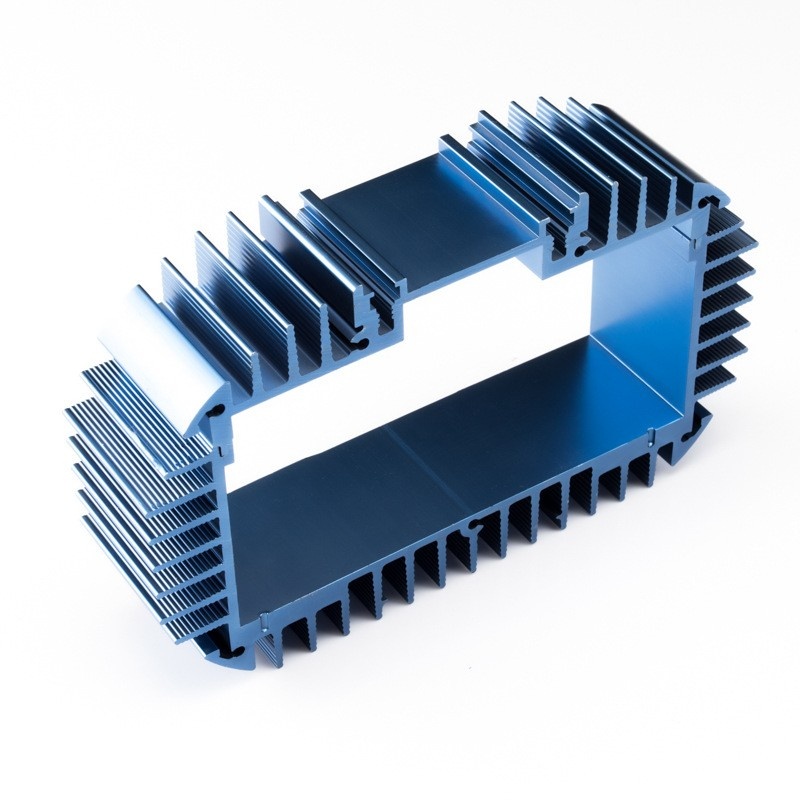
Aluminum profiles for radiators
Custom Colored Heat Sink Aluminum Profiles
Colored heat sink profiles matched to RAL or Pantone at Delta E 1.0, powder 60-80 um or anodizing 10-15 um, adhesion 4B. Color per your standard.
Product Details
Short answer: a colored heat sink is an extruded aluminum profile finished in the equipment maker's brand color without losing its thermal job. The color is delivered by powder coating at 60–80 µm, colored anodizing at 10–15 µm, electrophoretic coating, or fluorocarbon, chosen by how the color has to survive and by whether the color is even reachable in that process. Working reference: ΔE ≤ 1.0 batch to batch, cross-hatch adhesion 4B or better. Color, gloss and film are set by your drawing and your brand standard.
What it is used for
Heat sinks stopped being silver or black a while ago. Equipment makers now want the cooling part to match the enclosure, because an exposed fin stack in the wrong color reads as a bought-in component rather than a designed product.
Typical cases are branded equipment where the heat sink is visible, cabinet cooling profiles that have to match a painted panel, instrument and analyzer housings, outdoor kiosks and displays, audio and stage equipment, medical carts, and any product where the thermal part sits on the outside of the design language.
The difficulty is not the color itself. It is that the coating has to deliver the brand appearance, hold adhesion for the life of the product, and still let the part do its thermal job. Those three pull against each other, and the brief usually names only the first one.
Specifications
| Item | Working reference | How it is set |
|---|---|---|
| Color range | RAL and Pantone, plus sample matching | Set by your brand standard |
| Batch color difference | ΔE ≤ 1.0 | Set by your drawing |
| Gloss | Matte, semi-gloss or high gloss | Set by your drawing |
| Powder coating film | 60–80 µm | Set by your corrosion requirement |
| Colored anodizing film | 10–15 µm | Set by your drawing |
| Adhesion | Cross-hatch 4B or better, no cracking on impact | Set by your acceptance standard |
| Alloy | 6063-T5, about 201 W/m·K | Chosen against your load case |
| Masking | Threads, mating faces and grounding points | Per your assembly |
How it is made
- The section is extruded and cut, with the fin geometry formed in the die rather than added later.
- Surfaces are pre-treated for the chosen coating. On aluminum this step decides adhesion more than the coating itself does, and a skipped or rushed pre-treatment shows up as peeling in the field rather than at inspection.
- Coating or anodizing is applied to the agreed film thickness, with threads, mating faces and electrical contact points masked.
- The part is cured or sealed according to the process, then checked for color against the approved sample and for film thickness at several points.
- Adhesion and impact are tested on a sample from the batch, not only on the first article.
Where this fits
It fits when the heat sink is visible or has to match an enclosure, when the color is part of the product identity, and when the thermal duty leaves room for a coating in the path.
Where it does not fit: if the part runs at high heat flux through a coated face, a 70 µm organic film in the thermal path is a real resistance and should be designed around rather than ignored. If the required color is a saturated yellow or red, anodizing cannot reach it and the process has to change. And for a plain functional heat sink hidden inside a cabinet, color adds cost for nothing.
Choosing the process, and the trap in the brand color
Anodizing cannot make every color. Colored anodizing works within a metal palette: silver, champagne, bronze, black, gold tones, and the darker ranges that come from electrolytic coloring. A RAL 1023 traffic yellow or a RAL 3020 traffic red is not reachable that way. When a brand standard specifies those, the process is powder coating, electrophoretic coating or fluorocarbon, and that decision changes the film thickness, the thermal effect and the durability. It is worth settling before the drawing is frozen, because it is the most common mismatch we see between a brief and a process.
Film thickness is a thermal decision. Organic coatings conduct far worse than aluminum, so the film sits in the heat path as a resistance. At 10–15 µm of anodizing the effect is negligible and the emissivity gain more than offsets it. At 60–80 µm of powder the effect is small under forced convection but visible on a natural-convection part where the surface temperature is what drives the airflow. The rule we apply is simple: keep the coating off the surfaces that carry heat, and let it cover the surfaces that are seen.
Light colors radiate less, and that is the real conflict. A dark surface has high emissivity and radiates well. A pale yellow or white brand color does not. On a passively cooled outdoor part, the brand color can cost more in radiation than the coating costs in conduction. The practical fix, which we use often, is a split finish: black anodizing on the fin field where radiation and convection do the work, brand color on the visible outer faces. It costs one extra masking step and it lets the customer keep the design language without paying for it thermally.
Batch color consistency is a process discipline, not a promise. ΔE ≤ 1.0 across batches means the same pre-treatment line, the same film target and the same cure, plus a retained approved sample. When a supplier changes powder lot or line without telling anyone, the color drifts and the customer discovers it at assembly. We keep the approved sample and match against it.
What to send for a quote
- The section drawing with the surfaces that may be coated and the surfaces that must stay bare
- The color reference: RAL number, Pantone, or a physical sample
- Gloss level and any texture requirement
- Indoor or outdoor duty, and the corrosion or UV exposure expected
- Which faces carry heat, so masking can be planned before production
FAQ
Does the coating reduce heat dissipation?
Yes, by an amount that depends on the film and the duty. Anodizing at 10–15 µm is effectively neutral and its emissivity gain helps. Powder at 60–80 µm adds noticeable resistance in the path but is usually minor under forced convection. On natural convection, the coating on a heat-carrying face plus a pale color can together cost real degrees.
Can you match a specific RAL or Pantone color?
Yes, through powder coating, electrophoretic coating or fluorocarbon, with sample matching where the standard does not cover the shade. Batch color difference is held to ΔE ≤ 1.0 against the approved sample. Colored anodizing is limited to the metal palette, so a saturated brand color rules it out.
How is adhesion verified?
Cross-hatch to 4B or better, plus an impact test with no cracking or flaking. Both are run on samples from the production batch, because adhesion is a pre-treatment result and pre-treatment is where batch variation appears.
What about threads and mating faces?
They are masked. A coated thread loses its fit and a coated mating face adds resistance exactly where the heat enters. Masking is agreed at quotation, because it changes the process sequence and cannot be added later without stripping the part.
Which finish lasts outdoors?
Fluorocarbon for the longest service in strong UV and coastal air, powder coating in an outdoor grade for most equipment, and anodizing where the color palette allows. The decision is driven by the site, and a coating chosen for appearance alone often fails in year three on a coastal installation.
Can one part have two different finishes?
Yes, and on thermal parts it is often the right answer: black or anodized on the fin field, brand color on the visible faces. It needs masking and a defined sequence, so it has to be in the drawing rather than requested after the first batch.
Next step
Send the section drawing with the color reference and tell us which faces are seen and which faces carry heat. We will come back with a proposed process, a masking plan and a tolerance statement against your drawing.
Email: linjunbing@truetrustlv.com | Call or WhatsApp: +86 136 6644 0600
GET A QUOTE
Once you have submitted your requirements, we will contact you as soon as possible regarding your product inquiry.:Custom Colored Heat Sink Aluminum Profiles