Aluminum Profile Bending
Precision Stretch Bending
Aluminum profile stretch bending is a process that stretches aluminum alloy profiles to a custom arc using a stretch-bending machine, belonging to the cold-working category. The basic principle of stretch bending is to stretch the profile into the require
Product Details
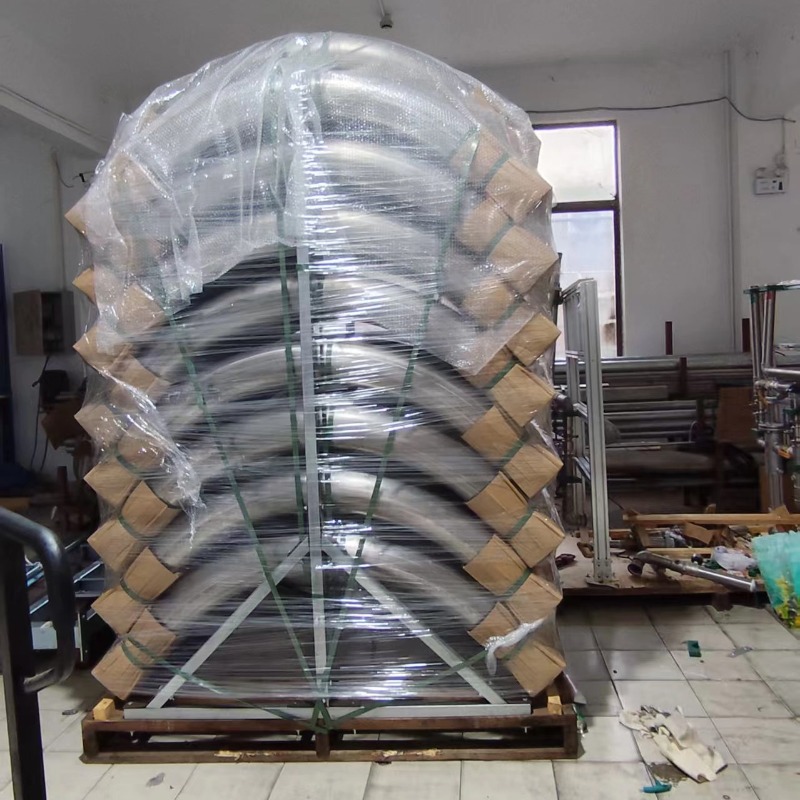
Aluminum profile stretch bending is a process that stretches aluminum alloy profiles to a custom arc using a stretch-bending machine, belonging to the cold-working category. The basic principle of stretch bending is to stretch the profile into the required arc by controlling the magnitude and direction of the tensile force, based on the material's elasticity, yield and elongation characteristics. Compared with ordinary bending, the advantage of stretch bending is a uniform and smooth arc, small cross-section deformation, and effective elimination of internal residual stress, making it especially suitable for arc-shaped structural parts with high requirements for arc uniformity and cross-section integrity.
Shanghai Chuangsi Aluminum Co., Ltd. is equipped with CNC stretch-bending machines and other precision processing equipment, capable of stretch bending, roll bending, press bending and other processes for aluminum profiles. Full-process one-stop delivery from extrusion and stretch bending to CNC machining and surface treatment.
01 Quality Starts with Raw Materials
Produced from A00 primary aluminum ingot with no scrap aluminum; the material is uniform and its mechanical properties are stable, ensuring the fatigue strength of stretch-bent profiles under arc-shaped loading conditions.
02 Precision CNC Stretch Bending
By controlling the direction and magnitude of the tensile force, the profile is stretched into the required arc. The arc is uniform and smooth, cross-section deformation is small, and internal residual stress is effectively eliminated. Wall thickness range is 0.8mm-6mm, bending error ±0.4mm, flatness 0.1mm-0.5mm.
03 Multi-Arc Form Processing
It supports conventional-arc stretch bending, fixed-arc stretch bending, large-arc stretch bending and multi-segment-arc stretch bending, meeting the needs of different equipment structures and arc designs.
04 One-Stop Delivery Service
Full-process one-stop delivery from extrusion and stretch bending to CNC machining and surface treatment, so the customer only deals with one supplier.
Stretch bending vs. roll bending vs. press bending:
| Comparison Item | Stretch Bending | Roll Bending | Press Bending |
|---|---|---|---|
| Forming Method | Tensile force + die bending | Continuous roller feed | Fixed-point angle forming |
| Arc Uniformity | High | Relatively high | General |
| Cross-Section Deformation | Small | General | Relatively large |
| Surface Quality | No press marks, no scratches | Slight roll marks | Bend marks present |
| Residual Stress | Effectively eliminated | Residual stress remains | Residual stress remains |
| Application Scenarios | High-precision arc-shaped structural parts | High-volume equal-cross-section arcs | Frames, bracket corners |
Machining capability parameters:
| Item | Parameter / Description |
|---|---|
| Processing Types | Aluminum profile stretch bending, roll bending, press bending |
| Available Materials | 6063-T5 / 6061-T6 / 6082-T6 |
| Arc Forms | Conventional arc, fixed arc, large arc, multi-segment arc |
| Wall Thickness Range | 0.8mm-6mm |
| Bending Error | ±0.4mm |
| Flatness | 0.1mm-0.5mm |
| Max. Processing Length | 6500mm |
| Extrusion Length | Up to 20M |
| Processing Equipment | CNC stretch-bending machines, roll bending machines, CNC bending machines |
| Supporting Processing | CNC milling, drilling, tapping, cutting, welding |
| Surface Treatment | Anodizing, hard anodizing, powder coating |
| Executive Standard | GB/T 6892-2023, ISO9001 |
| Production Location | Qingpu, Shanghai |
Main processing types:
-
Conventional-arc stretch bending: suitable for equipment frames and arc brackets
-
Fixed-arc stretch bending: stretch-formed to the arc specified by the customer
-
Large-arc stretch bending: suitable for long large-arc structural parts
-
Multi-segment-arc stretch bending: suitable for S-shaped/W-shaped multi-segment arc structural parts
-
Roll bending processing: suitable for high-volume, equal-cross-section arc processing
Typical Application Scenarios:
-
Curved frames for automation equipment
-
Bent rails for conveyor lines
-
Arc brackets for new-energy equipment
-
Precision instrument structural parts
-
Arc frames for equipment guards
-
Arc support structures for PV equipment
FAQ (Frequently Asked Questions)
Q1: What is the difference between stretch bending, roll bending and press bending?
A: Stretch bending applies a controllable tensile force to the profile through CNC stretch-bending equipment so the profile bends along a die, giving a uniform and smooth arc, small cross-section deformation and effective elimination of internal residual stress; it is suitable for arc-shaped structural parts with high requirements for arc uniformity and cross-section integrity. Roll bending gradually bends the profile through continuous roller feed and is suitable for high-volume, equal-cross-section arc processing. Press bending forms an angle (e.g., 90°) at specific positions of the profile and is suitable for frames, brackets and other structural parts needing straight corners. The three processes each have their applicable scenarios; our company can handle all of them and recommends the optimal solution according to the customer's design needs.
Q2: What accuracy can stretch bending achieve?
A: By precisely controlling the direction and magnitude of the tensile force through CNC stretch-bending equipment, the bending error is controlled within ±0.4mm and flatness at 0.1mm-0.5mm. The arc of stretch-bent profiles is uniform and smooth with small cross-section deformation; compared with ordinary press bending, it has higher arc accuracy and better surface quality.
Q3: Which materials and wall thicknesses of aluminum profiles can be stretch-bent?
A: It can process 6063-T5 (good formability, high surface finish), 6061-T6 (higher strength, suitable for equipment frames and arc brackets) and 6082-T6 (highest strength, better fatigue resistance, suitable for new-energy equipment, precision instruments and similar scenarios). The wall thickness range is 0.8mm-6mm; thin-wall profile stretch bending needs controlled tensile force to avoid deformation, while thick-wall profile stretch bending needs attention to equipment tonnage and springback compensation.
Q4: How is stretch bending charged?
A: Pricing is based on arc form, profile cross-section and wall thickness. Conventional arcs are priced per piece; large arcs and multi-segment arcs require additional evaluation of labor hours. Free sample-based evaluation and quotation are provided; please contact Manager Du at 13611846009.
Q5: What is the MOQ and lead time for stretch bending?
A: The MOQ is 50kg, supporting small-batch sampling. The sample lead time is 5-7 days (conventional arc) or 7-10 days (requiring mold development), and batch delivery is 7-15 days after sample confirmation. Because stretch bending requires tuning equipment tension and arc parameters, we recommend that the customer confirm the arc effect during the sample stage before batch production.
Q6: Can stretch-bent profiles undergo CNC machining and surface treatment afterward?
A: Yes. After stretch bending, CNC finishing (drilling, tapping, end-face milling, slotting, etc.) and surface treatment (natural/black anodizing, hard anodizing, powder coating, etc.) can be performed. Our company provides full-process one-stop delivery from extrusion and stretch bending to CNC machining and surface treatment, so the customer does not need multiple transshipments.

GET A QUOTE
Once you have submitted your requirements, we will contact you as soon as possible regarding your product inquiry.:Precision Stretch Bending