
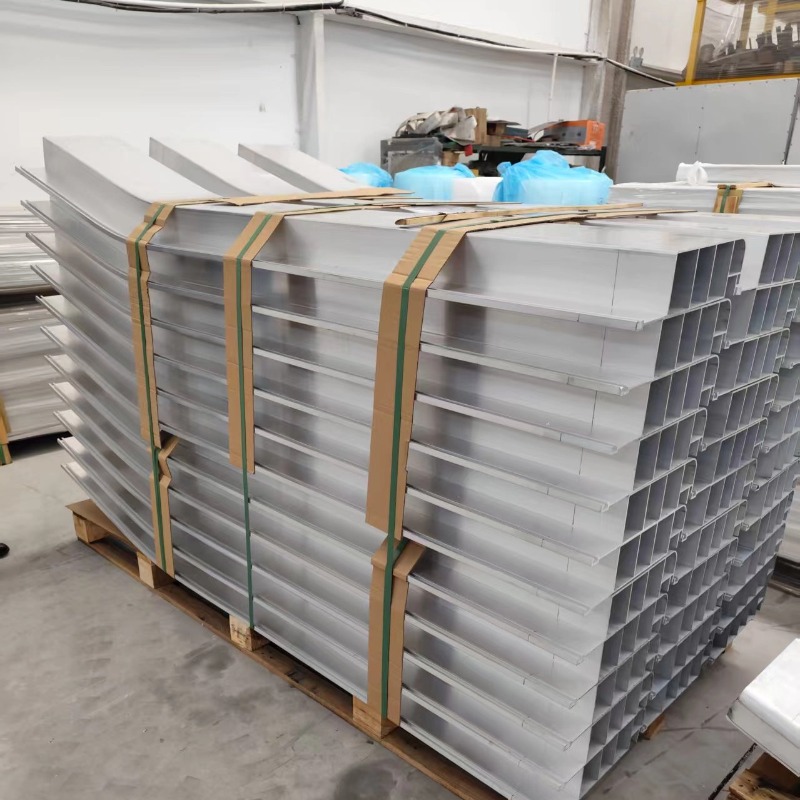
Aluminum Profile Bending
Multi-Segment Continuous Stretch Bending
Multi-segment continuous stretch bending means completing bending forming of multiple segments with different curvatures at different positions on the same profile; the radius and direction of each segment may differ. Compared with single-segment stretch
Product Details
Multi-segment continuous stretch bending means completing bending forming of multiple segments with different curvatures at different positions on the same profile; the radius and direction of each segment may differ. Compared with single-segment stretch bending, the difficulty of multi-segment continuous stretch bending lies in three areas: smooth transition control between curvatures - adjacent curvature segments must transition smoothly, with no creases or abrupt changes; accumulated deviation control - after multiple curvature segments are superimposed, the overall deviation must be controlled within range; and segmented springback compensation - each curvature segment requires independent springback compensation parameters.
Shanghai Chuangsi Aluminum Co., Ltd. is equipped with CNC stretch bending machines and can complete continuous stretch bending forming of multiple segments with different curvatures. Through CNC precise positioning and segmented springback compensation, curvature consistency of batch products is ensured. From extrusion and stretch bending to CNC machining and surface treatment, the full process is delivered as one-stop service.
01 Quality Starts With Raw Materials
Produced from A00 primary aluminum ingot, containing no scrap aluminum, with uniform material and stable mechanical properties, ensuring the fatigue resistance of multi-segment bent profiles under compound curvature conditions.
02 Multi-Segment Continuous Stretch Bending Forming
Continuous bending forming of multiple segments with different curvatures is completed on the same profile; each curvature segment is independently controlled, adjacent curvature segments transition smoothly, with no creases. Wall thickness 1mm-6mm, single-segment curvature error ±0.4mm, cumulative curvature deviation ≤ ±2mm.
03 Segmented Springback Compensation
For the different curvature segments of multi-segment continuous stretch bending, a segmented springback compensation process is adopted; bending parameters are independently adjusted for each curvature segment to ensure curvature consistency of batch products.
04 One-Stop Delivery Service
From extrusion and multi-segment continuous stretch bending to CNC machining and surface treatment, the full process is delivered as one-stop service, so customers only need to interface with one supplier.
Single-segment stretch bending vs. multi-segment continuous stretch bending:
| Comparison item | Single-segment stretch bending | Multi-segment continuous stretch bending |
|---|---|---|
| Bending shape | Single curvature | Multiple segments with different curvatures and directions |
| Number of curvature segments | One segment | 2-5 segments continuously formed |
| Process difficulty | Conventional | Relatively high |
| Core difficulty | Single springback compensation | Smooth transition + accumulated deviation + segmented compensation |
| Accumulated deviation | Easy to control | ≤±2mm |
| Equipment requirements | Conventional stretch bending machine | High-precision CNC stretch bending machine |
Processing capability parameters:
| Item | Parameter/Description |
|---|---|
| Processing type | Multi-segment continuous stretch bending, compound curvature forming |
| Applicable wall thickness | 1mm-6mm |
| Maximum machining length | 6500mm |
| Single-segment curvature error | ±0.4mm |
| Transition between adjacent curvature segments | Smooth transition, no creases |
| Cumulative curvature deviation | ≤±2mm |
| Applicable materials | 6063-T5, 6061-T6 |
| Processing equipment | CNC stretch bending machines, roll bending machines |
| Supporting machining | CNC milling, drilling, tapping, cutting |
| Surface treatment | Anodizing, electrostatic spraying |
| Execution standards | GB/T 6892-2023, ISO9001 |
| Production location | Qingpu, Shanghai |
Multi-segment continuous stretch bending types:
| Stretch bending type | Description | Typical applications |
|---|---|---|
| 2-segment same-direction stretch bending | U-shaped curvature, two bends in the same direction | Conveyor line supports, equipment base arc sections |
| 2-segment opposite-direction stretch bending | S-shaped curvature, two bends in opposite directions | Equipment connectors, transition bent rails |
| 3-segment compound stretch bending | Multi-direction multi-curvature bending | Equipment compound frames, multi-curvature bent rails |
| Multi-segment continuous stretch bending | Multi-segment curvature forming on the same profile | Complex structural components, non-standard connectors |
Processing key points:
The key to multi-segment continuous stretch bending lies in unified reference - all curvatures are positioned from the same datum surface to avoid accumulated deviation. Segmented springback compensation is adopted, with bending parameters independently adjusted for each curvature segment. Inspection reports are provided for each batch.
Typical application scenarios:
-
Compound frames for automated equipment
-
Multi-curvature connectors
-
Compound bent rails for conveyor lines
-
Complex curve structural components for new energy equipment
-
Multi-curvature borders for non-standard equipment
FAQ (Frequently Asked Questions)
Q1: What is the difference between multi-segment continuous stretch bending and single-segment stretch bending?
A: Single-segment stretch bending bends a profile into a single curvature, with a relatively simple process that only requires controlling the accuracy of one curvature segment. Multi-segment continuous stretch bending completes continuous bending forming of multiple segments with different curvatures and directions at different positions on the same profile; the difficulty lies in three aspects: first, smooth transition control between curvatures - adjacent curvature segments must transition smoothly, with no creases or abrupt changes; second, accumulated deviation control - after multiple curvature segments are superimposed, the overall deviation must be controlled within ≤ ±2mm; third, segmented springback compensation - each curvature segment requires independent springback compensation parameters. We ensure multi-segment stretch bending accuracy through CNC precise positioning and segmented springback compensation.
Q2: How is the cumulative curvature deviation of multi-segment continuous stretch bending controlled?
A: Cumulative curvature deviation refers to the total deviation between the end positions of the whole profile and the design values after multiple curvature segments are machined. We control the accumulated deviation through three links: first, unified reference - all curvatures are positioned from the same datum surface; second, segmented springback compensation - bending parameters are independently adjusted for each curvature segment; third, CNC precise positioning - the CNC system precisely controls the starting position and bending angle of each curvature segment. The cumulative deviation is controlled within ≤ ±2mm.
Q3: How is the smooth transition between adjacent curvature segments of multi-segment continuous stretch bending guaranteed?
A: The transition between adjacent curvature segments is the core difficulty of multi-segment stretch bending. We use the CNC system to precisely control the connection positions and angles of adjacent curvature segments, paired with dedicated molds and a segmented springback compensation process, to ensure smooth transitions between curvature segments with no creases. The surface quality and smoothness of transition areas directly affect the assembly effect and appearance quality of multi-curvature structural components.
Q4: How is multi-segment continuous stretch bending priced?
A: Pricing is based on a combination of the number of curvature segments, profile cross-section complexity, and wall thickness. 2-segment stretch bending is priced per piece, while 3-segment and above compound stretch bending requires additional evaluation of working hours and process difficulty. We provide free sample evaluation and quotation; please contact Manager Du at 13611846009.
Q5: What are the MOQ and lead time for multi-segment continuous stretch bending?
A: The MOQ is 50kg, supporting small-batch sampling. The sample lead time is 7-10 days (including multi-segment curvature debugging and trial bending verification), and batch delivery is 10-15 days after sample confirmation. Because multi-segment continuous stretch bending requires debugging of multi-segment curvature parameters and segmented springback compensation, the sample cycle is slightly longer than for single-segment stretch bending; we recommend discussing curvature combination requirements in advance.

GET A QUOTE
Once you have submitted your requirements, we will contact you as soon as possible regarding your product inquiry.:Multi-Segment Continuous Stretch Bending