
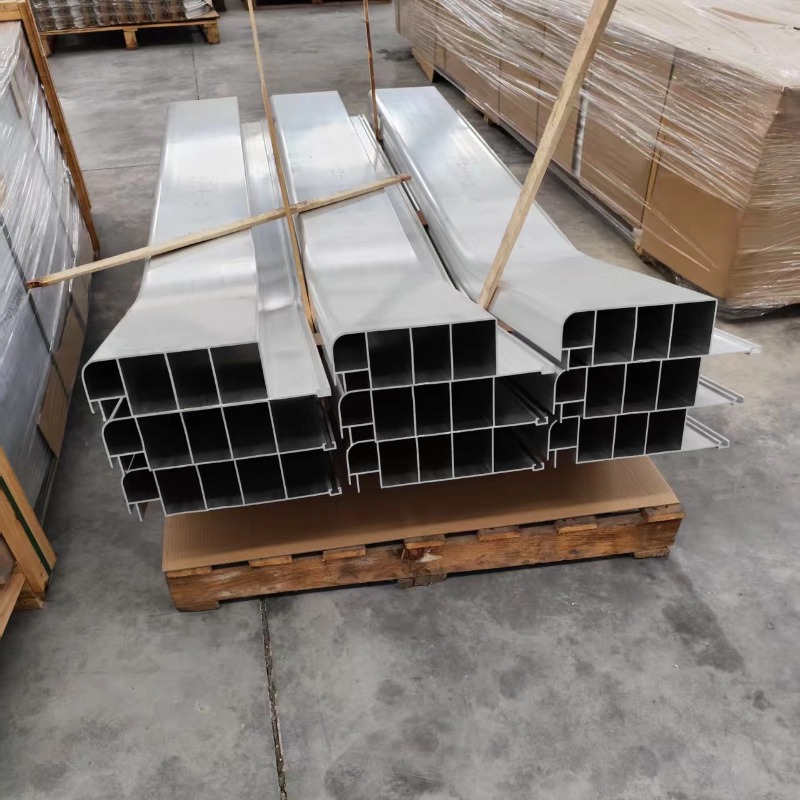
Aluminum Profile Bending
Heavy Thick-Wall Bending
Large-cross-section thick-wall aluminum profile bending is an important supporting process in the heavy industrial equipment field. When bending thickened aluminum profiles with wall thickness over 8mm, high tonnage is required from the bending machine, a
Product Details
Large-cross-section thick-wall aluminum profile bending is an important supporting process in the heavy industrial equipment field. When bending thickened aluminum profiles with wall thickness over 8mm, high tonnage is required from the bending machine, and more precise process parameters are needed for material springback compensation. Many processing shops can do thin-wall bending, but struggle to guarantee accuracy once thick-wall profiles are involved.
Shanghai Chuangsi Aluminum Co., Ltd. is equipped with large-tonnage CNC bending machines and can undertake bending of thickened aluminum profiles with wall thickness from 8mm to 12mm. Using a precise springback compensation algorithm, it effectively solves the problems of large springback and difficult accuracy assurance in thick-wall profile bending. From extrusion and bending to CNC machining and surface treatment, the full process is delivered as one-stop service.
01 Quality Starts With Raw Materials
Produced from A00 primary aluminum ingot, containing no scrap aluminum, with uniform material and stable mechanical properties, ensuring the structural strength of thick-wall profiles under heavy-load conditions.
02 Large-Tonnage Bending Equipment
Equipped with large-tonnage CNC bending machines, with a maximum machining length of 6500mm, ensuring thick-wall profiles are bent into place.
03 High-Precision Springback Control
Precise springback compensation algorithm, angle tolerance ±1 degrees, effectively solving the difficult problem of large springback in thick-wall profile bending.
04 One-Stop Delivery Service
From extrusion and bending to CNC machining and surface treatment, the full process is delivered as one-stop service, so customers only need to interface with one supplier.
Thick-wall bending vs. conventional bending:
| Comparison item | Conventional bending (wall thickness 1-3mm) | Thick-wall bending (wall thickness 8-12mm) |
|---|---|---|
| Wall thickness range | 1-3mm | 8-12mm |
| Equipment tonnage | Small/medium tonnage bending machine | Large-tonnage CNC bending machine |
| Springback amount | Small, easy to control | Large, requires precise springback compensation |
| Angle accuracy | ±1° | ±1 degrees (compensation algorithm required) |
| Mold requirements | Conventional molds | Thickened molds |
| Surface indentation | Slight | Requires mold polishing control |
| Applicable materials | 6063-T5 | 6061-T6, 6082-T6 |
Processing capability parameters:
| Item | Parameter/Description |
|---|---|
| Applicable wall thickness | 8mm-12mm |
| Bending type | Thickened right-angle bending, thick-wall U-shaped channels, heavy-load Z-shaped frames |
| Angle tolerance | ±1° |
| Maximum machining length | 6500mm |
| Applicable materials | 6061-T6 / 6082-T6 |
| Processing equipment | Large-tonnage CNC bending machines, CNC machining centers |
| Supporting machining | CNC milling, drilling, tapping, cutting, welding |
| Surface treatment | Anodizing, hard anodizing, electrostatic spraying |
| Execution standards | GB/T 6892-2023, ISO9001 |
| Production location | Qingpu, Shanghai |
Typical application scenarios:
-
Heavy equipment frames
-
Automotive bumpers
-
Rail transit structural components
-
Load-bearing beams for large machinery
-
New energy battery pack frames
FAQ (Frequently Asked Questions)
Q1: What is the difference between thick-wall aluminum profile bending and conventional thin-wall bending?
A: The difficulty of thin-wall profile bending (wall thickness 1-3mm) lies in cracking prevention; improper control of bending radius and mold angle easily causes cracks at the bend. Thick-wall profile bending (wall thickness 8-12mm) is difficult in two aspects: first, high equipment tonnage is required - bending aluminum profiles over 8mm requires a large-tonnage CNC bending machine, which ordinary bending machines cannot handle; second, springback control is difficult - thick-wall profiles spring back significantly after bending, requiring a precise springback compensation algorithm to guarantee angle accuracy. We use large-tonnage CNC bending machines paired with a precise springback compensation algorithm, controlling the angle tolerance within ±1 degrees.
Q2: How is the springback problem of thick-wall aluminum profile bending solved?
A: The elastic modulus of aluminum alloy is about 1/3 that of steel, and thick-wall profiles spring back more after bending. We use a precise springback compensation algorithm that calculates the springback amount based on parameters such as material grade, wall thickness, and bending angle, and pre-compensates accordingly. Trial bending verification is performed before batch machining, and batch production begins only after confirming the angle meets the standard, ensuring the angle tolerance is controlled within ±1 degrees.
Q3: How to choose between 6061-T6 and 6082-T6?
A: 6061-T6 is a general-purpose high-strength aluminum alloy with tensile strength ≥310MPa and good formability, suitable for most heavy equipment frames and heavy machine base scenarios; 6082-T6 has higher strength (tensile strength ≥330MPa) and better fatigue resistance, suitable for scenarios with higher strength and fatigue resistance requirements such as rail transit structural components, automotive bumpers, and load-bearing beams for large machinery. We can process both materials.
Q4: Will surface indentation appear after thick-wall aluminum profile bending?
A: Thick-wall profile bending requires large bending force, and the contact pressure between the mold and the profile surface is high. We use thickened mold configuration and surface polishing to reduce surface indentation during thick-wall bending. The post-bending surface quality meets the usage and appearance requirements of heavy structural components.
Q5: How is thick-wall bending priced?
A: Pricing is based on a combination of wall thickness, bending length, and bending angle. 8-12mm thick-wall profiles require large-tonnage equipment and springback compensation processes, so their processing cost is higher than that of conventional wall-thickness profiles. We provide free sample evaluation and quotation; please contact Manager Du at 13611846009.
Q6: What are the MOQ and lead time for thick-wall aluminum profile bending?
A: The MOQ is 50kg. The sample lead time is 7-10 days (trial bending verification of springback parameters is required), and batch delivery is 10-20 days after sample confirmation. Because thick-wall profiles require trial bending verification of springback parameters and angle compensation, the sample cycle is slightly longer than for thin-wall profiles.

GET A QUOTE
Once you have submitted your requirements, we will contact you as soon as possible regarding your product inquiry.:Heavy Thick-Wall Bending