Aluminum Profile Bending
Irregular Compound Bending
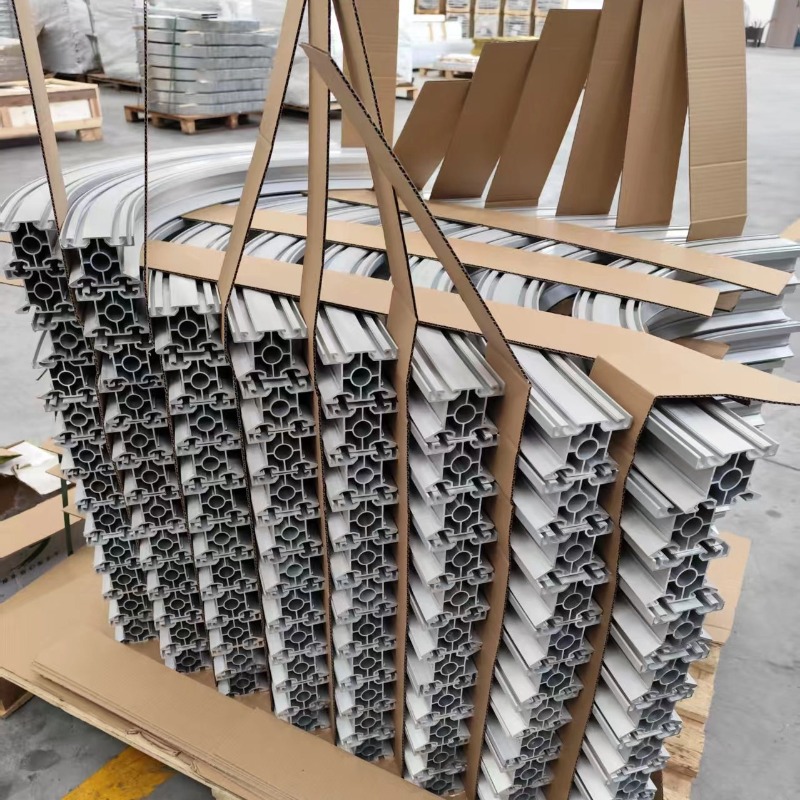
Compound bending of irregular cross-section aluminum profiles refers to completing continuous bending at multiple angles and multiple directions on the same profile. The compound bending of multi-cavity profiles and asymmetrical cross-section profiles is
Product Details
Compound bending of irregular cross-section aluminum profiles refers to completing continuous bending at multiple angles and multiple directions on the same profile. The compound bending of multi-cavity profiles and asymmetrical cross-section profiles is far more difficult than ordinary profiles - the cavity structure easily deforms and collapses during bending, and the uneven stress on asymmetrical cross-sections easily causes torsion and dimensional deviation. Many bending shops can do single bends, but when faced with multi-angle compound bending they struggle to ensure angle consistency across sections and overall length accuracy.
Shanghai Chuangsi Aluminum Co., Ltd. is equipped with CNC press brakes and other precision processing equipment, capable of completing continuous bending of 2-5 sections at different angles. Through CNC precise positioning and segmented springback compensation, we ensure angle consistency in batch products. We deliver one-stop full-process from extrusion and bending to CNC machining and surface treatment.
01 Quality Starts with Raw Materials
Produced from A00 primary aluminum ingot, containing no scrap aluminum, with uniform material and stable mechanical properties, ensuring the structural integrity of irregular profiles under compound bending conditions.
02 Precision Bending Equipment
Equipped with CNC press brakes and CNC machining centers, with machining accuracy controllable within ±0.01mm.
03 Segmented Springback Compensation
Each bending section's angle is independently adjusted to ensure consistent bending angles for irregular cross-sections and avoid torsion.
04 One-Stop Delivery Service
Full-process one-stop delivery from extrusion and bending to CNC machining and surface treatment; the customer only interfaces with one supplier.
Processing Capability Parameters:
| Item | Parameter / Description |
|---|---|
| Applicable Cross-Section Types | Multi-cavity profiles, asymmetrical cross-sections, irregular cross-sections |
| Bending Type | 2-5 section continuous bending, multi-angle compound bending, irregular bending |
| Applicable Wall Thickness | 1mm-6mm |
| Maximum Processing Length | 6500mm |
| Single-Section Bending Angle | 30°-150° |
| Angle Tolerance | ±1° |
| Spacing Between Adjacent Bending Sections | ±0.5mm |
| Cumulative Overall-Length Deviation | ≤±2mm |
| Applicable Materials | 6063-T5, 6061-T6 |
| Processing Equipment | CNC press brakes, CNC machining centers |
| Supporting Processing | CNC milling, drilling, tapping, cutting |
| Surface Treatment | Anodizing, electrostatic powder coating |
| Executive Standard | GB/T 6892-2023, ISO9001 |
| Production Location | Qingpu, Shanghai |
Compound Bending Types:
| Bending Type | Description | Typical Applications |
|---|---|---|
| 2-section same-direction bend (U-shape) | Two bends in the same direction | Conveyor line brackets, equipment bases |
| 2-section opposite-direction bend (Z-shape) | Two bends in opposite directions | Equipment connectors, transition brackets |
| 3-section compound bend | Multiple bends in multiple directions | Equipment compound frames, cabinet skeletons |
| 4-5 section continuous bend | Complex multi-section bending | Complex structural parts, non-standard connectors |
Typical Application Scenarios:
-
Compound frames for automation equipment
-
Multi-bend cabinet structures
-
Compound brackets for conveyor lines
-
Multi-angle connectors
-
Structural parts for new energy equipment
FAQ (Frequently Asked Questions)
Q1: What is the difference between irregular cross-section compound bending and ordinary profile bending?
A: Ordinary profile bending (e.g., solid or simple symmetrical cross-sections) receives uniform stress and can be completed in a single bend. Irregular cross-section compound bending is far more difficult - in multi-cavity profiles the cavity structure easily deforms and collapses during bending, and the uneven stress on asymmetrical cross-sections easily causes torsion and dimensional deviation. We effectively solve the challenges of irregular cross-section compound bending through segmented springback compensation (independently adjusting each bending section's angle) and precision mold control.
Q2: What does 2-5 section continuous bending in compound bending mean?
A: Compound bending refers to completing continuous bending at multiple angles and multiple directions on the same profile. A 2-section same-direction bend forms a U-shape, suitable for conveyor line brackets and equipment bases; a 2-section opposite-direction bend forms a Z-shape, suitable for equipment connectors and transition brackets; a 3-section compound bend is suitable for equipment compound frames and cabinet skeletons; a 4-5 section continuous bend is suitable for complex structural parts and non-standard connectors. The more sections and the more complex the directions, the higher the bending difficulty. We can complete continuous bending of 2-5 sections.
Q3: How is cavity collapse prevented when bending multi-cavity profiles?
A: When bending multi-cavity profiles, the internal cavities lack support and are extremely prone to collapse deformation. We prevent cavity deformation through two measures: first, adding internal-cavity support structures in the bending die to support the profile cavity from the inside during bending; second, controlling speed and pressure during bending to avoid excessive localized stress. After bending, full inspection confirms the cross-sectional shape is intact, ensuring cavity dimensions meet assembly requirements.
Q4: How is torsion prevented when bending asymmetrical cross-section profiles?
A: Asymmetrical cross-section profiles receive uneven stress and easily develop torsion and dimensional deviation during bending. We develop dedicated bending solutions for asymmetrical cross-sections: precisely controlling each bending section's angle through segmented springback compensation, and fixing the profile position with dedicated fixtures to prevent torsional deformation during bending, ensuring angle consistency across sections and overall length accuracy.
Q5: How is compound bending charged?
A: Pricing is based on a combination of number of bending sections, profile cross-section complexity and wall thickness. 2-section bends are priced per piece; 3-5 section multi-section compound bends require additional assessment of working hours and process difficulty. We offer free evaluation and quoting from samples - please contact Manager Du at 13611846009.
Q6: What is the MOQ and lead time for compound bending?
A: The MOQ is 50kg, supporting small-batch sampling. The sample lead time is 7-10 days (requiring adjustment of multi-section bending parameters), and mass production delivery is 10-20 days after sample approval. Because compound bending requires adjusting multi-section angles and segmented springback compensation, we recommend confirming the first-article result before mass production.

GET A QUOTE
Once you have submitted your requirements, we will contact you as soon as possible regarding your product inquiry.:Irregular Compound Bending