Aluminum Profile Bending
Custom Multi-Curvature Stretch Bending
Multi-curvature stretch bending of aluminum profiles is a cold-bending process that can bend aluminum profiles and tubes of various cross-sections. Beyond standard circular arcs, it can form U-shaped, S-shaped, W-shaped, elliptical, parabolic, arc-with-st
Product Details
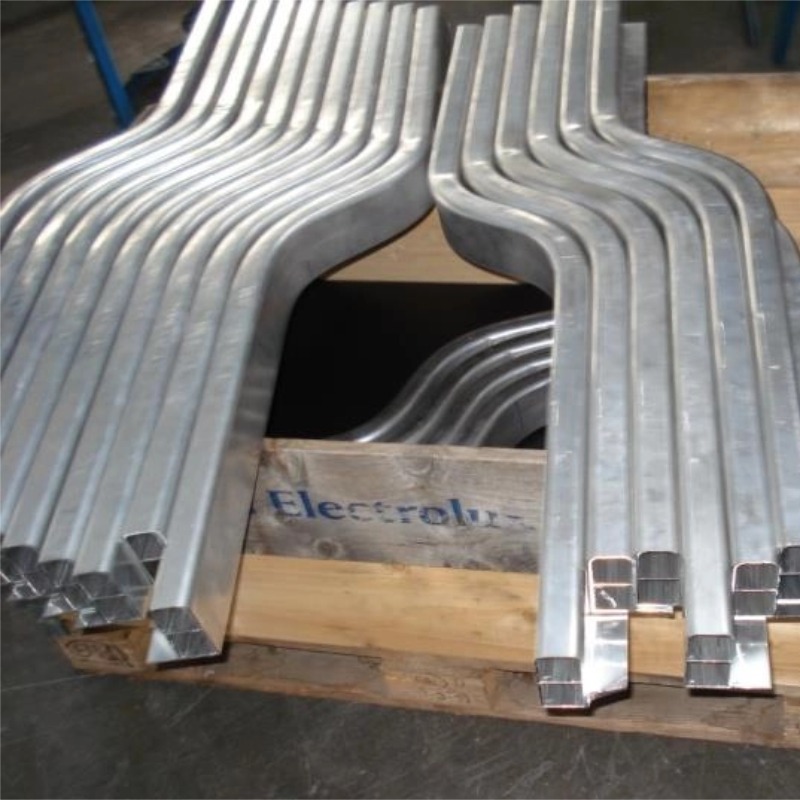
Multi-curvature stretch bending of aluminum profiles is a cold-bending process that can bend aluminum profiles and tubes of various cross-sections. Beyond standard circular arcs, it can form U-shaped, S-shaped, W-shaped, elliptical, parabolic, arc-with-straight-segment, and conical curved shapes.
The core difference between multi-curvature and single-curvature stretch bending is that multi-segment bends of different radii are formed continuously on one profile, demanding higher equipment precision and process control. Materials already treated by coating, e-coat, electroplating, polishing, or brushing can be bent directly, with no press marks or scratches on the surface.
Shanghai Chuangsi Aluminum provides a full-process one-stop service from extrusion and stretch bending to CNC machining and surface treatment. Equipped with professional stretch-bending equipment, we control tension direction and force according to material properties, with bend-radius error within ±0.4mm, flatness 0.1mm-0.5mm, and extrusion length up to 20m.
01 Quality Starts from Raw Materials
Produced from A00 primary aluminum ingot with no scrap aluminum, giving uniform material and stable mechanical properties, ensuring structural integrity of multi-curvature profiles under complex-curve service conditions.
02 Multi-Curvature Stretch Bending
We can form standard arcs, U-shaped, L-shaped, S-shaped, W-shaped, elliptical, parabolic, and conical curved shapes, with bend-radius error within ±0.4mm and flatness 0.1mm-0.5mm.
03 Direct Bending of Surface-Treated Profiles
Materials already treated by coating, e-coat, electroplating, polishing, or brushing can be bent directly, with no press marks or scratches, and without the waviness and creases caused by ordinary press bending.
04 One-Stop Delivery Service
From extrusion and stretch bending to CNC machining and surface treatment, the full process is delivered one-stop, so the customer deals with only one supplier.
Multi-curvature vs. single-curvature stretch bending:
| Comparison item | Single-curvature stretch bending | Multi-curvature stretch bending |
|---|---|---|
| Bend shape | Single standard arc | S-shaped, W-shaped, U-shaped, elliptical, parabolic, and other multi-segment curves |
| Number of curvatures | One curvature | Continuous forming of multiple curvatures |
| Process difficulty | Standard | Higher, requires segmented springback compensation |
| Equipment requirement | Standard stretch-bend machine | High-precision CNC stretch-bend equipment |
| Precision control | Single springback compensation | Separate compensation for each curvature |
Machining capability parameters:
| Item | Parameter/Description |
|---|---|
| Bend shape | Standard arc, U-shaped, L-shaped, S-shaped, W-shaped, elliptical, parabolic, conical curve |
| Applicable alloys | 6063-T5 / 6061-T6 / 6082-T6 |
| Applicable cross-sections | Round tube, square tube, channel, angle, contoured profiles |
| Bend-radius error | ±0.4mm |
| Flatness | 0.1mm-0.5mm |
| Extrusion length | Up to 20m |
| Machining equipment | Stretch-bend machine, roll-bend machine |
| Supporting processing | Mold development, extrusion, CNC machining, welding |
| Surface treatment | Anodizing, hard anodizing, coating |
| Executive standard | GB/T 6892-2023, ISO9001 |
| Production location | Qingpu, Shanghai |
Multi-curvature stretch bending types:
-
S-shaped stretch bending: suited to equipment connectors, transition curved rails
-
W-shaped stretch bending: suited to multi-curvature connectors, complex structural frames
-
U-shaped stretch bending: suited to conveyor line supports, equipment base arc segments
-
Elliptical/parabolic stretch bending: suited to curved structures, contoured frames
-
Multi-shape bending on one profile: multiple curvatures on a single profile
Typical applications:
-
Complex curved structural parts
-
Multi-curvature connectors
-
Contoured frames
-
Curved structures
-
Multi-curvature frames for automated equipment
FAQ (Frequently Asked Questions)
Q1: What is the difference between multi-curvature and single-curvature stretch bending?
A: Single-curvature stretch bending bends the profile into one radius (such as a standard arc), and is relatively simple. Multi-curvature stretch bending forms multiple segments of different radii continuously on one profile (such as S-shaped, W-shaped, elliptical, or parabolic), where each segment's radius and direction may differ, demanding higher equipment precision and process control. The difficulty lies in three areas: smooth transition between curvatures, cumulative error control, and segmented springback compensation.
Q2: Which shapes can multi-curvature stretch bending form?
A: We can form standard arcs, U-shaped, L-shaped, S-shaped, W-shaped, elliptical, parabolic, arc-with-straight-segment, and conical curves. S-shaped bending suits equipment connectors and transition curved rails; W-shaped suits multi-curvature connectors and complex structural frames; U-shaped suits conveyor line supports and equipment base arc segments; elliptical/parabolic suits curved structures and contoured frames.
Q3: Can surface-treated profiles be stretch-bent directly?
A: Yes. One feature of multi-curvature stretch bending is that profiles already treated by coating, e-coat, electroplating, polishing, or brushing can be bent directly, with no press marks or scratches and without the waviness and creases of ordinary press bending. This advantage makes multi-curvature stretch bending especially suited to curved structures and appearance parts requiring surface quality.
Q4: What precision can multi-curvature stretch bending achieve?
A: Professional stretch-bend equipment precisely controls tension direction and force, holding bend-radius error within ±0.4mm and flatness at 0.1mm-0.5mm. Transitions between curvatures are smooth, and cumulative error is held within design tolerance.
Q5: How is multi-curvature stretch bending priced?
A: Priced by curvature complexity, profile cross-section, and wall thickness. S-shaped and U-shaped bending is priced per piece; W-shaped and multi-segment composite curvatures require extra evaluation of labor and process difficulty. Free evaluation and quotation on samples. Contact Manager Du at 13611846009.
Q6: What are the MOQ and lead time for multi-curvature stretch bending?
A: MOQ is 50kg, supporting small-batch prototyping. Sample lead time is 7-10 days (requiring setup of multi-segment curvature parameters), and batch lead time is 10-20 days after sample confirmation. Because multi-curvature bending requires setting up segments and springback compensation, sample lead time is slightly longer than single-curvature bending; we recommend discussing curvature combinations in advance.

GET A QUOTE
Once you have submitted your requirements, we will contact you as soon as possible regarding your product inquiry.:Custom Multi-Curvature Stretch Bending