
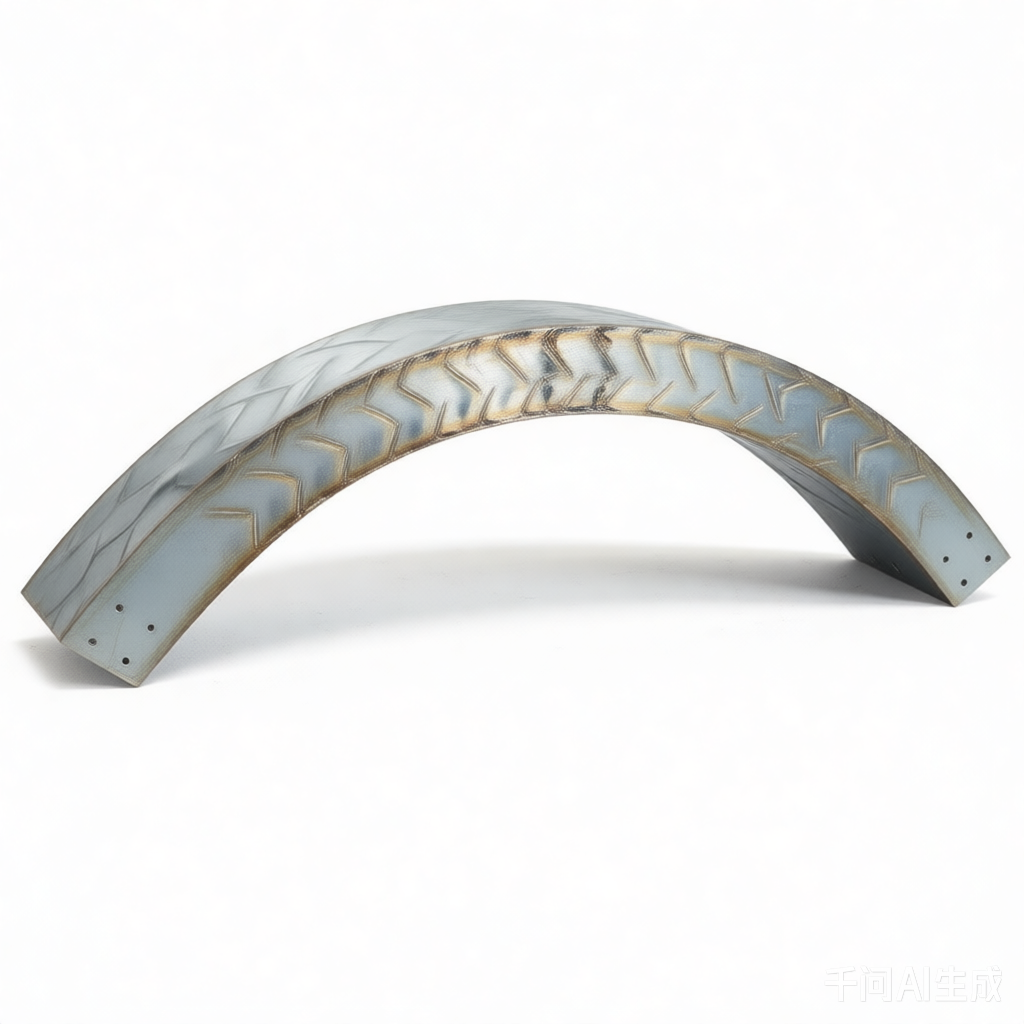
Aluminum Profile Bending
Aluminum Profile Press-Bend Welding
Aluminum profile press-bending and welding assembly is a compound machining method that combines bending forming with welding. Aluminum profiles are first bent to the required angle or curvature using bending equipment, and then multiple bent segments are
Product Details
Aluminum profile press-bending and welding assembly is a compound machining method that combines bending forming with welding. Aluminum profiles are first bent to the required angle or curvature using bending equipment, and then multiple bent segments are joined into an integral frame or large structural part through MIG (metal inert gas) or TIG (tungsten inert gas) welding. The bending-welding compound process is suitable for scenarios requiring complex structures such as large equipment frames, cabinet skeletons, and conveyor line supports.
Shanghai Chuangsi Aluminum provides full-process one-stop service from extrusion, bending, welding, CNC finish machining to surface finishing, equipped with a full set of processing equipment including CNC press brakes, MIG/TIG welders, and CNC machining centers. Bending angle tolerance ±1°, post-weld overall dimensional deviation ≤±1.5mm, weld strength ≥85% of base metal strength, applicable wall thickness 1.5mm-6mm, compatible with 6063-T5, 6061-T6 and other materials, and we provide weld inspection reports and dimensional inspection reports for every batch.
01 Quality starts with the raw material
Produced from A00 primary aluminum ingot, containing no scrap aluminum, with uniform material and stable welding performance, ensuring weld quality and structural strength of bent-welded parts.
02 Precision bending forming
Using CNC bending equipment with angle tolerance ±1°, for precise and controllable bending dimensions. Before bending, dimensions are calculated based on welding allowance to ensure the post-weld overall dimensions meet design requirements.
03 MIG/TIG precision welding
Two processes are adopted: MIG (metal inert gas) and TIG (tungsten inert gas). MIG welding is highly efficient, suitable for thick-wall profiles and batch welding; TIG welding has high accuracy and aesthetic welds, suitable for thin-wall profiles and scenarios with high appearance requirements. The welding wire grade is matched to the base metal, with full, defect-free welds and weld strength ≥85% of base metal strength.
04 Post-weld CNC finish machining
After welding, the overall structural part is CNC finish machined to precisely machine mounting holes, locating surfaces, and connecting surfaces, ensuring post-weld dimensional accuracy.
05 One-stop delivery service
One-stop delivery across the full process from extrusion, bending, welding, CNC finish machining to surface finishing, so customers only deal with one supplier.
Machining capability parameters:
| Item | Parameter / Description |
|---|---|
| Machining type | Bending + welding compound structural parts |
| Applicable wall thickness | 1.5mm-6mm |
| Bending form | L-shaped bending, U-channel, Z-shaped frame, right-angle bending |
| Angle tolerance | ±1° |
| Welding process | MIG, TIG |
| Weld strength | ≥85% of base metal strength |
| Post-weld overall dimensional deviation | ≤±1.5mm |
| Welding wire selection | Matched to base metal |
| Maximum machining length | 6500mm |
| Applicable materials | 6063-T5, 6061-T6 |
| Machining equipment | CNC press brakes, MIG/TIG welders, CNC machining centers |
| Supported processing | Extrusion, mold development, CNC milling, drilling, tapping |
| Surface treatment | Anodizing, hard anodizing, electrostatic powder coating |
| Executive standard | GB/T 6892-2023, ISO9001 |
| Production location | Qingpu, Shanghai |
Key points of the press-bend weld process:
-
Reserve welding allowance before bending to ensure post-weld overall dimensions meet design requirements
-
Select welding wire grade matched to the base metal, with full, defect-free welds
-
Keep post-weld overall dimensional deviation at ≤±1.5mm
-
After welding, CNC finish machine mounting holes, locating surfaces, and connecting surfaces
-
Provide weld inspection reports and dimensional inspection reports for every batch
Typical application scenarios:
-
Welded-bent compound frames
-
Large equipment welded structural parts
-
Non-standard bent-welded parts
-
Large equipment compound frames
-
Cabinet skeleton welded structures
FAQ (Frequently Asked Questions)
Q1: What is the difference between aluminum profile press-bend welding and pure bending?
A: Pure bending is bending a single profile into shape, suitable for frames with simple structure that are formed as a single piece. Press-bend welding first bends the profile into shape, then welds multiple bent segments into an integral frame or large structural part, suitable for scenarios requiring complex structures such as large equipment frames and cabinet skeletons. We can take on both processes and recommend the optimal solution based on the customer's structural design.
Q2: What welding process is used for aluminum profile press-bend welding?
A: Two processes are adopted: MIG (metal inert gas) and TIG (tungsten inert gas). MIG welding is highly efficient, suitable for thick-wall profiles and batch welding; TIG welding has high accuracy and aesthetic welds, suitable for thin-wall profiles and scenarios with high appearance requirements. The welding wire grade is matched to the base metal, with full, defect-free welds and weld strength ≥85% of base metal strength.
Q3: Can post-weld dimensional accuracy be guaranteed for press-bend welded parts?
A: Yes. We guarantee post-weld dimensional accuracy through three stages: first, dimensions are calculated before bending based on welding allowance; second, tooling fixtures are used during welding to fix positions and control welding deformation; third, post-weld overall dimensional deviation is kept at ≤±1.5mm, and final dimensional accuracy is ensured through CNC finish machining after welding. We provide dimensional inspection reports for every batch.
Q4: What inspections are required after aluminum profile press-bend welding?
A: After welding, we perform weld appearance inspection (no cracks, no pores, no undercut), weld dimensional inspection (weld leg height and weld width meet design requirements), and post-weld dimensional inspection (overall dimensional deviation ≤±1.5mm). We provide weld inspection reports and dimensional inspection reports for every batch, meeting the quality traceability requirements of structural parts.
Q5: How is press-bend welding machining charged?
A: Pricing is based on structural part complexity, weld length, and number of bending passes. Simple frames are priced per set; complex structural parts are priced by weld meter or by labor hours. We provide free evaluation and quoting based on samples; welcome to contact Manager Du at 13611846009.
Q6: What is the MOQ and lead time for aluminum profile press-bend welding?
A: The MOQ is 50kg, and we support small-batch sampling. Sample lead time is 10-14 days (including welding parameter setup and trial welding verification), and batch lead time is 14-25 days after sample approval. Because press-bend welding must ensure weld quality and post-weld dimensional accuracy, the sample cycle is slightly longer than pure bending; we recommend communicating the structural design and welding requirements in advance.

GET A QUOTE
Once you have submitted your requirements, we will contact you as soon as possible regarding your product inquiry.:Aluminum Profile Press-Bend Welding