
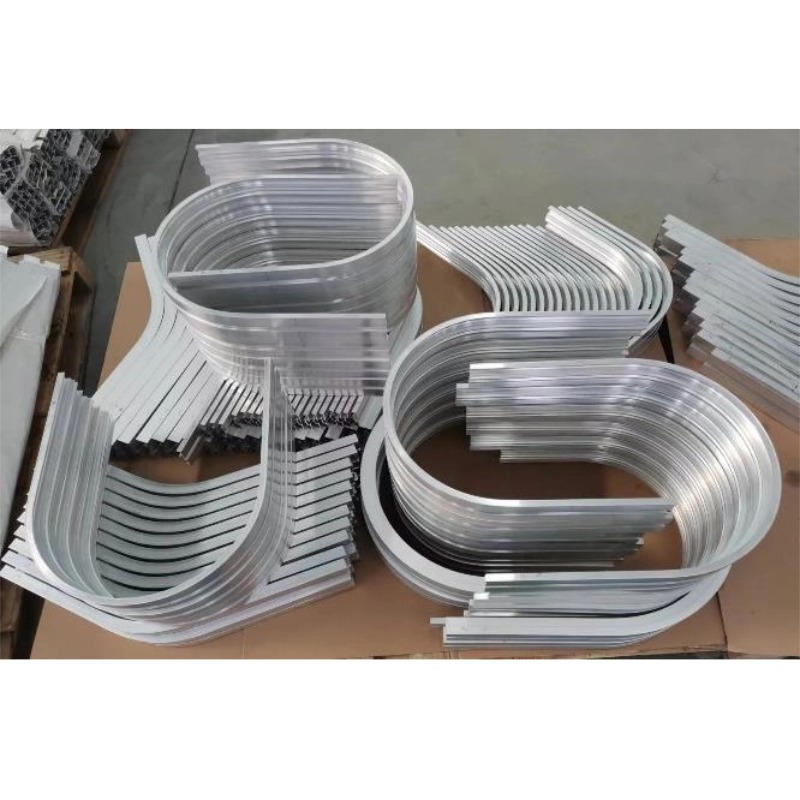
Aluminum Profile Bending
Small-Radius Bending of Aluminum Profiles
Small-radius bending of aluminum profiles is a highly difficult technique in the bending process. Conventional bending usually has a minimum radius of ≥500mm, whereas small-radius bending requires forming bends at extremely small radii of R100mm-R300mm, i
Product Details
Small-radius bending of aluminum profiles is a highly difficult technique in the bending process. Conventional bending usually has a minimum radius of ≥500mm, whereas small-radius bending requires forming bends at extremely small radii of R100mm-R300mm, imposing very high demands on equipment accuracy, mold design and process control. The smaller the radius, the greater the tensile stress on the outer side and the compressive stress on the inner side of the profile, making outer cracking and inner wrinkling very likely.
Shanghai Chuangsi Aluminum Co., Ltd. provides a full-process one-stop service from extrusion and bending to CNC machining and surface treatment, equipped with high-precision CNC bending equipment, with a bending error of ±0.3mm, flatness of 0.1mm-0.3mm, applicable wall thickness of 0.8mm-3mm, and fit for round tubes, square tubes, channel aluminum and special-shaped profiles.
01 Quality Starts with Raw Materials
Produced from A00 primary aluminum ingot with no scrap aluminum; the material is uniform and elongation is stable. For small-radius bending, 6063-T5 with good elongation is selected to reduce cracking risk. If the customer specifies 6061-T6, the minimum radius must be ≥1.5 times the wall thickness.
02 High-Precision CNC Bending
By precisely controlling bending speed and feed rate, the bending error is ±0.3mm, flatness is 0.1mm-0.3mm, roundness is precisely controlled and the arc is uniform. Trial bending is verified before batch processing to confirm no cracking or wrinkling before mass production.
03 Dedicated Molds and Process Control
Small-radius bending requires custom dedicated bending molds that support the profile from the inside during bending, preventing cross-section deformation and collapse. Bending speed is also precisely controlled to avoid outer cracking or inner wrinkling caused by excessive speed.
04 Aging Stress-Relief Treatment
After small-radius bending, the profile carries significant internal residual stress; a matching aging stress-relief process releases the internal stress so that long-term running does not easily deform and the dimensional stability of bent parts is ensured.
05 One-Stop Delivery Service
Full-process one-stop delivery from extrusion and bending to CNC machining and surface treatment, so the customer only deals with one supplier.
Small-radius bending vs. conventional bending:
| Comparison Item | Conventional Bending | Small-Radius Bending |
|---|---|---|
| Bending Radius | ≥500mm | R100mm-R300mm |
| Cracking Risk | Low | Very high, requires strict control |
| Wrinkling Risk | Low | Very high, requires process intervention |
| Equipment Requirements | Ordinary bending machine | High-precision CNC bending machine |
| Mold Requirements | General-purpose molds | Dedicated molds |
| Process Requirements | Conventional roll bending | Precise speed control + dedicated support |
Machining capability parameters:
| Item | Parameter / Description |
|---|---|
| Minimum Bending Radius | R100mm |
| Applicable Radius Range | R100mm-R300mm |
| Applicable Wall Thickness | 0.8mm-3mm |
| Available Materials | 6063-T5 (recommended), 6061-T6 (requires evaluation) |
| Available Cross-Sections | Round tube, square tube, channel aluminum, special-shaped profile |
| Bending Error | ±0.3mm |
| Flatness | 0.1mm-0.3mm |
| Processing Equipment | High-precision CNC bending machine, roll bending machine |
| Supporting Processing | Extrusion, mold development, CNC machining |
| Surface Treatment | Anodizing, hard anodizing |
| Executive Standard | GB/T 6892-2023, ISO9001 |
| Production Location | Qingpu, Shanghai |
Key technical points for small-radius bending:
-
Select 6063-T5 with good elongation to reduce cracking risk
-
Custom dedicated bending molds to prevent cross-section deformation and collapse
-
Precisely control bending speed to avoid outer cracking and inner wrinkling
-
Apply aging stress-relief to release internal stress and ensure dimensional stability
-
Verify by trial bending before batch production, confirming no cracking or wrinkling
Typical Application Scenarios:
-
Small-radius bent structural parts
-
Curved frames for compact spaces
-
Curved equipment frames
-
Precision bent structural parts
-
Parts with special-radius bending
FAQ (Frequently Asked Questions)
Q1: What is the difference between small-radius bending and conventional bending?
A: Conventional bending usually has a minimum radius of ≥500mm and a relatively simple process. Small-radius bending requires forming bends at extremely small radii of R100mm-R300mm; the smaller the radius, the greater the tensile stress on the outer side and the compressive stress on the inner side, making outer cracking and inner wrinkling very likely. Small-radius bending imposes very high demands on equipment accuracy, mold design and process control and is a highly difficult technique. Our company uses high-precision CNC bending equipment, dedicated molds and aging stress-relief to effectively solve the challenges of small-radius bending.
Q2: What is the minimum radius achievable for small-radius bending?
A: The minimum bending radius is R100mm. The specific minimum radius depends on the profile cross-section size, wall thickness and material — the minimum radius is relatively small for round and square tubes, and larger for special-shaped profiles. We recommend that the customer provide the profile cross-section drawings and radius requirements so our company can evaluate whether small-radius bending is feasible.
Q3: How to choose between 6063-T5 and 6061-T6 for small-radius bending?
A: For small-radius bending, 6063-T5 is recommended first for its good elongation and excellent formability, which can effectively reduce cracking risk. If the customer specifies 6061-T6 (higher strength), the minimum bending radius should be appropriately increased (recommended ≥1.5 times the wall thickness). Our company can evaluate processing feasibility according to the customer's material and radius requirements.
Q4: How is outer cracking prevented during small-radius bending?
A: During small-radius bending, the outer side of the profile is under tensile stress; the smaller the radius, the greater the tensile strain, and the more likely it exceeds the elongation limit and causes cracking. Our company prevents cracking through three measures: first, selecting 6063-T5 with good elongation; second, precisely controlling bending speed to avoid local stress concentration caused by excessive speed; third, verifying by trial bending before batch processing to confirm no cracking before mass production.
Q5: How is inner wrinkling prevented during small-radius bending?
A: During small-radius bending, the inner side of the profile is under compressive stress; the smaller the radius, the greater the compressive strain, and the more likely wrinkling and creasing occur. Our company prevents wrinkling through two measures: first, adding inner-cavity supports in the mold to support the profile from the inside during bending; second, precisely controlling bending speed to avoid material buildup caused by excessive slowness.
Q6: How is small-radius bending charged?
A: Pricing is based on cross-section complexity, bending radius and wall thickness. Conventional cross-sections are priced per piece; special-shaped profiles and small radii require additional evaluation of mold and labor costs. Free sample-based evaluation and quotation are provided; please contact Manager Du at 13611846009.
Q7: What is the MOQ and lead time for small-radius bending?
A: The MOQ is 50kg, supporting small-batch sampling. The sample lead time is 7-10 days (requiring tuning of bending parameters and molds), and batch delivery is 10-20 days after sample confirmation. Because small-radius bending must ensure no cracking, no wrinkling and accuracy control, we recommend that the customer confirm the first-article effect before batch production.

GET A QUOTE
Once you have submitted your requirements, we will contact you as soon as possible regarding your product inquiry.:Small-Radius Bending of Aluminum Profiles