
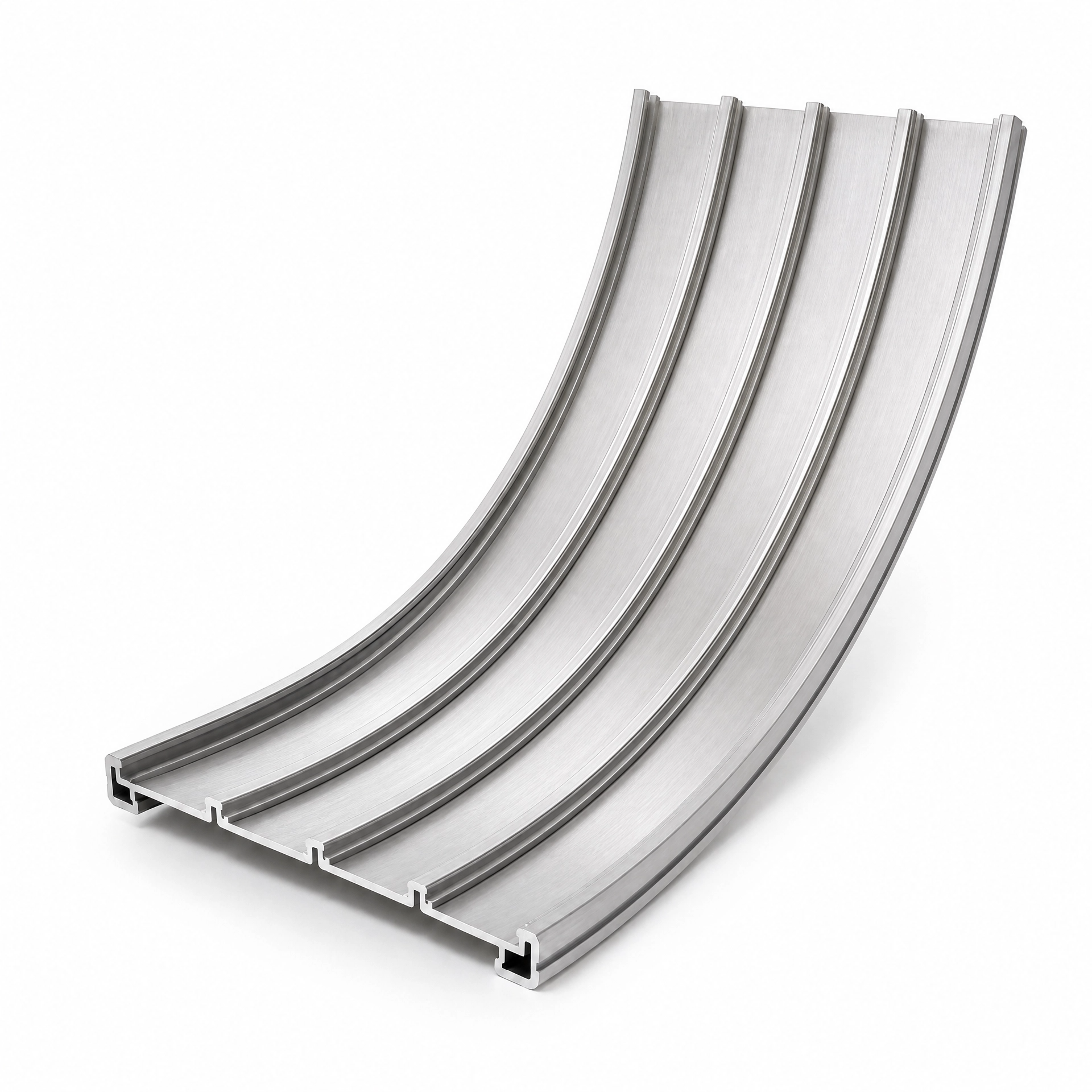
Aluminum Profile Bending
Aluminum Profile Wide-Format Bending
Wide-format aluminum profile bending refers to bending and arc-forming of aluminum profiles with large cross-section width and wide face. Compared with conventional narrow-profile bending, the core difficulty of wide-format profile bending is: the wide fa
Product Details
Wide-format aluminum profile bending refers to bending and arc-forming of aluminum profiles with large cross-section width and wide face. Compared with conventional narrow-profile bending, the core difficulty of wide-format profile bending is: the wide face is subjected to uneven force, easily causing cross-section distortion and torsional deformation. The die width of conventional bending machines cannot cover wide profiles, so custom wide-format bending dies and large-tonnage equipment are required.
Shanghai Chuangsi Aluminum is equipped with large-tonnage wide-format CNC bending machines and custom wide-format dies, effectively solving the cross-section distortion and torsional deformation problems when bending wide-format profiles. One-stop delivery from extrusion, bending to CNC machining and surface treatment.
01 Quality Starts From Raw Materials
Produced from A00 primary aluminum ingot, containing no scrap aluminum, with uniform material and stable mechanical properties, ensuring the structural strength of wide profiles under long-span bending conditions.
02 Wide-Format Bending Forming
Using large-tonnage wide-format CNC bending machines with custom wide-format dies to ensure even force on wide profiles, effectively solving cross-section distortion and torsional deformation. Angular tolerance ±1°, arc bending error ±0.4mm, max. machining length 6500mm.
03 Custom Wide-Format Dies
Wide-format bending dies are customized according to customer profile cross-section dimensions, ensuring even force during bending, consistent bending angles, and avoiding cross-section deformation and twisting.
04 One-Stop Delivery Service
One-stop delivery from extrusion, bending to CNC machining and surface treatment - customers deal with only one supplier.
Wide-format bending vs conventional bending:
| Comparison Item | Conventional Bending | Wide-Format Bending |
|---|---|---|
| Cross-Section Width | ≤100mm | ≥400mm, some up to over 600mm |
| Force State | Narrow face, even force | Wide face, uneven force, easy deformation |
| Die Requirements | Universal bending dies | Custom wide-format dies required |
| Equipment Requirements | Conventional bending machines | Large-tonnage, large-bed equipment |
| Main Difficulties | Springback, angular deviation | Cross-section distortion, torsional deformation, long-span precision control |
Machining capability parameters:
| Item | Parameter / Description |
|---|---|
| Applicable Cross-Section Width | ≥400mm (larger widths customizable) |
| Bending Type | Wide-format right-angle bending, wide-format arc bending, long-span frame bending |
| Angular Tolerance | ±1° |
| Arc Bending Error | ±0.4mm |
| Max. Machining Length | 6500mm |
| Applicable Materials | 6061-T6 / 6082-T6 / 6063-T5 |
| Machining Equipment | Large-tonnage wide-format CNC bending machines, CNC machining centers |
| Supporting Machining | CNC milling, drilling, tapping, cutting, welding |
| Surface Treatment | Anodizing, hard anodizing, electrostatic spraying |
| Executive Standard | GB/T 6892-2023, ISO9001 |
| Production Location | Qingpu, Shanghai |
Key technical points of wide-format bending:
-
Custom wide-format bending dies to ensure even force on wide profiles
-
Large-tonnage equipment drive to ensure wide profiles bend into place
-
Segmented springback compensation to control angular deviation ±1°
-
Long-span arc precision control to ensure assembly consistency
Typical application scenarios:
-
Large equipment wide-format frames
-
Automation line long-span curved beams
-
Wide-format conveyor line supports
-
New energy equipment wide-format structural parts
-
Long-span equipment borders
FAQ (Frequently Asked Questions)
Q1: What is the difference between wide-format aluminum profile bending and conventional narrow bending?
A: Conventional narrow bending (cross-section width ≤100mm) has relatively even force and can be processed with universal bending dies. The core difficulty of wide-format bending (cross-section width ≥400mm) is: wide profiles are subjected to uneven force during bending, easily causing cross-section distortion (cross-section shape deformation) and torsional deformation (the profile twists along its length). We use large-tonnage wide-format CNC bending machines with custom wide-format dies to ensure even force, effectively solving cross-section distortion and torsional deformation.
Q2: Why do cross-section distortion and torsional deformation occur during wide-format bending?
A: Wide profiles have a large cross-section width (≥400mm), and different sections are in different force states during bending - the outside of the profile is in tension, the inside in compression, and the stress distribution varies more across the wide face, easily causing cross-section shape distortion (e.g., openings flaring or closing) and torsional deformation (the profile twists along its length). In addition, wide-face profiles have inherently low rigidity and are more prone to uneven deformation during bending. We use custom wide-format dies to make the profile bend with even force, combined with segmented springback compensation, to effectively control cross-section distortion and torsional deformation.
Q3: How is wide-format bending charged?
A: Priced comprehensively by profile cross-section width, bending length and process difficulty. Wide-format bending costs more than conventional bending because it requires custom wide-format dies and occupies large-tonnage equipment. Free evaluation and quotation on sample submission; please contact Manager Du at 13611846009.
Q4: How to choose between 6061-T6 and 6063-T5 for wide-format bending?
A: 6063-T5 has good formability and high surface finish, suitable for wide-format decorative profiles and frames with high surface quality and bending performance requirements; 6061-T6 has higher strength, suitable for long-span curved beams, large equipment wide-format frames and other scenarios requiring structural strength. Wide-face profiles have inherently low rigidity; if used for load-bearing structures, 6061-T6 is recommended.
Q5: What is the maximum machining width and length for wide-format aluminum profile bending?
A: Max. machining width ≥400mm (larger widths customizable), max. machining length 6500mm. Wide-profile bending imposes high requirements on equipment bed width and rigidity; our large-tonnage wide-format CNC bending machines can meet the bending needs of large cross-section wide profiles. The specific max. machining width should be evaluated and determined according to the profile cross-section and bending type.
Q6: What is the MOQ and lead time for wide-format aluminum profile bending?
A: MOQ 50kg. Sample lead time 7-10 days (custom wide-format die and trial bending verification required), bulk lead time 10-20 days after sample approval. Wide-format bending requires custom dies, so the preparation period is slightly longer; we recommend discussing cross-section dimensions and bending requirements in advance.

GET A QUOTE
Once you have submitted your requirements, we will contact you as soon as possible regarding your product inquiry.:Aluminum Profile Wide-Format Bending