
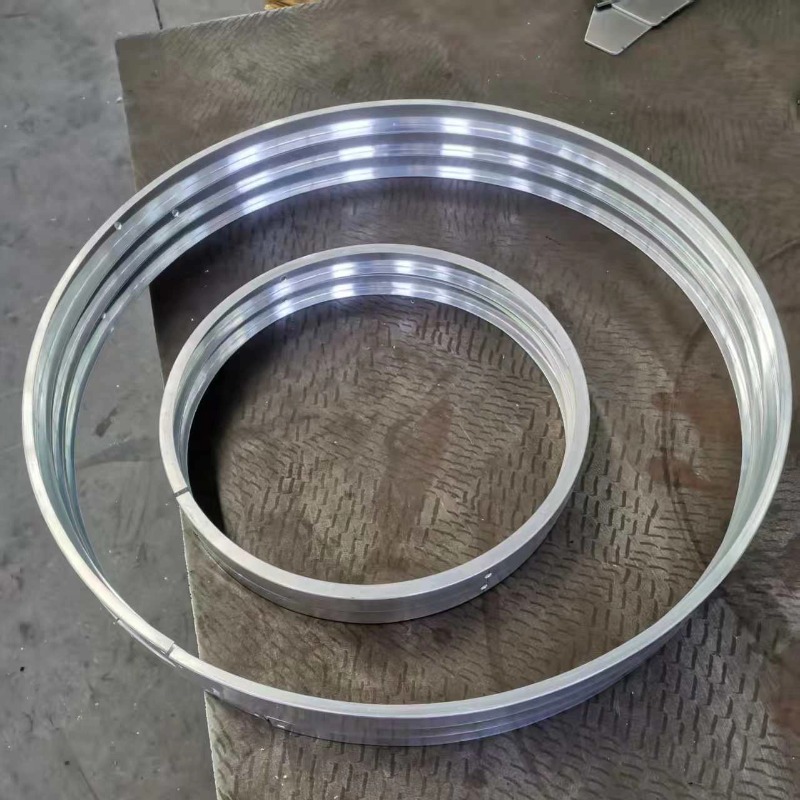
Aluminum Profile Bending
Full-Circle Bending
Aluminum profile full-circle bending is a process that bends a straight profile in one pass, using precision roll-bending equipment, into a complete circular ring; it is widely used in circular guide rails, round-tube frames, robotic circular tracks, circ
Product Details
Aluminum profile full-circle bending is a process that bends a straight profile in one pass, using precision roll-bending equipment, into a complete circular ring; it is widely used in circular guide rails, round-tube frames, robotic circular tracks, circular conveyor lines and other fields. Unlike ordinary arc bending, full-circle bending requires the two ends of the profile to close perfectly, imposing higher demands on arc accuracy, roundness control and joint handling.
Shanghai Chuangsi Aluminum Co., Ltd. uses precision roll-bending processes and accurate arc control to ensure uniform arc, precise roundness and perfect end closure for full-circle bending. Full-process one-stop delivery from extrusion and full-circle bending to CNC machining and surface treatment.
01 Quality Starts with Raw Materials
Produced from A00 primary aluminum ingot with no scrap aluminum; the material is uniform and its mechanical properties are stable, ensuring the structural integrity of circular profiles under ring-shaped loading conditions.
02 Precision Full-Circle Bending
Using precision roll-bending equipment, a straight profile is bent in one pass into a complete circular ring, with a full-circle error of ±0.4mm, flatness of 0.1mm-0.5mm and an end-closing gap of ≤0.5mm.
03 Multi-Cross-Section Processing
Full-circle bending can process round tubes, square tubes, channel aluminum, angle aluminum and special-shaped profiles to fit different structural needs.
04 One-Stop Delivery Service
Full-process one-stop delivery from extrusion and full-circle bending to CNC machining and surface treatment, so the customer only deals with one supplier.
Full-circle bending vs. ordinary arc bending:
| Comparison Item | Ordinary Arc Bending | Full-Circle Bending |
|---|---|---|
| Bending Angle | Any arc (non-closed) | 360° fully closed circular ring |
| Accuracy Requirements | General arc control | Full-circle error ±0.4mm, strict roundness control |
| End Joint | Usually no joint needed | Requires perfect end closure and seamless joining |
| Application Scenarios | Arc tracks, bent frames | Circular guide rails, round-tube frames, robotic circular tracks |
Machining capability parameters:
| Item | Parameter / Description |
|---|---|
| Processing Types | Full-circle bending, circular-ring bending, circular guide rail |
| Bending Angle | 360° fully closed circular ring |
| Full-Circle Error | ±0.4mm |
| Flatness | 0.1mm-0.5mm |
| End-Closing Gap | ≤0.5mm |
| Available Materials | 6063-T5 / 6061-T6 / 6082-T6 |
| Available Cross-Sections | Round tube, square tube, channel aluminum, angle aluminum, special-shaped profile |
| Extrusion Length | Up to 20M |
| Processing Equipment | Roll bending machines, ring bending machines, CNC bending machines |
| Supporting Processing | Mold development, extrusion, CNC machining, welding |
| Surface Treatment | Anodizing, hard anodizing, coating |
| Executive Standard | GB/T 6892-2023, ISO9001 |
| Production Location | Qingpu, Shanghai |
Full-circle bending types:
-
Round-tube full-circle bending: suitable for round-tube frames and ring-shaped structural parts
-
Square-tube full-circle bending: suitable for square-tube ring frames and equipment frames
-
Special-shaped profile full-circle bending: suitable for special-shaped cross-section circular guide rails and special structural parts
-
Circular guide-rail full circle: suitable for robotic circular tracks and circular conveyor lines
Typical Application Scenarios:
-
Circular guide rail systems
-
Round-tube frame structures
-
Robotic circular tracks
-
Circular conveyor line tracks
-
Full-circle decorative structural parts
FAQ (Frequently Asked Questions)
Q1: What is the difference between full-circle bending and ordinary arc bending?
A: Ordinary arc bending bends a straight profile into any arc (non-closed), with relatively low accuracy requirements, and is suitable for arc tracks, bent frames and similar scenarios. Full-circle bending bends a straight profile in one pass into a 360° fully closed circular ring, requiring the two ends to close perfectly and join seamlessly, with higher demands on full-circle error (±0.4mm), roundness control and joint handling. Full-circle bending is suitable for circular guide rails, round-tube frames, robotic circular tracks and other applications needing a complete closed loop.
Q2: What accuracy can full-circle bending achieve?
A: Through precision roll bending, the full-circle error is controlled at ±0.4mm and flatness at 0.1mm-0.5mm. The end-closing point of full-circle bending is precision-processed so that the joining gap is controlled within 0.5mm, ensuring the smoothness and consistency of circular guide rails or ring frames. The larger the full-circle diameter, the harder the accuracy control; our company guarantees the accuracy of large-diameter full circles through large-tonnage roll-bending equipment and precise arc control.
Q3: How is smoothness ensured at the end joint of full-circle bending?
A: The joint gap is ≤0.5mm; after CNC finishing and grinding, the joint transitions smoothly with no obvious step. For scenarios with high smoothness requirements such as circular guide rails, welding or reinforcing connectors can be added at the joint to improve overall structural strength and smoothness, ensuring stable and smooth passage of carts or sliders.
Q4: Which cross-section types of aluminum profiles can be processed by full-circle bending?
A: Round tubes, square tubes, channel aluminum, angle aluminum and special-shaped profiles can all be processed. Once the customer provides the profile cross-section drawings, our company evaluates whether full-circle bending is suitable and determines the minimum full-circle diameter.
Q5: How is full-circle bending charged?
A: Pricing is based on the full-circle diameter, cross-section type and wall thickness. Standard circular guide rails are priced by diameter; large-diameter or special-shaped cross-sections require additional evaluation. Free sample-based evaluation and quotation are provided; please contact Manager Du at 13611846009.
Q6: What is the MOQ and lead time for full-circle bending?
A: The MOQ is 50kg. The sample lead time is 7-10 days (depending on cross-section complexity and full-circle diameter), and batch delivery is 10-20 days after sample confirmation. Because full-circle bending requires tuning roll-bending equipment and arc parameters, the sample cycle is slightly longer than conventional bending; it is recommended to discuss the full-circle diameter and accuracy requirements in advance.

GET A QUOTE
Once you have submitted your requirements, we will contact you as soon as possible regarding your product inquiry.:Full-Circle Bending