
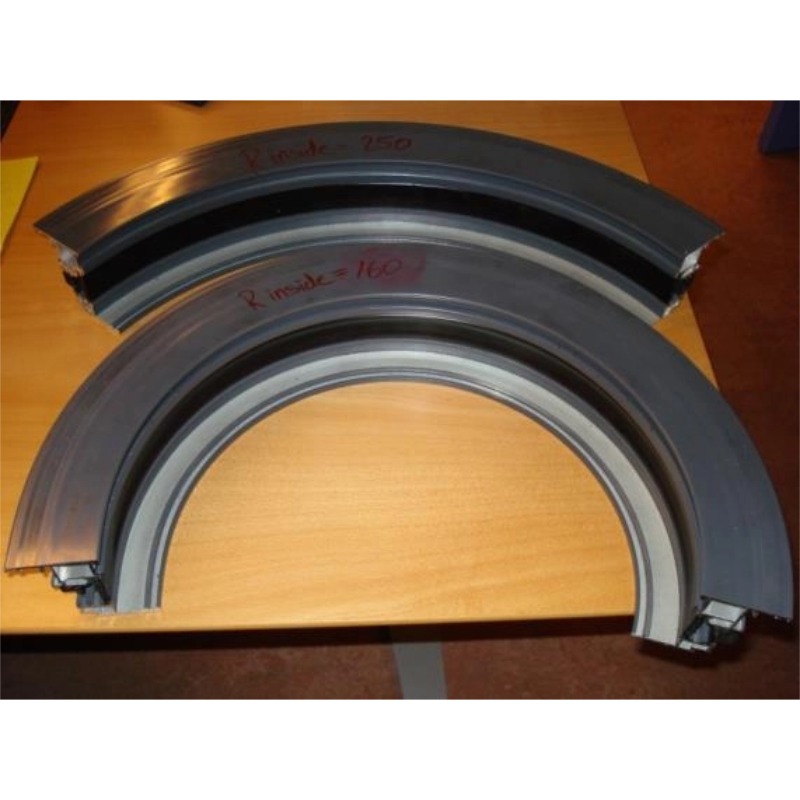
Aluminum Profile Bending
Complex Cross-Section Bending
Bending complex cross-section aluminum profiles is a highly demanding process in aluminum profile machining. Ordinary profile bending has relatively even force and a wide process window; however, complex cross-section profiles with multi-cavity, irregular
Product Details
Bending complex cross-section aluminum profiles is a highly demanding process in aluminum profile machining. Ordinary profile bending has relatively even force and a wide process window; however, complex cross-section profiles with multi-cavity, irregular, and asymmetric structures experience extremely uneven force during bending, and are highly prone to defects such as cross-section distortion, local collapse, corner cracking, and torsional deformation. Bending these profiles is far more difficult than conventional profiles, with higher requirements for equipment accuracy, die design, and process control.
Targeting the core difficulties of complex cross-section profile bending, Shanghai Chuangsi Aluminum adopts a mandrel/core support process paired with custom dedicated bending dies, supporting the profile cavity from the inside during bending to effectively prevent cross-section deformation. We provide one-stop delivery across the full process from extrusion, bending to CNC machining and surface finishing.
01 Quality starts with the raw material
Produced from A00 primary aluminum ingot, containing no scrap aluminum, with uniform material and stable mechanical properties, ensuring the structural integrity of complex cross-section profiles under bending conditions.
02 Mandrel-supported bending forming
For multi-cavity and semi-open cross-section profiles, a mandrel support mechanism or contoured inner-cavity support is added inside the bending die, supporting the profile cavity from the inside during bending to effectively prevent cross-section collapse and deformation. Bending radius error ±0.4mm, angle tolerance ±1°, flatness 0.1mm-0.5mm.
03 Custom dedicated bending dies
Dedicated bending dies are custom-made according to the customer's profile cross-section drawings; the die cavity precisely matches the profile cross-section, ensuring even force during bending and consistent bending angles.
04 One-stop delivery service
One-stop delivery across the full process from extrusion, bending to CNC machining and surface finishing, so customers only deal with one supplier.
Complex cross-section bending vs ordinary profile bending:
| Comparison item | Ordinary profile bending | Complex cross-section bending |
|---|---|---|
| Cross-section structure | Solid or simple symmetric cross-section | Multi-cavity, irregular, asymmetric, hollowed, grooved |
| Force state | Even, wide process window | Extremely uneven, local stress concentration |
| Main defects | Springback, angle deviation | Cross-section collapse, corner cracking, torsional deformation |
| Die requirements | General-purpose bending die | Requires custom dedicated bending die |
| Process support | Conventional bending | Requires mandrel support, inner-cavity support |
| Machining difficulty | Conventional | High |
Core difficulties and solutions:
Difficulty 1: Cross-section distortion and local collapse. When bending multi-cavity and semi-open cross-section profiles, the internal cavities are subjected to uneven force and are highly prone to collapse, wrinkling, and waviness.Solution: Add a mandrel support mechanism or contoured inner-cavity support inside the bending die, supporting the profile cavity from the inside during bending to prevent cross-section deformation.
Difficulty 2: Corner cracking. The corners of irregular cross-section profiles experience stress concentration during bending and are prone to cracking.Solution: Select T5-temper material (good ductility), keep the bending radius at ≥3 times the wall thickness, and precisely control bending speed and die clearance.
Difficulty 3: Torsional deformation. Asymmetric cross-section profiles are subjected to uneven force and prone to torsion and dimensional deviation during bending.Solution: Develop a dedicated bending plan for asymmetric cross-sections, using segmented springback compensation to ensure consistent bending angles.
Machining capability parameters:
| Item | Parameter / Description |
|---|---|
| Applicable cross-section types | Multi-cavity profiles, irregular cross-sections, asymmetric structures, grooved/hollowed profiles |
| Bending form | Complex cross-section arc bending, irregular bending, compound bending |
| Bending radius error | ±0.4mm |
| Angle tolerance | ±1° |
| Flatness | 0.1mm-0.5mm |
| Extrusion length | Up to 20M |
| Applicable materials | 6063-T5 / 6061-T6 / 6082-T6 |
| Machining equipment | Precision CNC press brakes, custom bending dies, CNC machining centers |
| Supported processing | Mold development, extrusion, CNC machining, precision slot milling |
| Surface treatment | Anodizing, hard anodizing, electrostatic powder coating |
| Executive standard | GB/T 6892-2023, ISO9001 |
| Production location | Qingpu, Shanghai |
Complex cross-section bending types:
-
Multi-cavity profile arc bending: suitable for multi-cavity rails and complex structural parts
-
Irregular cross-section bending: suitable for non-standard irregular frames and special-equipment structural parts
-
Asymmetric structure bending: suitable for asymmetric cross-section equipment frames and special structural parts
-
Grooved/hollowed profile bending: suitable for functional-slot profiles and lightweight structural parts
Typical application scenarios:
-
Multi-cavity rail arc bending systems
-
Irregular frames for automation equipment
-
Complex structural parts for special equipment
-
Irregular frames for non-standard equipment
-
Complex cross-section structural parts for rail transit
FAQ (Frequently Asked Questions)
Q1: What is complex cross-section aluminum profile bending? How does it differ from ordinary bending?
A: Complex cross-section aluminum profile bending refers to arc bending of aluminum profiles with multi-cavity, irregular cross-sections, asymmetric structures, grooved or hollowed features. Ordinary profile bending (such as solid or simple symmetric cross-sections) has even force and a wide process window, while complex cross-section profiles experience extremely uneven force during bending and are highly prone to defects such as cross-section distortion, local collapse, corner cracking, and torsional deformation. Complex cross-section bending has higher requirements for equipment accuracy, die design, and process control, and is a highly demanding process in aluminum profile machining.
Q2: What defects are likely to occur when bending complex cross-section profiles?
A: There are three typical defects: first, cross-section distortion and local collapse—when bending multi-cavity and semi-open cross-section profiles, the internal cavities are subjected to uneven force and are prone to collapse, wrinkling, and wavy deformation; second, corner cracking—the corners of irregular cross-section profiles experience stress concentration during bending and are prone to cracking; third, torsional deformation—asymmetric cross-section profiles are subjected to uneven force and prone to torsion and dimensional deviation during bending. We effectively solve these three types of defects through custom dedicated bending dies, the mandrel support process, and segmented springback compensation.
Q3: How to prevent cross-section collapse when bending complex cross-section profiles?
A: When bending multi-cavity and semi-open cross-section profiles, the internal cavities lack support and are highly prone to collapse. We add a mandrel support mechanism or contoured inner-cavity support inside the bending die, supporting the profile cavity from the inside during bending to prevent cross-section deformation. At the same time, for multi-cavity profiles, we optimize support positions and force distribution in the die design to ensure the cross-section shape remains complete and dimensions are accurate after bending.
Q4: How to prevent corner cracking when bending complex cross-section profiles?
A: The corners of irregular cross-section profiles experience stress concentration during bending and are prone to cracking. Solutions include: selecting T5-temper material (better ductility, suitable for bending), keeping the bending radius at ≥3 times the wall thickness, precisely controlling bending speed and die clearance to avoid excessive local stress, and conducting trial bending verification before batch machining to confirm no cracking before mass production.
Q5: How is complex cross-section bending machining charged?
A: Pricing is based on cross-section complexity, bending difficulty, and die customization costs. Multi-cavity and irregular cross-sections require custom dedicated bending dies and mandrel support tooling, so the upfront preparation cost is higher, but the per-piece cost becomes controllable when spread over volume production. We provide free evaluation and quoting based on samples; welcome to contact Manager Du at 13611846009.
Q6: How to choose between 6063-T5 and 6061-T6 for complex cross-section bending?
A: 6063-T5 has the best formability and high surface finish, suitable for complex cross-section bending scenarios with high formability requirements. 6061-T6 has higher strength, suitable for complex cross-section structural parts with structural strength requirements. For complex cross-section bending, 6063-T5 is recommended first; 6061-T6 is chosen for high load-bearing requirements. High-strength materials such as 7075 have poor bending performance and are generally not recommended for complex cross-section bending.
Q7: What is the MOQ and lead time for complex cross-section bending?
A: The MOQ is 50kg. Sample lead time is 7-10 days (requiring custom dedicated dies and process verification), and batch lead time is 10-20 days after sample approval. Because complex cross-section bending requires custom dedicated dies and mandrel support tooling, the upfront preparation cycle is longer; we recommend communicating the cross-section drawings and bending requirements in advance.

GET A QUOTE
Once you have submitted your requirements, we will contact you as soon as possible regarding your product inquiry.:Complex Cross-Section Bending