
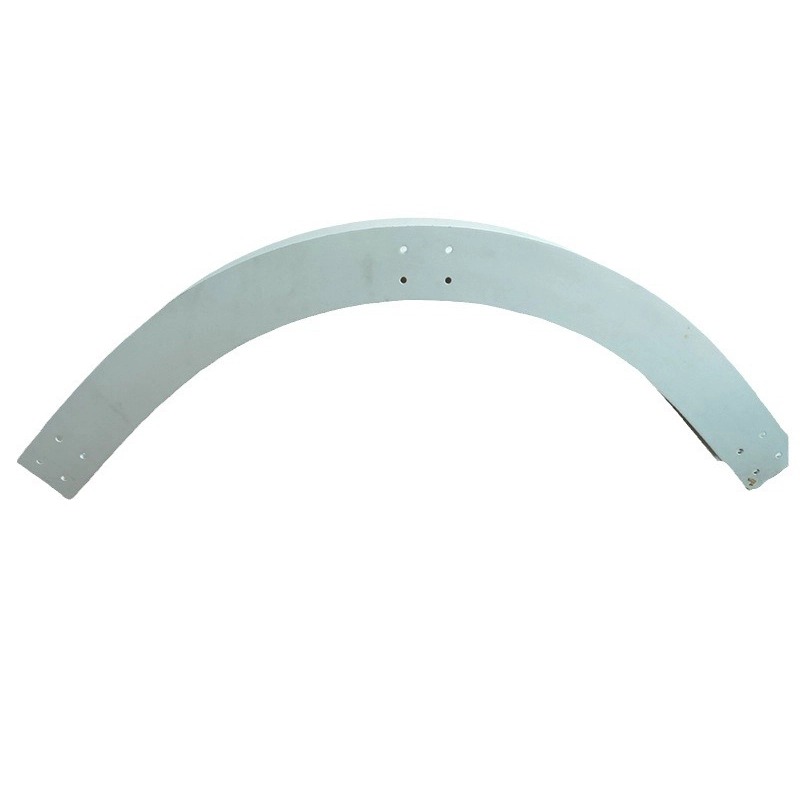
Aluminum Profile Bending
Roll Bending Service
Aluminum profile roll bending is a process that uses a roll bender to perform customized radius forming on aluminum alloy profiles, belonging to the cold working category. The rollers rotate and drive the profile forward through friction between the profi
Product Details
Aluminum profile roll bending is a process that uses a roll bender to perform customized radius forming on aluminum alloy profiles, belonging to the cold working category. The rollers rotate and drive the profile forward through friction between the profile and the rollers, while the upper roller applies pressure to the profile, causing plastic bending deformation.
The core difference between roll bending, press bending, and conventional bending is that roll bending produces uniform curvature, wrinkle-free surfaces, and good cross-section retention. Profiles that have undergone powder coating, electrophoretic coating (e-coat), or brushing can be bent directly without the waviness, creases, and scratches caused by ordinary press bending.
Shanghai Chuangsi Aluminum Co., Ltd. is equipped with roll benders, stretch bending machines, and other professional processing equipment. By precisely controlling roller parameters and bending speed, we ensure uniform stress, smooth curvature, and wrinkle-free surfaces during profile bending. Full-process one-stop delivery from extrusion and roll bending to CNC machining and surface treatment.
01 Quality Starts From Raw Materials
Produced using A00 primary aluminum ingot, containing no scrap aluminum, with uniform material properties and stable mechanical performance, ensuring structural integrity of profiles under roll bending conditions.
02 Precision Roll Bending Forming
Through precise control of roller parameters and bending speed on the roll bender, curving error is ±0.4mm and flatness is 0.1mm-0.5mm. Uniform curvature, wrinkle-free surface, and good cross-section retention.
03 Multi-Cross-Section Machining
Capable of roll bending various cross-sections including round tubes, square tubes, channel aluminum, angle aluminum, and special profiles, adapting to different structural requirements.
04 One-Stop Delivery Service
Full-process one-stop delivery from extrusion and roll bending to CNC machining and surface treatment — customers deal with only one supplier.
Roll bending vs. conventional bending vs. press bending:
| Comparison item | Roll bending | Conventional bending | Press bending |
|---|---|---|---|
| Forming method | Continuous feed bending | Fixed-point angular forming | Single-stroke die pressing |
| Curvature uniformity | High | General | General |
| Surface quality | Wrinkle-free, scratch-free | Has bend creases | Has press marks |
| Cross-section distortion | Minor | Relatively large | Relatively large |
| Pre-surface-treated profiles | Can be roll-bent directly | Requires protection | Easily damaged |
| Applicable scenarios | Large-radius arcs, circular | Frames, bracket corners | Small-batch simple shapes |
Machining capability parameters:
| Item | Parameter / Description |
|---|---|
| Machining type | Aluminum profile roll bending, curving, arc rolling |
| Applicable material | 6063-T5 / 6061-T6 / 6082-T6 |
| Applicable cross-section | Round tube, square tube, channel aluminum, angle aluminum, special profile |
| Curving error | ±0.4mm |
| Flatness | 0.1mm-0.5mm |
| Extrusion length | Up to 20M maximum |
| Machining equipment | Roll bender, stretch bending machine |
| Supporting machining | Mold development, extrusion, CNC machining, welding |
| Surface treatment | Anodizing, hard anodizing, powder coating |
| Execution standard | GB/T 6892-2023, ISO9001 |
| Production location | Qingpu, Shanghai |
Roll bending types:
-
Round tube roll bending: suitable for circular frames and tubular structural parts
-
Square tube roll bending: suitable for square tube curved frames and equipment borders
-
Special profile roll bending: suitable for arc forming of complex cross-section profiles
Typical application scenarios:
-
Automated equipment curved frames
-
Round tube structural parts
-
Square tube curved borders
-
Special profile curved structural parts
-
Industrial equipment curved components
-
Decorative curved frames
FAQ (Frequently Asked Questions)
Q1: What is the difference between roll bending, conventional bending, and press bending?
A: Roll bending uses a roll bender to continuously feed the profile and gradually bend it into an arc, producing uniform curvature, wrinkle-free surfaces, and good cross-section retention, making it suitable for large-radius arcs and circular work. Conventional bending forms angles (such as 90°) at specific positions on the profile, suitable for structural parts requiring straight corners such as frames and brackets. Press bending uses a die for single-stroke forming, suitable for small-batch simple shapes. The core advantage of roll bending is that profiles that have undergone powder coating, e-coat, or brushing can be roll-bent directly without the waviness, creases, and scratches caused by ordinary press bending. All three processes are available at our facility.
Q2: Which cross-section types can be roll-bent?
A: We can process round tubes (suitable for circular frames and tubular structural parts), square tubes (suitable for square tube curved frames and equipment borders), channel aluminum (suitable for channel-type curved guide rails and borders), angle aluminum (suitable for angle aluminum curved borders), and special profiles (suitable for arc forming of complex cross-sections). Customers provide profile cross-section drawings and radius requirements, and we evaluate whether roll bending is suitable and determine the optimal process.
Q3: What precision can roll bending achieve?
A: Through precise control of roller parameters and bending speed, curving error is controlled at ±0.4mm and flatness at 0.1mm-0.5mm. During roll bending, the profile experiences uniform stress, smooth curvature, and wrinkle-free surfaces. Compared with press bending and conventional bending, roll bending is more suitable for applications requiring long, consistent radii.
Q4: Can pre-surface-treated profiles be roll-bent directly?
A: Yes. During roll bending, friction between the profile and rollers is rolling friction, causing minimal surface damage. Profiles that have undergone powder coating, e-coat, or brushing can be roll-bent directly without the waviness, creases, and scratches caused by ordinary press bending. This advantage makes roll bending especially suitable for decorative and appearance parts with surface quality requirements — surface treatment can be performed first, followed by roll bending.
Q5: How is roll bending charged?
A: Pricing is based on cross-section complexity, radius, and length. Round tube and square tube roll bending is priced per meter; special profile roll bending requires additional evaluation of custom roller costs. Free evaluation and quotation are provided based on samples; please contact Manager Du at 13611846009.
Q6: How to choose between 6063-T5 and 6061-T6 for roll bending?
A: 6063-T5 has good formability and high surface finish, suitable for decorative curved frames and appearance parts with high surface quality and roll bending performance requirements. 6061-T6 has higher strength, suitable for industrial equipment curved components and automated equipment curved frames with structural strength requirements. 6082-T6 has the highest strength, suitable for heavy-duty curved structural parts. During roll bending, the profile is subjected to bending stress; load-bearing structural parts are recommended to use 6061-T6 or 6082-T6.
Q7: What is the minimum order quantity and lead time for roll bending?
A: The minimum order quantity is 50kg. Sample lead time is 5-7 days (standard cross-sections such as round tubes and square tubes) or 7-10 days (custom rollers required for special profiles), and batch delivery is 7-15 days after sample confirmation. Round tube and square tube roll bending has a shorter sample cycle due to versatile rollers; special profile roll bending requires custom dedicated rollers and has a slightly longer cycle.

GET A QUOTE
Once you have submitted your requirements, we will contact you as soon as possible regarding your product inquiry.:Roll Bending Service