
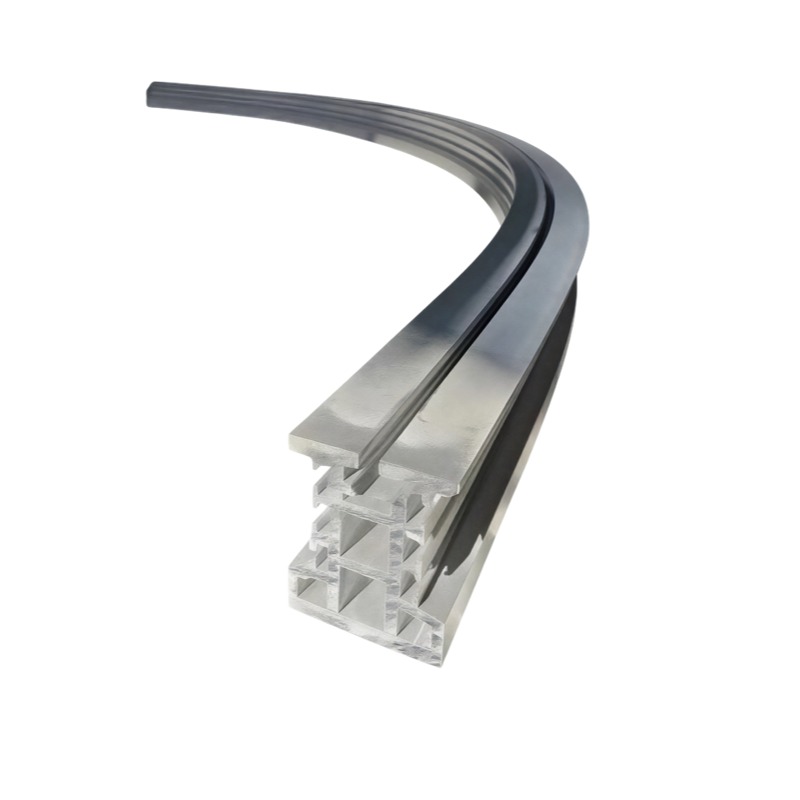
Aluminum Profile Bending
Rail Bending
Demand for rail aluminum profiles is growing in intelligent warehousing, automated logistics, robotics, and other fields, with especially prominent demand for annular arc rails and bent rails. Traditional straight profiles cannot meet the requirements of
Product Details
Demand for rail aluminum profiles is growing in intelligent warehousing, automated logistics, robotics, and other fields, with especially prominent demand for annular arc rails and bent rails. Traditional straight profiles cannot meet the requirements of curved rails; aluminum profiles must be bent to specific radii through press bending and circular bending processes.
The core difference between rail bending and ordinary profile bending is that rail bending has far higher requirements for curvature accuracy, straightness, and splicing gaps. Excessive curvature deviation causes jolting and derailing when carts turn, affecting the running stability of the entire conveyor system.
Shanghai Chuangsi Aluminum adopts precision bending processes and accurate curvature control to ensure uniform rail curvature, small splicing gaps, and smooth, jolt-free running of carts. We provide one-stop delivery across the full process from extrusion, bending to CNC machining and surface finishing.
01 Quality starts with the raw material
Produced from A00 primary aluminum ingot, containing no scrap aluminum, with uniform material and stable mechanical properties, ensuring the structural strength of rail profiles under curved working conditions.
02 Precision rail bending forming
Using precision bending processes to bend aluminum profiles to the curvature required by rails, with bending radius error ±0.4mm and flatness 0.1mm-0.5mm. Rail curvature is uniform, splicing gaps are small, and carts run smoothly without jolting.
03 Multi-type rail machining
We can machine RGV/AGV curved rails, intelligent warehousing annular guide rails, stacker crane rail curved sections, automated conveyor line bent rails, express sorting center bent rails, and many other rail types, supporting custom S-shaped, annular, and U-shaped paths.
04 One-stop delivery service
One-stop delivery across the full process from extrusion, bending to CNC machining and surface finishing, so customers only deal with one supplier.
Rail bending vs ordinary profile bending:
| Comparison item | Ordinary profile bending | Rail bending |
|---|---|---|
| Accuracy requirements | General angle control | Bending radius error ±0.4mm, high accuracy requirements |
| Splicing requirements | Lower | Splicing gap ≤0.5mm |
| Surface quality | General | No scratches, no wrinkles |
| Applicable scenarios | General structural parts | RGV/AGV bent rails, annular guide rails, stacker crane rails |
| Running requirements | Static structure | Cart travel path, high stability |
Machining capability parameters:
| Item | Parameter / Description |
|---|---|
| Machining form | Rail bending, bent rail machining, arc guide rail bending |
| Applicable scenarios | RGV/AGV bent rails, annular guide rails, stacker crane rail arcs |
| Bending radius error | ±0.4mm |
| Flatness | 0.1mm-0.5mm |
| Extrusion length | Up to 20M |
| Applicable materials | 6063-T5 / 6061-T6 / 6005A-T6 |
| Machining equipment | CNC press brakes, bending machines, stretch bending machines |
| Supported processing | Mold development, extrusion, CNC machining, precision slot milling |
| Surface treatment | Anodizing, hard anodizing |
| Splicing gap | ≤0.5mm |
| Executive standard | GB/T 6892-2023, ISO9001 |
| Production location | Qingpu, Shanghai |
Main machining types:
-
RGV/AGV arc rails
-
Intelligent warehousing annular guide rails
-
Stacker crane rail curved sections
-
Automated conveyor line bent rails
-
Express sorting center bent rails
-
Custom S-shaped / annular / U-shaped multi-path bent rails
Typical application scenarios:
-
Intelligent warehousing annular rail systems
-
Automated conveyor line bent rails
-
RGV/AGV arc rails
-
Stacker crane rail curved sections
-
Express sorting center bent rails
FAQ (Frequently Asked Questions)
Q1: What is the difference between rail bending and ordinary profile bending?
A: Rail bending specifically refers to arc bending of aluminum profiles used for RGV/AGV carts, annular guide rails, stacker crane rails, and similar scenarios. Compared with ordinary profile bending, rail bending has far higher requirements for curvature accuracy, straightness, and splicing gaps. Excessive curvature deviation causes jolting and derailing when carts turn, affecting the running stability of the entire conveyor system. We control rail bending radius error to ±0.4mm and splicing gap to ≤0.5mm, ensuring carts run smoothly.
Q2: Why are rail bending accuracy requirements so high?
A: Rails are the travel path for RGV/AGV carts, stacker cranes, and other equipment, and carts are highly sensitive to rail accuracy when running on them. Curvature deviation generates lateral force when carts turn, increasing wheel wear; excessive splicing gaps cause impact and vibration as carts pass; straightness deviation causes carts to drift. Rail bending accuracy directly determines cart running stability, positioning accuracy, and equipment service life.
Q3: What types can be machined by rail bending?
A: We can machine RGV/AGV curved rails, intelligent warehousing annular guide rails, stacker crane rail curved sections, automated conveyor line bent rails, express sorting center bent rails, and custom S-shaped/annular/U-shaped multi-path bent rails. Customers provide rail path drawings, and we can evaluate and recommend the optimal arc solution.
Q4: How is rail bending machining charged?
A: Pricing is based on rail type, curvature complexity, and profile cross-section. Standard arc rails are priced by the meter; annular or S-shaped multi-section bent rails require additional labor evaluation. We provide free evaluation and quoting based on samples; welcome to contact Manager Du at 13611846009.
Q5: How to choose between 6063-T5 and 6061-T6 for rail bending?
A: 6063-T5 has good formability and high surface finish, suitable for conventional RGV/AGV bent rails and light annular guide rails. 6061-T6 has higher strength (yield strength ≥240MPa), suitable for heavy-load RGV rails, stacker crane curved sections, and other scenarios with higher load-bearing and impact-resistance requirements. For heavy-load or high-speed scenarios, 6061-T6 or 6005A-T6 is recommended.
Q6: What is the MOQ and lead time for rail bending?
A: The MOQ is 50kg. Sample lead time is 7-10 days (including arc die setup and trial bending verification), and batch lead time is 10-20 days after sample approval. Because rail bending must ensure arc accuracy and splicing quality, the sample cycle is slightly longer than ordinary bending; we recommend communicating the rail path and turning radius requirements in advance.

GET A QUOTE
Once you have submitted your requirements, we will contact you as soon as possible regarding your product inquiry.:Rail Bending