
Aluminum Profile Bending
Spiral Roll Bending
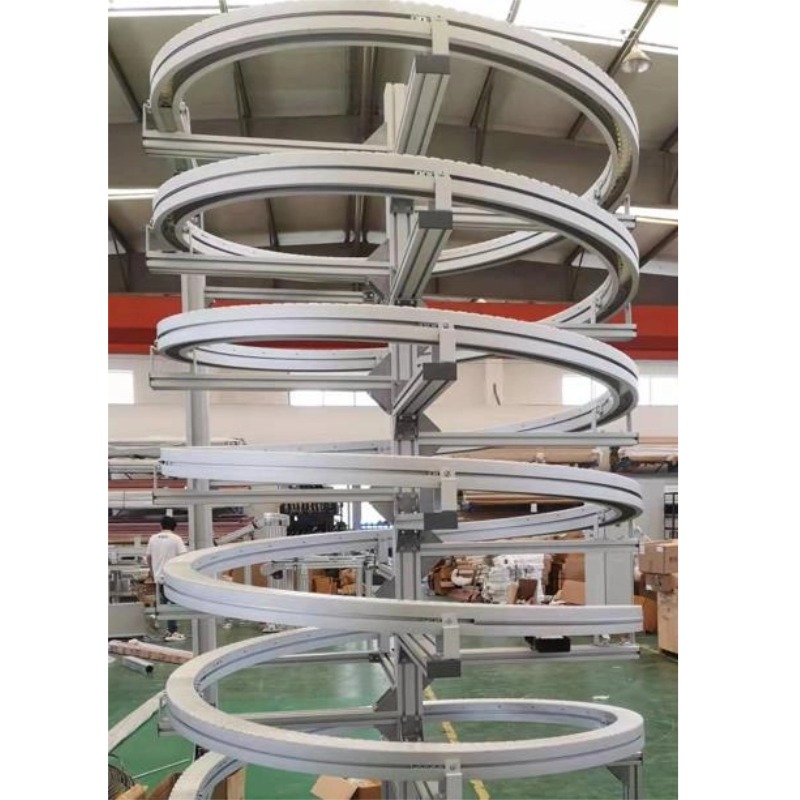
Aluminum profile spiral roll bending is a process that bends a straight profile in one pass, using precision roll-bending and spiral-forming equipment, into a rising three-dimensional spiral structure. Its shape resembles an oversize spring — the profile
Product Details
Aluminum profile spiral roll bending is a process that bends a straight profile in one pass, using precision roll-bending and spiral-forming equipment, into a rising three-dimensional spiral structure. Its shape resembles an oversize spring — the profile forms circular rings in the horizontal direction while continuously rising in the vertical direction, creating a multi-turn continuous spiral. Unlike ordinary planar full-circle bending, spiral bending requires continuous vertical rise on top of a 360° closed ring, imposing higher demands on arc accuracy, spiral-lead-angle control and multi-turn joining.
Shanghai Chuangsi Aluminum Co., Ltd. provides a full-process one-stop service from extrusion and spiral bending to CNC machining and surface treatment. Using precision roll-bending and spiral-forming equipment, the bending error is ±0.4mm, flatness is 0.1mm-0.5mm, the maximum extrusion length is 20M, suitable materials include 6063-T5, 6061-T6 and 6082-T6, and it fits round tubes, square tubes, channel aluminum, angle aluminum and special-shaped profiles.
01 Quality Starts with Raw Materials
Produced from A00 primary aluminum ingot with no scrap aluminum; the material is uniform and its mechanical properties are stable, ensuring the structural integrity of spiral profiles under multi-dimensional bending conditions.
02 Precision Spiral Roll Forming
Using precision roll-bending and spiral-forming equipment, a straight profile is bent in one pass into a rising three-dimensional spiral structure, with a bending error of ±0.4mm and flatness of 0.1mm-0.5mm.
03 Multi-Cross-Section Processing
Spiral bending can process round tubes, square tubes, channel aluminum, angle aluminum and special-shaped profiles, forming single-turn or multi-turn continuous spirals to fit different structural needs.
04 One-Stop Delivery Service
Full-process one-stop delivery from extrusion and spiral bending to CNC machining and surface treatment, so the customer only deals with one supplier.
Spiral bending vs. planar full-circle bending:
| Comparison Item | Planar Full-Circle Bending | Three-Dimensional Spiral Bending |
|---|---|---|
| Bending Dimension | Two-dimensional plane (horizontal) | Three-dimensional (horizontal + vertical) |
| Shape Characteristics | Single planar ring | Rising spiral, spring-like |
| Accuracy Requirements | Full-circle error ±0.4mm | Full-circle error ±0.4mm + spiral lead-angle control |
| Processing Difficulty | Conventional roll bending | Multi-dimensional compound bending, higher difficulty |
| Application Scenarios | Circular guide rails, round-tube frames | Spiral conveyor lines, stereoscopic-warehousing guide rails, spiral staircases |
Machining capability parameters:
| Item | Parameter / Description |
|---|---|
| Processing Types | Spiral bending, three-dimensional ring bending, multi-turn spiral forming |
| Bending Dimension | Three-dimensional (horizontal ring + vertical rise) |
| Spiral Shape | Single-turn spiral, multi-turn continuous spiral, spring-like winding structure |
| Full-Circle Error | ±0.4mm |
| Flatness | 0.1mm-0.5mm |
| Available Materials | 6063-T5 / 6061-T6 / 6082-T6 |
| Available Cross-Sections | Round tube, square tube, channel aluminum, angle aluminum, special-shaped profile |
| Extrusion Length | Up to 20M |
| Processing Equipment | Roll bending machines, spiral bending machines, CNC bending machines |
| Supporting Processing | Mold development, extrusion, CNC machining, welding |
| Surface Treatment | Anodizing, hard anodizing, coating |
| Executive Standard | GB/T 6892-2023, ISO9001 |
| Production Location | Qingpu, Shanghai |
Spiral bending types:
-
Single-turn spiral bending: suitable for single-layer spiral structures and circular display stands
-
Multi-turn continuous spiral bending: suitable for spiral conveyor lines and stereoscopic-warehousing guide rails
-
Spring-like winding structure: suitable for automated three-dimensional bending rails and spiral conveying systems
-
Special-shaped profile spiral bending: suitable for special-shaped cross-section spiral structural parts and custom needs
Typical Application Scenarios:
-
Spiral conveyor line track systems
-
Stereoscopic-warehousing spiral guide rails
-
Rotating display stand spiral frames
-
Spiral staircase handrails and structural parts
-
Automated three-dimensional bending rails
-
Circular spiral conveyor lines
FAQ (Frequently Asked Questions)
Q1: What is the difference between spiral bending and ordinary full-circle bending?
A: Ordinary full-circle bending bends a straight profile into a single ring in a two-dimensional plane; the profile forms a closed ring horizontally, with a full-circle error of ±0.4mm. Spiral bending bends a straight profile into a three-dimensional rising structure (like an oversize spring) — the profile forms circular rings horizontally while continuously rising vertically, creating a multi-turn continuous spiral. Spiral bending imposes far higher demands on arc accuracy, spiral-lead-angle control and multi-turn joining than ordinary full-circle bending.
Q2: Can the spiral lead angle be controlled in spiral bending?
A: Yes. The spiral lead angle (i.e., the rise per turn) can be customized to customer requirements. A small lead angle (small rise per turn) is suitable for gentle spiral conveyor-line tracks and stereoscopic-warehousing guide rails; a large lead angle (large rise per turn) is suitable for structures that need rapid rise, such as spiral staircase handrails and rotating display stand frames. Once the customer provides the required lead angle, our company precisely controls it by adjusting the spiral-forming equipment parameters, ensuring a consistent lead angle per turn and smooth transitions.
Q3: How are the multi-turn joints handled in spiral bending?
A: Multi-turn joining is the process difficulty of spiral bending. Ordinary full-circle bending only needs the two ends to close; spiral bending requires the two ends of each turn to precisely meet to form a continuously rising spiral. Our company uses precision roll-bending and spiral-forming processes to form single-turn or multi-turn continuous spirals, with a bending error of ±0.4mm, good lead-angle consistency and smooth, step-free multi-turn joints. After each spiral turn, the two end faces are finished by CNC machining to ensure precise on-site joining.
Q4: How many turns can be processed in spiral bending?
A: The number of turns depends on the profile cross-section size, spiral diameter, lead angle and extrusion length. The maximum extrusion length is 20M, and the bendable number of turns is calculated from the spiral diameter and lead angle. Once the customer provides the spiral diameter, lead angle and required number of turns, our company evaluates whether it can be formed in one pass or needs segmented processing. Generally, small-diameter spirals can be bent into more turns, while large-diameter spirals have relatively fewer turns.
Q5: How is spiral bending charged?
A: Pricing is based on the spiral diameter, number of turns and cross-section complexity. Conventional single-turn spirals are priced per piece; multi-turn continuous spirals require additional evaluation of labor hours and process difficulty. Free sample-based evaluation and quotation are provided; please contact Manager Du at 13611846009.
Q6: How to choose between 6063-T5 and 6061-T6 for spiral bending?
A: 6063-T5 has good formability and is suitable for rotating display stand frames, spiral staircase handrails and other applications with high requirements for surface quality and spiral bending performance. 6061-T6 has higher strength and better fatigue resistance, and is suitable for spiral conveyor-line tracks, stereoscopic-warehousing spiral guide rails and other scenarios requiring structural strength and long-term running stability. After spiral bending, the profile carries multi-dimensional internal stress; 6061-T6 has better fatigue resistance and suits long-term cyclic spiral-rail applications.
Q7: What is the MOQ and lead time for spiral bending?
A: The MOQ is 50kg. The sample lead time is 7-10 days (including equipment debugging and trial-bending verification), and batch delivery is 10-20 days after sample confirmation. Because spiral bending requires tuning multi-dimensional forming parameters and accuracy verification, the sample cycle is slightly longer than ordinary bending; it is recommended to discuss the spiral diameter, lead angle and number of turns in advance.

GET A QUOTE
Once you have submitted your requirements, we will contact you as soon as possible regarding your product inquiry.:Spiral Roll Bending