
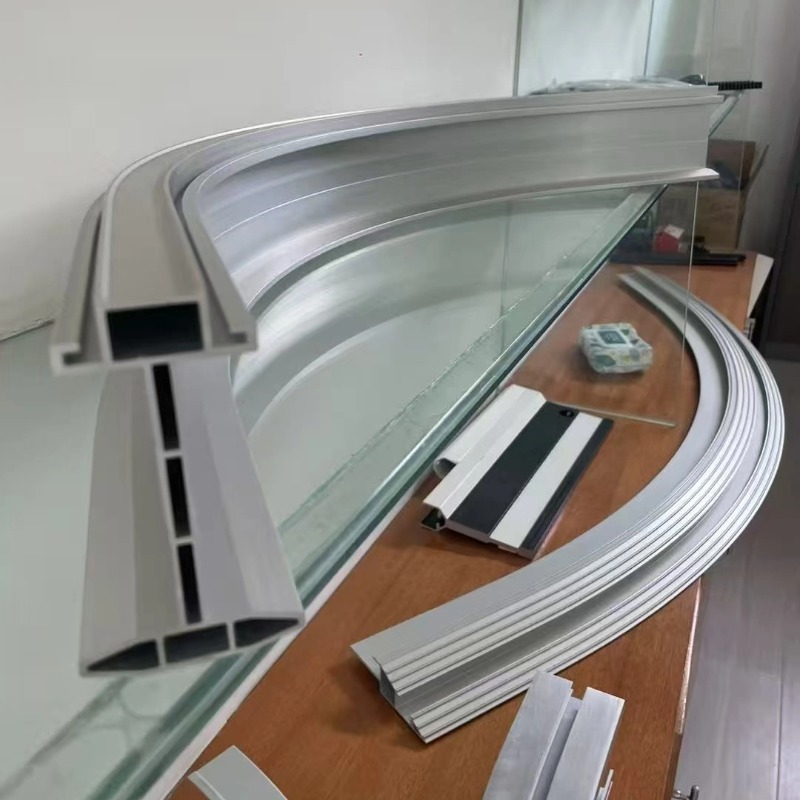
Aluminum Profile Bending
Thin-Wall Precision Bending
Bending thin-wall aluminum profiles (wall thickness 0.8mm-1.5mm) is a precision process in aluminum profile fabrication. The thinner the wall, the more likely stress concentration during bending leads to cracking, wrinkling, and cross-section distortion.
Product Details
Bending thin-wall aluminum profiles (wall thickness 0.8mm-1.5mm) is a precision process in aluminum profile fabrication. The thinner the wall, the more likely stress concentration during bending leads to cracking, wrinkling, and cross-section distortion. Many bending shops can handle wall thicknesses of 2mm and above, but struggle to guarantee precision and surface quality with 0.8mm-1.5mm thin-wall profiles.
Shanghai Chuangsi Aluminum Co., Ltd. is equipped with precision CNC bending machines and can take on precision bending of thin-wall aluminum profiles with wall thicknesses from 0.8mm to 1.5mm. Using T5 temper material combined with a bending radius of at least 3 times the wall thickness effectively avoids cracking and wrinkling of thin-wall profiles. Full-process one-stop delivery from extrusion and bending to CNC machining and surface treatment.
01 Quality Starts From Raw Materials
Produced using A00 primary aluminum ingot, containing no scrap aluminum, with uniform material properties and stable mechanical performance, ensuring material consistency of thin-wall profiles during bending.
02 Precision Bending Forming
Using T5 temper material (low springback, good ductility) combined with a bending radius of at least 3 times the wall thickness effectively avoids cracking and wrinkling of thin-wall profiles. Angular tolerance is ±1°, minimum bend dimension is 10mm, with no cracks or wrinkles at the bend.
03 Surface Protection Process
PE film is applied to the profile surface for protection, and bending dies are polished and hard-chrome plated to avoid scratches and indentations during thin-wall profile bending.
04 One-Stop Delivery Service
Full-process one-stop delivery from extrusion and bending to CNC machining and surface treatment — customers deal with only one supplier.
Thin-wall bending vs. conventional bending:
| Comparison item | Conventional bending (wall thickness ≥2mm) | Thin-wall bending (wall thickness 0.8-1.5mm) |
|---|---|---|
| Wall thickness range | ≥2mm | 0.8-1.5mm |
| Bending radius | ≥1.5-2 times wall thickness | ≥3 times wall thickness (mandatory) |
| Material temper | T5/T6 both acceptable | T5 preferred (low springback, good ductility) |
| Cracking risk | Low | High, requires strict control |
| Wrinkling risk | Low | High, requires process intervention |
| Surface protection | General | Extremely high, requires film + die polishing |
| Bending speed | Can be relatively fast | Requires low-speed control |
Machining capability parameters:
| Item | Parameter / Description |
|---|---|
| Applicable wall thickness | 0.8mm-1.5mm |
| Bending type | L-type, U-type, V-type, small-radius curving |
| Minimum bend dimension | 10mm |
| Angular tolerance | ±1° |
| Maximum machining length | 6500mm |
| Minimum bending radius | ≥3 times wall thickness |
| Applicable material | 6063-T5 |
| Machining equipment | Precision CNC bending machines, CNC machining centers |
| Supporting machining | CNC milling, drilling, tapping, cutting |
| Surface treatment | Anodizing, electrostatic powder coating |
| Execution standard | GB/T 6892-2023, ISO9001 |
| Production location | Qingpu, Shanghai |
Key technical points for thin-wall bending:
-
Select T5 temper material (low springback, good ductility) to reduce cracking risk
-
Control the bending radius at ≥3 times the wall thickness to ensure bend quality
-
Precisely control bending speed and die clearance to prevent wrinkling
-
Apply protective film to the profile surface and polish dies to avoid scratches and indentations
-
Perform trial bending verification before batch production, confirming no cracking or wrinkling before volume production
Typical application scenarios:
-
Electronic equipment enclosures
-
Precision instrument frames
-
LED lighting profile curving
-
Medical equipment thin-wall structural parts
-
Thin-wall decorative frames
FAQ (Frequently Asked Questions)
Q1: What is the difference between thin-wall aluminum profile bending and conventional wall thickness bending?
A: Conventional wall thickness bending (wall thickness above 2mm) has a relatively wide process window and good material stability under stress. The challenge of thin-wall bending (wall thickness 0.8mm-1.5mm) is that the thinner the wall, the more likely stress concentration during bending leads to cracking, wrinkling, and cross-section distortion. Many bending shops can handle wall thicknesses of 2mm and above, but struggle to guarantee precision and surface quality with 0.8mm-1.5mm thin-wall profiles. We use T5 temper material combined with a bending radius of at least 3 times the wall thickness to effectively avoid cracking and wrinkling of thin-wall profiles.
Q2: Why does thin-wall aluminum profile bending tend to crack?
A: During cold bending of thin-wall profiles, the outer surface of the material is subjected to tensile stress and the inner surface to compressive stress. The thinner the wall, the greater the strain at the bend, which can easily exceed the material's elongation limit, causing outer-surface tensile cracking or inner-surface compressive wrinkling. We avoid thin-wall cracking by selecting T5 temper material (good elongation, low springback), controlling the bending radius at ≥3 times the wall thickness, and precisely controlling bending speed and die clearance.
Q3: What is the minimum bending radius for thin-wall aluminum profile bending?
A: The minimum bending radius must be determined according to wall thickness. For 6063-T5 thin-wall profiles (wall thickness 0.8mm-1.5mm), the recommended minimum bending radius is ≥3 times the wall thickness. For example, a 6063-T5 profile with 1mm wall thickness has a minimum bend radius of about 3mm; a profile with 1.5mm wall thickness has a minimum bend radius of about 4.5mm. An excessively small bending radius causes outer-surface tensile cracking or inner-surface wrinkling at the bend.
Q4: What advantages does 6063-T5 offer in thin-wall bending?
A: 6063-T5 is the preferred material for thin-wall bending, with three key advantages: first, good elongation — elongation at break ≥8%, so it does not crack easily during bending; second, low springback — T5 temper material is artificially aged, resulting in small springback and stable angles after bending; third, high surface finish — thin-wall profiles have a smooth surface after bending, suitable for applications with high appearance requirements such as electronic equipment enclosures and LED lighting profiles.
Q5: How can surface scratches be prevented during thin-wall aluminum profile bending?
A: Thin-wall profiles have high surface quality requirements, and special attention to surface protection is needed during bending. We take dual protection during bending: first, PE film is applied to the profile surface to avoid direct contact with dies and prevent scratches; second, bending dies are polished and hard-chrome plated to reduce surface roughness. After bending, 100% inspection confirms surface quality meets the requirements of electronic equipment enclosures and medical device appearance parts.
Q6: How is thin-wall aluminum profile bending charged?
A: Pricing is based on wall thickness, number of bend angles, and length. The thinner the wall and the more bend angles, the higher the process difficulty. Free evaluation and quotation are provided based on samples; please contact Manager Du at 13611846009.
Q7: What is the minimum order quantity and lead time for thin-wall aluminum profile bending?
A: The minimum order quantity is 50kg, supporting small-batch prototyping. Sample lead time is 5-7 days (standard cross-sections) or 7-10 days (mold development required), and batch delivery is 7-15 days after sample confirmation. Since thin-wall bending requires trial bending to verify cracking and wrinkling risks, customer participation in confirming bend results during the sample stage is recommended before batch production.

GET A QUOTE
Once you have submitted your requirements, we will contact you as soon as possible regarding your product inquiry.:Thin-Wall Precision Bending