
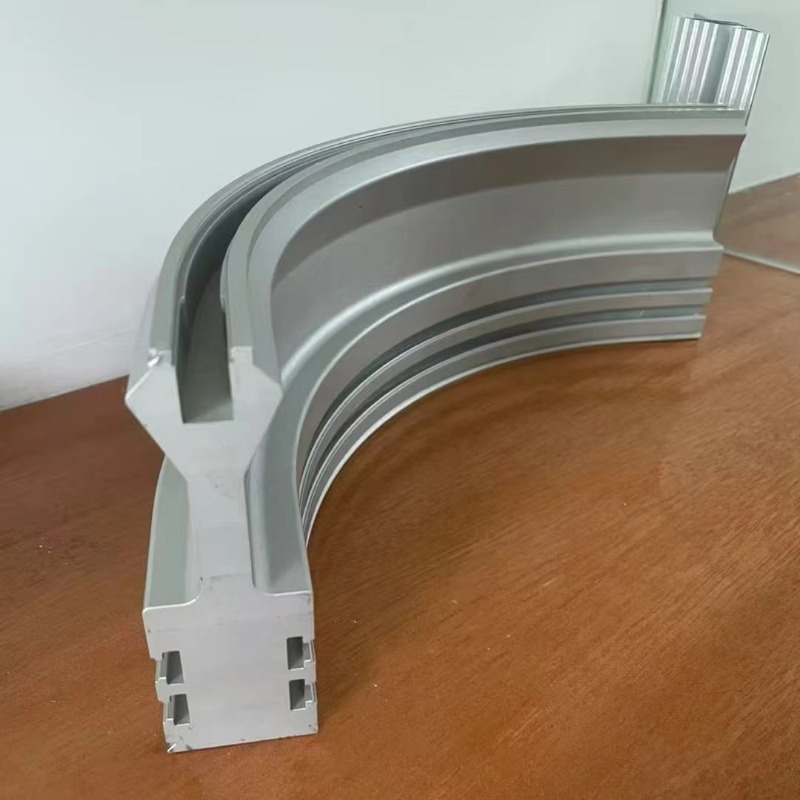
Aluminum Profile Bending
Circular Bend-Stretch Bending
Aluminum profile circular bending and stretch bending is the process of machining aluminum profiles into arc, semicircular, full-circle, and other shapes using specialized bending equipment, and is widely used in intelligent warehousing, automated logisti
Product Details
Aluminum profile circular bending and stretch bending is the process of machining aluminum profiles into arc, semicircular, full-circle, and other shapes using specialized bending equipment, and is widely used in intelligent warehousing, automated logistics, robotics, and other fields. Demand for curved and arc-shaped rails and bent profiles is growing, because traditional straight profiles cannot meet the requirements of curved rails; aluminum profiles must be bent to specific radii through circular bending and stretch bending processes.
Shanghai Chuangsi Aluminum adopts CNC precision roll bending forming for uniform curvature, small splicing gaps, and smooth, jolt-free cornering of carts. The running surface of the rail can be hard-anodized for wear resistance, suiting high-frequency reciprocating handling conditions. We provide one-stop delivery across the full process from extrusion, circular bending to CNC machining and surface finishing.
01 Quality starts with the raw material
Produced from A00 primary aluminum ingot, containing no scrap aluminum, with uniform material and stable mechanical properties, ensuring the structural strength of bent profiles under curved working conditions.
02 Precision circular bending and stretch bending forming
Using specialized bending and stretch bending equipment to bend aluminum profiles into arc, semicircular, full-circle, S-shaped, and other irregular structures, with curvature accuracy ≤0.5°, bending radius error ±0.4mm, and flatness 0.1mm-0.5mm.
03 Multi-type rail machining
We can machine RGV curved rails, robot overhead rail bending, annular conveyor line rails, intelligent warehousing annular rails, express climbing rail curved sections, arc-shaped I-beam aluminum alloy rails, and custom-curvature bent rails, among many other types.
04 One-stop delivery service
One-stop delivery across the full process from extrusion, circular bending to CNC machining and surface finishing, so customers only deal with one supplier.
Circular bend-stretch vs roll bending vs ordinary stretch bending:
| Comparison item | Roll bending | Ordinary stretch bending | Circular bend-stretch |
|---|---|---|---|
| Forming method | Continuous roller feed | Stretching force + die | Circular bending + stretch bending compound |
| Applicable scenarios | Large-batch constant-cross-section curvature | Small-radius high-precision arcs | Arc rails, annular guide rails |
| Curvature accuracy | General | Relatively high | ≤0.5° |
| Splicing method | Whole piece or segmented | Whole-piece forming | Whole-piece forming, no splicing |
| Surface quality | Slight roll marks | No pressure marks | No wrinkles, no scratches |
| Cross-section deformation | General | Small | Small |
Machining capability parameters:
| Item | Parameter / Description |
|---|---|
| Bending form | Arc bending, semicircular bent rail, circular bent rail, S-shaped bent rail |
| Curvature accuracy | ≤0.5° |
| Bending radius error | ±0.4mm |
| Flatness | 0.1mm-0.5mm |
| Extrusion length | Up to 20M |
| Applicable materials | 6063-T5 / 6061-T6 / 6005A-T6 |
| Machining equipment | Bending machines, stretch bending machines, CNC press brakes |
| Supported processing | Mold development, extrusion, CNC machining |
| Surface treatment | Anodizing, hard anodizing |
| Splicing gap | ≤0.5mm |
| Executive standard | GB/T 6892-2023, ISO9001 |
| Production location | Qingpu, Shanghai |
Main product types:
-
RGV arc rails / semicircular bent rails
-
Robot overhead rail bending
-
Annular conveyor line rails
-
Express climbing rail curved sections
-
Arc-shaped I-beam aluminum alloy rails
-
Custom-curvature bent rails
Typical application scenarios:
-
Intelligent warehousing annular rails
-
Automated conveyor line bent rails
-
Robot overhead rail systems
-
RGV rail-guided vehicle arc rails
-
Electronics cyclic production line curved rails
FAQ (Frequently Asked Questions)
Q1: What is the difference between circular bend-stretch and roll bending?
A: Circular bend-stretch continuously bends profiles into arcs or full circles using bending equipment, with even force between the profile and the equipment, good surface quality, uniform curvature, and no wrinkles. Stretch bending uses tensile force to make the profile conform to a die for bending, effectively reducing springback, and is suitable for small-radius and high-precision arc machining, especially for irregular and complex cross-section profiles. We can take on both processes, and customers can choose based on curvature requirements, precision needs, and batch size. Circular bending suits conventional arcs and rings; stretch bending suits small-radius and high-precision arcs.
Q2: What accuracy can circular bend-stretch achieve?
A: Curvature accuracy is ≤0.5°, bending radius error controlled to ±0.4mm, and flatness 0.1mm-0.5mm. After circular bend-stretch, the profile curvature is uniform, the splicing gap is small, and carts or robots run smoothly. Compared with ordinary press bending, circular bend-stretch offers more precise curvature control and better surface quality.
Q3: What types of rails can be machined by circular bend-stretch?
A: We can machine RGV arc rails, robot overhead rail bending, annular conveyor line rails, intelligent warehousing annular rails, express climbing rail curved sections, arc-shaped I-beam aluminum alloy rails, and custom-curvature bent rails. Customers provide the rail path drawings, and we can evaluate and recommend the optimal bending solution.
Q4: How is circular bend-stretch machining charged?
A: Pricing is based on the bending form, curvature complexity, and profile cross-section. Conventional arcs are priced by the meter; full-circle and S-shaped multi-section bending requires additional labor evaluation. We provide free evaluation and quoting based on samples; welcome to contact Manager Du at 13611846009.
Q5: How to choose among 6063-T5, 6061-T6, and 6005A-T6 for circular bend-stretch?
A: 6063-T5 has good formability and high surface finish, suitable for decorative arc rails with high surface quality and bending performance requirements; 6061-T6 has higher strength and better fatigue resistance, suitable for RGV arc rails, robot overhead rail bending, and other scenarios with structural strength requirements; 6005A-T6 offers balanced overall performance, combining good bending performance and strength, suitable for intelligent warehousing annular rails, express climbing rail curved sections, and similar scenarios. Profiles retain internal stress after circular bend-stretch; for heavy-load or high-frequency operation, 6061-T6 or 6005A-T6 is recommended.
Q6: What is the minimum bending radius for circular bend-stretch?
A: The minimum bending radius depends on the profile cross-section size, wall thickness, and material, and is generally recommended to be ≥500mm. The specific value needs comprehensive evaluation based on the profile cross-section, wall thickness, and equipment capability. We recommend customers provide profile cross-section drawings and curvature requirements so we can assess feasibility in advance and recommend the optimal bending solution.
Q7: What is the MOQ and lead time for circular bend-stretch?
A: The MOQ is 50kg. Sample lead time is 5-7 days (standard cross-sections) or 7-10 days (irregular profiles requiring custom rollers), and batch lead time is 7-15 days after sample approval. Because circular bend-stretch requires adjusting equipment curvature parameters, customers are advised to confirm the curvature effect at the sample stage before mass production.
Q8: Can CNC machining and surface treatment be done after circular bend-stretch?
A: Yes. After circular bend-stretch is completed, CNC finish machining (drilling, tapping, end-face milling, slotting, etc.) and surface treatment (natural/black anodizing, hard anodizing, etc.) can be performed. Note that circular bend-stretch must be completed before CNC machining and surface treatment, to avoid re-bending after machining and finishing, which would affect accuracy. We provide one-stop delivery across the full process from extrusion, circular bend-stretch to CNC machining and surface finishing, so customers do not need repeated transfers.

GET A QUOTE
Once you have submitted your requirements, we will contact you as soon as possible regarding your product inquiry.:Circular Bend-Stretch Bending